The total project cost for the establishment of the National Subtropical Arboretum has been finalized. The creation of the Subtropical Arboretum is set to begin in earnest next year, with completion targeted for 2030.
The Korea Forest Service announced on the 24th that the total project cost for the arboretum has been set at 181.5 billion won.
This finalized budget is an increase of 34.2 billion won (23%) compared to the total project cost of 147.3 billion won estimated in the 2020 preliminary feasibility study. The increase reflects the growing importance of subtropical and tropical arboreta in responding to the climate crisis, the use of domestic wooden structures, the need for Barrier-Free (BF) certification, and rising prices.
The entire construction period is five years (2026-2030), and the schedule is expected to accelerate starting with the detailed design order in the first half of next year.
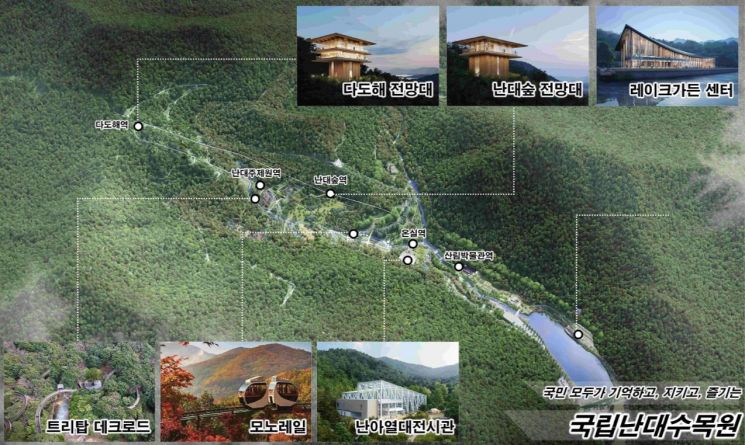 The National Subtropical Arboretum is scheduled to be established in Wando by 2030. A bird's-eye view of the Subtropical Arboretum. Provided by the Korea Forest Service.
The Korea Forest Service plans to redevelop the Wando Provincial Arboretum, which has been operated by South Jeolla Province since its opening in 1991, as the new Subtropical Arboretum.
According to climate change scenarios for the Korean Peninsula, by 2100, subtropical areas are projected to account for 21% of the nation's total land area. This suggests that the subtropical and tropical climate zones are already expanding across the peninsula.
The Subtropical Arboretum is being established in anticipation of this trend, with the aim of proactively cultivating and managing subtropical and tropical forests. The goal is to develop tree species suited to the peninsula's future climate conditions and to initiate preemptive forest management, taking into account the growth period of trees.
Wando exhibits a typical subtropical climate, with an average annual temperature of 14.33 degrees Celsius and annual precipitation of 1,510 millimeters. Influenced by the warm Jeju Current and the West Korean Coastal Current, the area has high humidity, making it ideal for the growth of subtropical forests. The Korea Forest Service has identified that 3,446 hectares (35%) of the peninsula's total 9,852 hectares of subtropical forests are concentrated in Wando. This is the primary reason for establishing the Subtropical Arboretum in Wando.
By leveraging these conditions, the Korea Forest Service intends to create a subtropical botanical garden in Wando, positioning it as a forward base for research on forest genetic resources in subtropical and tropical regions and for developing promising tree species in response to global warming.
Subtropical tree species are mostly evergreen broad-leaved trees, known for their excellent carbon absorption capacity. In particular, the red buckthorn tree, which is the most widely distributed species in Wando, can absorb 7.89 tons of carbon dioxide per hectare of plantation, making its carbon absorption and storage capacity far superior to other species.
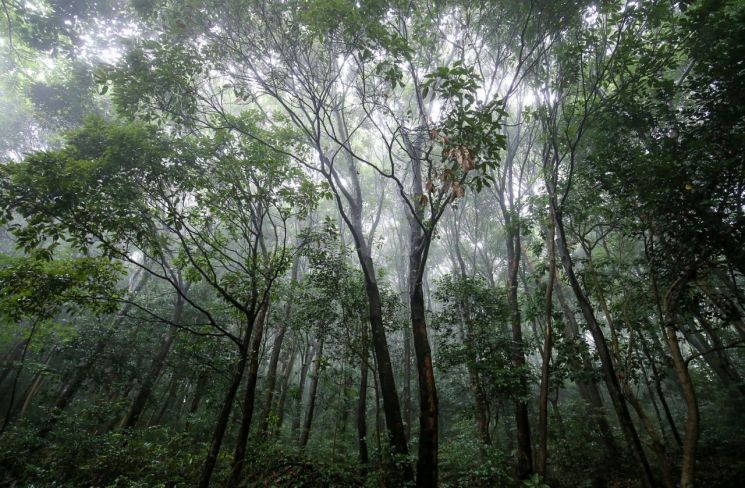
The Korea Forest Service plans to identify economically valuable tree species growing in Wando, including the red buckthorn, and improve them for greater utilization as forest resources. At the same time, the agency aims to contribute to achieving the national greenhouse gas reduction targets through the creation of subtropical forests.
Above all, the vision is for the Subtropical Arboretum to serve not only as a research institution but also as an operator of nature ecology programs that reflect the region's mild climate throughout the year. To support these programs, the arboretum will be equipped with themed gardens, exhibition greenhouses, treetop deck roads, a lake garden center, an observatory, a monorail, and other facilities.
Park Younghwan, Director of the Arboretum Establishment Project Team at the Korea Forest Service, stated, "Once established, the Subtropical Arboretum will serve as the southernmost forward base for responding to the climate crisis. The Korea Forest Service will strive to ensure that the Subtropical Arboretum, in addition to its research functions, becomes a unique national arboretum and a healing space where humans and nature coexist."
© The Asia Business Daily(www.asiae.co.kr). All rights reserved.
![Clutching a Stolen Dior Bag, Saying "I Hate Being Poor but Real"... The Grotesque Con of a "Human Knockoff" [Slate]](https://cwcontent.asiae.co.kr/asiaresize/183/2026021902243444107_1771435474.jpg)
















