Government to Push for Special Law to Promote SME Succession through M&A
The government has decided to push for the enactment of a special law to support small and medium-sized enterprise (SME) succession through mergers and acquisitions (M&A). The policy aims to revitalize M&A activity so that SMEs can remain sustainable and avoid closure even after the retirement of elderly business owners.
On December 24, the Ministry of SMEs and Startups announced the “Measures to Establish a Foundation for Promoting SME Succession through M&A” at the Economic Ministers’ Meeting and the Industrial Competitiveness Enhancement Ministers’ Meeting. The government is pursuing the establishment of a support system for business succession through M&A as a national policy task, so that SMEs facing difficulties with family succession can continue to grow without shutting down.
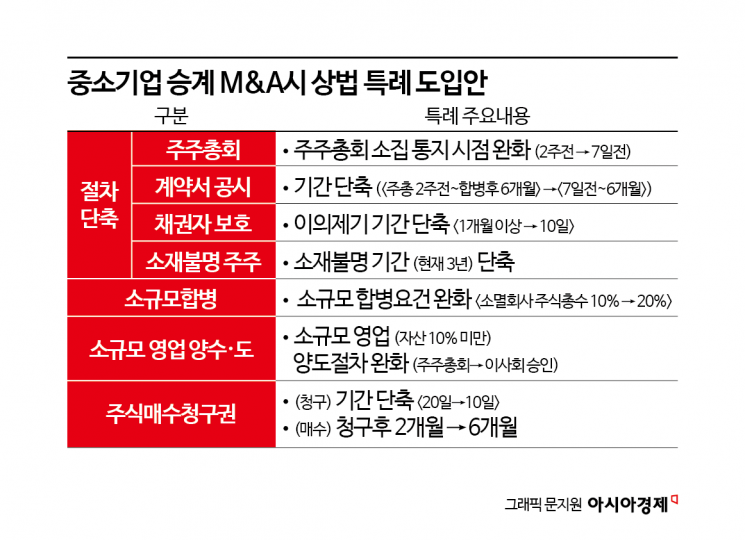
First, the Ministry plans to enact a special law that comprehensively defines SME succession via M&A, including criteria such as the age of the business owner and management tenure, which will serve as the foundation for support policies. Existing business succession support provisions under the SME Promotion Act will be transferred and regulated under the special law, creating an integrated policy framework for all aspects of business succession.
The special law will also include provisions allowing public and private organizations or associations with expertise in M&A and SME support policies to be designated and operated as “Business Succession Support Centers.” It will also establish a registration system for business succession M&A intermediaries. This is intended to create an institutional framework so that those seeking business succession through M&A can access services from private consultants and intermediaries with proven basic capabilities.
In addition, considering that requiring unlisted SMEs, which are relatively small in scale, to comply with a series of procedures mandated by the Commercial Act during M&A could lead to inefficiencies, the special law will introduce exceptions to the Commercial Act.
The special law will also provide the legal basis for programs that support costs incurred when attempting M&A transactions. This will include support for expenses related to consulting, business valuation, and due diligence required for M&A. Beyond reducing the burden of entering the M&A market, the law will also include provisions for support needed to help businesses settle and continue to grow after business succession through M&A has been completed.
The business succession M&A platform will be piloted through the Korea Technology Finance Corporation in the first half of next year, with services to begin in the second half. Through this platform, the government plans to identify M&A demand for business succession and provide a robust matching service for buyers and sellers. Even before the special law is enacted, companies identified as having business succession M&A needs through this platform will be eligible for basic consulting programs.
Han Sung-sook, Minister of SMEs and Startups, stated, “Creating a sustainable management environment for SMEs after the retirement of business owners is not just an issue for individual companies, but a pressing national task necessary to maintain the local economy and manufacturing base, and therefore requires swift policy action. We will actively cooperate with the National Assembly to ensure the special law is enacted as soon as possible, and will work closely with relevant ministries to develop and implement policies beyond legislation.”
© The Asia Business Daily(www.asiae.co.kr). All rights reserved.
![Clutching a Stolen Dior Bag, Saying "I Hate Being Poor but Real"... The Grotesque Con of a "Human Knockoff" [Slate]](https://cwcontent.asiae.co.kr/asiaresize/183/2026021902243444107_1771435474.jpg)
















