"College Admissions Reform Should Focus on Normalizing Public Education and Reducing Dependence on Private Education"
On December 23, National Education Commission Chairman Cha Jeongin stated that the proposed measures in the education sector, such as the "absolute grading system for school records" and the "expansion of essay-type assessments," require in-depth review regarding the necessary budget, the time needed for preparation, and the potential use of AI technology. He also emphasized the need to examine whether these policies would reduce reliance on private education.
Chairman Cha made these remarks at the "National Education Commission Operation Briefing," which was held to mark his 100th day in office, in relation to the direction of the reform of the college admissions system.
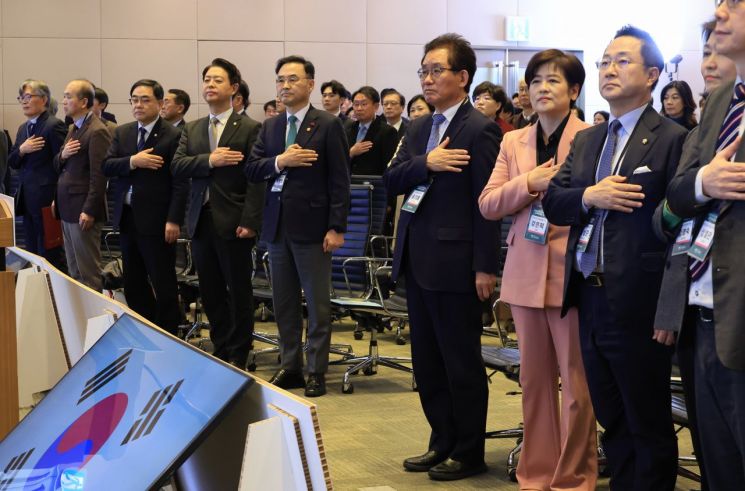
During a comprehensive discussion chaired by Yoo Kihong, Chairman of the Future Education Hope Foundation and former Chairman of the National Assembly's Education Committee, Chairman Cha was asked about the direction of the college admissions system. He responded, "It is difficult to provide specific details until the special committee has had sufficient discussion." However, he noted that the principles and main direction agreed upon by the committee members are "normalization of public education" and "reducing dependence on private education."
Chairman Cha stated, "College admissions and high school education are closely connected," adding, "We will design the college admissions reform plan to normalize high school education and achieve 'joint reform' of both high school education and college admissions." He also indicated that joint meetings between the special committees on college admissions and high school education would be necessary for this purpose.
He emphasized, "Above all, the college admissions system should be structured to reduce reliance on private education," and added, "We need to ensure that students and parents feel that receiving a solid public education is more advantageous for college admissions than relying on private education." Chairman Cha also remarked, "We cannot experiment on students," and noted, "Although it is not easy, we must predict the effectiveness and feasibility of the policies."
Chairman Cha shared, "There is some encouraging news. Fundamentally, easing competition in college admissions is closely related to resolving academic elitism. Recently, an educational organization announced survey results indicating that large companies are shifting their hiring focus from academic background to job competency." He continued, "Although parents still believe that academic background has a significant impact on employment, the actual survey results are markedly different." He also mentioned, "In February next year, the National Assembly is scheduled to discuss a bill that would prohibit listing one's alma mater on job applications."

The Framework Act on Employment Policy (Article 7, Paragraph 1) stipulates that discrimination based on gender, religion, age, educational background, or alma mater is prohibited when recruiting or hiring workers without reasonable cause. However, the lack of specific penalty provisions has limited its effectiveness in correcting improper practices, making it largely declarative. As a result, civic groups and others have called for strong legislation to eradicate hiring discrimination, demanding the passage of the "Alma Mater Hiring Discrimination Prevention Act."
The Alma Mater Hiring Discrimination Prevention Act was sponsored by Kang Deukgu, a lawmaker from the Democratic Party of Korea. Assemblyman Kang proposed an amendment to the "Act on Fairness in Hiring Procedures" to exclude "educational background and alma mater" from personal information collected during recruitment, as well as a bill to establish a dedicated body responsible for promoting employment for high school graduates. The aim is to create an environment where stable employment is possible without a university degree, thereby breaking down academic elitism.
Chairman Cha stated, "It is necessary to accelerate the trend of resolving academic elitism by passing the relevant bills in the National Assembly in February."
© The Asia Business Daily(www.asiae.co.kr). All rights reserved.
![Clutching a Stolen Dior Bag, Saying "I Hate Being Poor but Real"... The Grotesque Con of a "Human Knockoff" [Slate]](https://cwcontent.asiae.co.kr/asiaresize/183/2026021902243444107_1771435474.jpg)
















