Dong-A ST announced on December 23 that its remote patient monitoring platform, HiCardi, has been recognized by the Health Insurance Review and Assessment Service as eligible for reimbursement under “Remote Heart Rate Monitoring (EX871).”
The HiCardi platform is the first wearable patient monitoring system in Korea, developed by Meju and distributed by Dong-A ST. It enables remote monitoring of multiple patients’ real-time electrocardiograms, heart rates, respiratory rates, skin temperatures, and oxygen saturation levels. As a lightweight wearable patch, it improves upon the discomfort of conventional electrocardiogram devices.
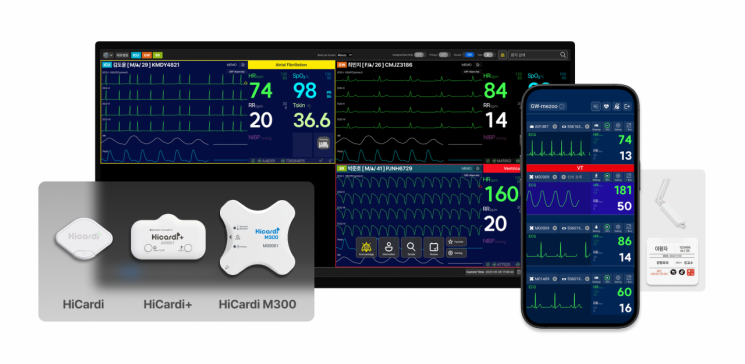 HiCardi platform (bottom left) and the Live Studio running screen that monitors and records biometric signal data on computer and smartphone. Dong-A ST
HiCardi was the first wearable device to be recognized for reimbursement under “Bedside Electrocardiogram Monitoring (E6544)” in 2020. Over more than five years, it has been stably operated in real-world clinical settings, accumulating large-scale real-world evidence (RWE). This accumulated RWE has proven HiCardi’s reliability and sustainability, which formed the basis for obtaining the EX871 reimbursement code.
“Remote Heart Rate Monitoring (EX871)” is a test conducted for patients at high risk of arrhythmia who require real-time monitoring or continuous assessment of treatment effectiveness. While “Bedside Electrocardiogram Monitoring (E6544)” is limited to patients lying in bed, EX871 requires real-time monitoring even as patients move during outpatient visits or hospitalization.
For patients who move frequently within the hospital, real-time monitoring requires not only high performance in measuring and analyzing biometric signals but also uninterrupted surveillance regardless of the patient’s location or movement. HiCardi is designed for continuous monitoring across the entire hospital, not limited to beds or wards, and has been operated in real clinical environments, accumulating RWE in numerous medical institutions.
The HiCardi platform is used for real-time monitoring of mobile patients in more than 350 tertiary hospitals, general hospitals, specialty hospitals, and clinics nationwide. It is currently in use at more than 25 out of 47 tertiary hospitals in Korea, with the number of hospitals and clinical departments adopting the system continuing to grow.
The single-channel electrocardiogram-based HiCardi has been primarily used in institutional medical settings, where its stability and utility have been verified. Reflecting the needs of healthcare professionals and hospital operations, the lineup has expanded to include HiCardi+, and recently to the multi-channel electrocardiogram-based “HiCardi M300,” enabling more complex real-time monitoring at the ward and hospital level. Notably, the new reimbursement applies to all HiCardi products, not just a specific device, and the technological advancements and development of the entire HiCardi platform have been institutionally recognized.
Park Junghwan, CEO of Meju, stated, “I believe that the data and operational experience accumulated through years of real-world use in medical settings led to the additional recognition of the EX871 reimbursement code. We are grateful to the Health Insurance Review and Assessment Service for establishing a system that comprehensively considers changes in clinical practice and real-world operations, even in a rapidly evolving medical technology environment.”
Jung Jaehoon, President of Dong-A ST, commented, “The concept of hospital monitoring, which goes beyond monitoring limited to beds or wards and recognizes the entire hospital as a continuous monitoring space, is emerging as a key topic. HiCardi is a digital healthcare solution that has been operated in real clinical settings based on an environment not limited to beds or wards.”
He added, “Based on our experience connecting medical practice and technology, Dong-A ST will take the lead in building an ecosystem where the digital healthcare solution HiCardi is stably established and expanded within both the institutional framework and clinical practice.”
© The Asia Business Daily(www.asiae.co.kr). All rights reserved.
![Clutching a Stolen Dior Bag, Saying "I Hate Being Poor but Real"... The Grotesque Con of a "Human Knockoff" [Slate]](https://cwcontent.asiae.co.kr/asiaresize/183/2026021902243444107_1771435474.jpg)















