For the first time since the overhaul of the evaluation system in 2022, the integrity scores of 450 public institutions-including central administrative agencies and metropolitan governments-that had been steadily declining have rebounded this year.
On December 23, the Anti-Corruption and Civil Rights Commission announced the results of the "2025 Comprehensive Integrity Assessment of Public Institutions." This year’s assessment covered 709 public institutions, excluding 12 organizations such as those in special disaster areas and liquidation agencies.
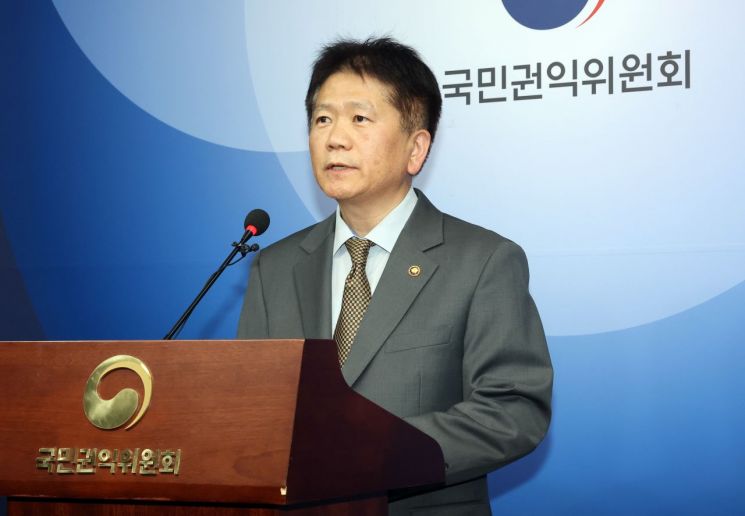 Myungsoon Lee, Vice Chairperson of the Anti-Corruption Division at the Anti-Corruption and Civil Rights Commission, is speaking at the government tax office briefing room. Photo by Yonhap News Agency
The comprehensive integrity score was calculated by combining three components: perceived integrity, based on surveys of internal officials and civil petitioners; integrity efforts, which evaluates the institution’s anti-corruption initiatives; and the corruption status assessment, which deducts points for the occurrence of corruption cases.
The comprehensive integrity score for 450 public institutions across five categories-including central administrative agencies, metropolitan governments, and local governments-was 81 points, up 0.7 points from the previous year. After the evaluation system was revised in 2022, the score fell steadily from 81.2 points that year to 80.3 points last year, before rising for the first time this year.
By institution type, the results were as follows: 48 central administrative agencies scored 81 points (up 0.5 points); 17 metropolitan governments scored 81.4 points (up 0.8 points); 218 local governments scored 78.2 points (up 1.1 points); 17 education offices scored 83.5 points (up 0.1 points); and 150 organizations affiliated with public officials scored 84.9 points (up 0.3 points).
All institution types received higher scores for integrity efforts compared to last year. However, perceived integrity scores declined for two groups: 48 central administrative agencies (from 81.1 to 80.8 points) and 17 metropolitan governments (from 77.5 to 77.0 points), while other institutions saw increases.
When calculating the comprehensive integrity grade-using the average and standard deviation of perceived integrity, integrity efforts, and corruption status assessments-the number of institutions rated as Grade 1 increased by six from the previous year, reaching 24. The integrity grade improved for 131 institutions compared to last year, while it declined for 113 institutions.
Meanwhile, a separate assessment was conducted for 16 national and public universities and 243 local councils, whose work characteristics differ from those of organizations affiliated with public officials or administrative agencies. The comprehensive integrity score for national and public universities was 78 points, up 0.4 points from 2023. Since these universities were not evaluated last year, the comparison was made with the 2023 assessment.
However, the perceived integrity score for national and public universities dropped to 74.1 points from 76.2 points in 2023. This decline was attributed to decreases in both the score given by the general public (from 94.5 to 93.5 points) and the score given by internal members (from 71 to 68.6 points). Notably, in the research and administrative sectors, the rate of internal members experiencing corruption related to research fund embezzlement or misappropriation (2.38%) was relatively higher than the rate for experiences involving bribes or entertainment (2.08%).
The comprehensive integrity score for local councils was 74.9 points, up 5.7 points from last year. However, the perceived integrity score-evaluated by local government officials, employees of affiliated organizations, and local residents-fell by 0.4 points to 67. The most significant decline was observed in the legislative activity sector, which measures the degree of fair work processing without solicitation or lobbying (from 66.5 to 65.8 points).
Myungsoon Lee, Vice Chairperson of the Anti-Corruption Division at the Anti-Corruption and Civil Rights Commission, stated, "The results demonstrate that the anti-corruption efforts pursued in the public sector have led to an increase in the comprehensive integrity score." She added, "However, we must remain vigilant about the rising incidence of traditional types of corruption, such as bribery and entertainment, and will continue to promote anti-corruption initiatives that the public can truly feel."
© The Asia Business Daily(www.asiae.co.kr). All rights reserved.

















