Technology Outlook Beyond 2026
"SoC Optimization: Smarter Systems"
Integrated Design of CPUs, Accelerators, and Memory
Physical AI Emerges as the Next-Generation Platform
There is a forecast that, after 2026, the computing environment will evolve away from a centralized, cloud-centric structure and move toward a model where cloud, physical, and edge AI (artificial intelligence) environments are interconnected.
On December 23, Arm shared its outlook on next-generation technologies, stating, "In the future, computing will become more modular and power-efficient, while cloud, edge, and physical AI environments will be seamlessly connected."
First, in silicon design, Arm predicted an accelerated shift from single (monolithic) chips to chiplet-based modular designs. By separating computing, memory, and I/O (input/output) into reusable building blocks, it becomes possible to combine different process nodes (chip generation units), thereby reducing both design costs and development time. This signifies a transition from 'bigger chips' to 'smarter systems,' providing a foundation for faster SoC (system-on-chip) optimization and product differentiation tailored to various workloads. Furthermore, Arm expects that the evolution of open chiplet standards will enhance interoperability among vendors and expand supply chain flexibility.
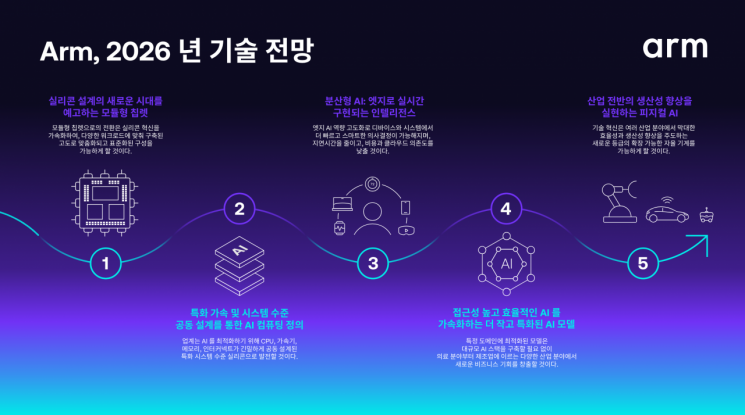
In the field of AI computing, domain-specific accelerators and system-level co-design have been highlighted as key trends. Moving away from the traditional approach of separating general-purpose CPUs (central processing units) and accelerators, the analysis suggests that integrated platform designs-combining CPUs, accelerators, memory, and interconnects tailored to specific AI frameworks and data types-will become more widespread. Arm cited AWS's Graviton, Google Cloud's Axion, and Microsoft Azure's Cobalt as representative examples, evaluating that this approach enhances both development efficiency and scalability. This is expected to lead to the rise of integrated AI data centers, which increase AI computing density per unit area while reducing power consumption and costs.
The center of gravity for AI intelligence is expected to gradually shift to 'edge' systems that process data near the device. While large-scale model training will still be handled by the cloud, it is anticipated that inference will increasingly take place on devices and on-site systems. Thanks to advancements in algorithm sophistication, model quantization, and specialized silicon, real-time inference and local learning will become possible even in edge environments. This will reduce latency and dependence on the cloud, while redefining edge devices as independent computing nodes.
In enterprise environments, the use of small language models (SLMs) is expected to spread rapidly. Through model compression, knowledge distillation, and architectural innovation, high-performance inference will become possible with fewer parameters, making AI models optimized for power-constrained environments and edge deployment mainstream. Arm predicted that, in the future, energy efficiency indicators such as 'inference performance per joule' will emerge as key metrics for AI competitiveness.
In the long term, physical AI is expected to emerge as the next-generation AI platform. With multimodal AI and efficient learning and inference technologies, intelligence will be embedded in autonomous machines and robots, driving productivity improvements across industries such as manufacturing, logistics, healthcare, and mining. In particular, chips developed for automotive applications are expected to be reused in humanoid and factory robots, raising the possibility of forming a unified computing platform spanning vehicles and robotics.
Arm stated, "The common goal of technological evolution after 2026 is to realize high-performance intelligence powered by energy efficiency, anywhere."
© The Asia Business Daily(www.asiae.co.kr). All rights reserved.
![Clutching a Stolen Dior Bag, Saying "I Hate Being Poor but Real"... The Grotesque Con of a "Human Knockoff" [Slate]](https://cwcontent.asiae.co.kr/asiaresize/183/2026021902243444107_1771435474.jpg)
















