BOJ Raises Rates for First Time in 30 Years
Dollar-Yen Surpasses 157 Amid 'Super Yen Depreciation'
On Fiscal Deterioration Concerns: "Already Anticipated"
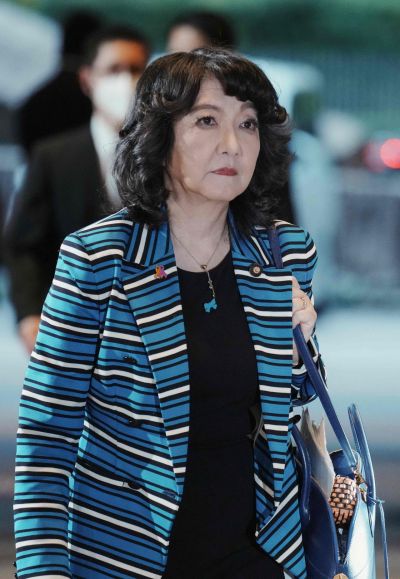 Satsuki Katayama, Japan's Minister of Finance, commuting to the Tokyo residence last October. Photo by AFP Yonhap News
"Japan holds a 'free hand' to take bold action regarding the gap between the exchange rate and fundamentals."
On December 22 (local time), Satsuki Katayama, Japan's Minister of Finance, stated in an interview with Bloomberg that the government could intervene in its foreign exchange market. On December 19, the Bank of Japan (BOJ) raised its benchmark interest rate from 0.5% to 0.75%, the highest level in 30 years. However, as the yen continued to depreciate, exceeding 157 yen per dollar and resulting in a 'super weak yen,' the government appeared to have made verbal interventions.
Minister Katayama, referring to last week's sharp yen depreciation, said, "This movement is clearly inconsistent with fundamentals and is speculative," adding, "The government has made it clear that it will take bold action against such movements, as stipulated in the joint statement by the US and Japanese finance ministers."
When asked about the possibility of market intervention during the year-end Christmas holidays and vacation season, when trading volume is expected to decline, she replied, "We are always fully prepared."
The market reacted sensitively to these remarks. The dollar-yen exchange rate, which had previously surpassed the 157-yen level, fell to the 156-yen range that day. During the session, the yen strengthened to 156.71 per dollar. According to Reuters, this is expected to be the largest daily drop since the end of November. A drop in the exchange rate means a stronger yen.
Market assessments on this were mixed. Juan Perez, Head of Trading at Monex USA, told Reuters, "The BOJ's rate hike has already been largely priced in, and the yen's weakness stems from factors beyond that," adding, "In the past, foreign exchange market interventions have had limited effectiveness relative to their cost." On the other hand, Marc Chandler, Chief Market Strategist at Bannockburn Global Forex, said, "Verbal intervention after a rate hike is reasonable," analyzing, "As the perception spreads that the yen has deviated from fundamentals due to the BOJ's tightening, short covering (yen buying) has emerged."
Meanwhile, Minister Katayama described both the supplementary budget and next year's main budget as "aggressive" in relation to Sanae Takaichi's administration's growth strategy. According to local media reports, the House of Councillors (upper house) recently passed a supplementary budget for fiscal year 2025 totaling 18.3034 trillion yen (about 174 trillion won), a 31% increase from the previous year.
Regarding concerns about fiscal deterioration due to the Takaichi cabinet's proactive fiscal policy, she said, "It will be temporary," predicting that government spending will stimulate the economy, leading to a surge in investment and increased tax revenue within the next one to two years. She added, "We knew from the outset that fiscal indicators could worsen somewhat in the first fiscal year as we shift to an aggressive fiscal policy. But that is not a problem. There is no reason to repeat the approaches of the past."
© The Asia Business Daily(www.asiae.co.kr). All rights reserved.
![Clutching a Stolen Dior Bag, Saying "I Hate Being Poor but Real"... The Grotesque Con of a "Human Knockoff" [Slate]](https://cwcontent.asiae.co.kr/asiaresize/183/2026021902243444107_1771435474.jpg)















