Launch of the Public-Private-Academic-Research "Chemical Industry Innovation Alliance"
Tailored to Demand in Semiconductors, Displays, Secondary Batteries, and More
"Top Priority Support for Companies Participating in Business Restructuring"
The government is launching a public-private joint research and development (R&D) system that includes demand companies, in order to transform the structurally stagnant domestic chemical industry from a focus on commodity products to a high value-added and eco-friendly sector. By integrating the entire value chain, from raw materials to end-users, into a single business unit, technology development and commercialization will be linked based on the performance requirements of demand industries. The plan is to provide priority R&D support to companies undergoing business restructuring, aiming to raise the global ranking of the chemical industry from fifth to fourth by 2030.
On December 23, the Ministry of Trade, Industry and Energy held a launch ceremony for the "Chemical Industry Innovation Alliance" at Lotte Hotel in Jung-gu, Seoul, and announced the "K-Chemical Next-Generation Technology Innovation Roadmap 2030." This marks the first time that the government and companies have jointly formalized a mid- to long-term technology transition strategy for the chemical industry.
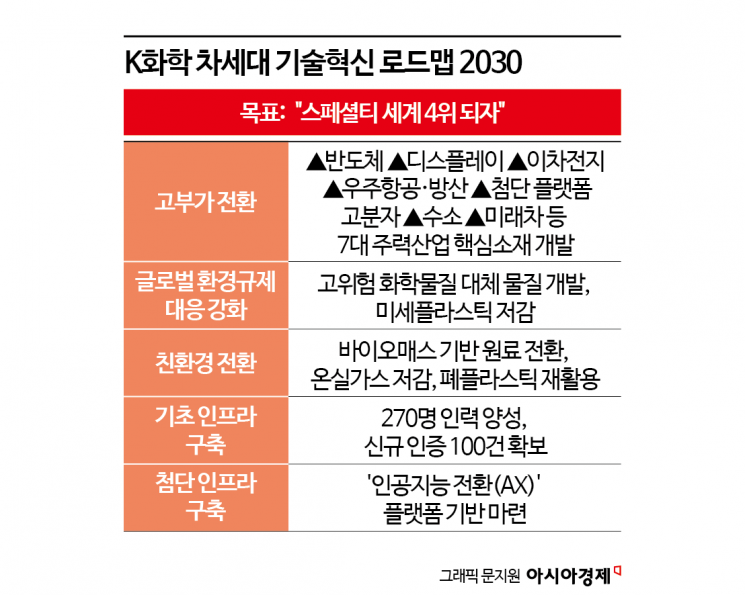
The government has determined that, given the growing pressure for restructuring due to global oversupply and declining profitability, simply reducing facilities will not be sufficient to restore industrial competitiveness. The starting point of this roadmap is the recognition that the industry must shift from a commodity-based production structure to a high value-added specialty focus, while simultaneously establishing R&D and commercialization systems to support this transformation.
Accordingly, the previous approach of conducting R&D separately by material has been replaced with a system that integrates the value chain-from raw materials and components to applications and end-users-into a single business unit. When demand industries such as semiconductors, next-generation vehicles, secondary batteries, and shipbuilding specify their required core performance, chemical companies, small and medium-sized enterprises, and research institutes will form consortia to connect technology development with commercialization.
The alliance is overseen by the Chemical Industry Team of the Ministry of Trade, Industry and Energy, with the Korea Institute for Advancement of Technology and the Korea Chemical Industry Council serving as joint coordinators. There will be nine sector-specific divisions: semiconductors, displays, next-generation vehicles, secondary batteries, aerospace and defense, electricity and telecommunications, advanced platform polymers, eco-friendly, and regulatory response. Each division will pursue flagship projects tailored to its field.

In the high value-added transition field, key tasks include materials for artificial intelligence semiconductor packaging, next-generation lithium-ion battery electrolytes and cathode materials, composite materials for aerospace and satellites, and high-reliability optical materials for foldable and wearable displays. Strategic items also include high-voltage direct current (HVDC) cable insulation and sheathing materials to support power infrastructure expansion, as well as engineering plastics for electric vehicle lightweighting.
The government plans to provide top-priority R&D support to companies participating in business restructuring. On December 19, twelve major petrochemical companies with naphtha cracking centers (NCCs) and propane dehydrogenation (PDH) facilities submitted business restructuring plans. The government aims to drive both restructuring and technological transition simultaneously to fundamentally improve the industry's structure. A representative from the petrochemical industry commented, "Because this is connected with demand companies, it is expected to create new markets," adding, "It will also serve as an opportunity to further advance products that have already been developed."
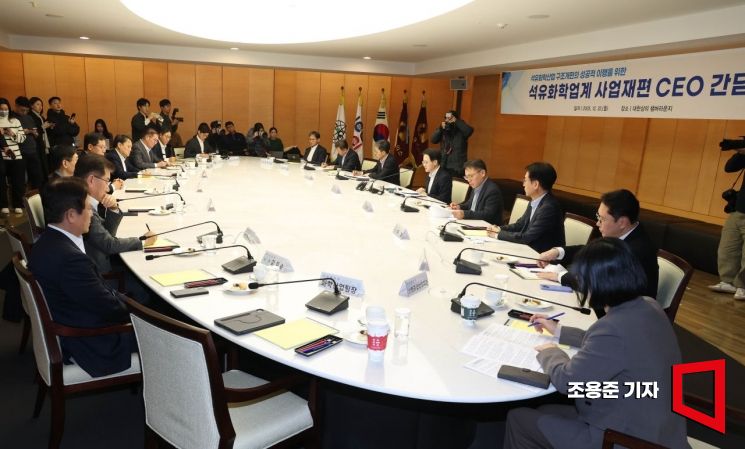 Kim Jeong-Kag, Minister of Trade, Industry and Energy, is speaking at the 'Petrochemical Industry Business Restructuring CEO Meeting' held on December 22, 2025, at the Chamber Lounge of the Korea Chamber of Commerce and Industry in Jung-gu, Seoul. Photo by Jo Yongjun
More than 80 domestic experts participated in the development of this roadmap over six months, conducting technology level analysis and identifying key tasks. After review by research directors from petrochemical companies, 217 core technologies were compiled. The Ministry of Trade, Industry and Energy plans to categorize these by market potential and technology readiness, and apply tailored support strategies for commercialization, challenge-driven research, new market development, and process efficiency. Through the alliance, the ministry will further specify follow-up projects and plans to launch large-scale R&D initiatives in the first quarter of next year.
© The Asia Business Daily(www.asiae.co.kr). All rights reserved.
![Clutching a Stolen Dior Bag, Saying "I Hate Being Poor but Real"... The Grotesque Con of a "Human Knockoff" [Slate]](https://cwcontent.asiae.co.kr/asiaresize/183/2026021902243444107_1771435474.jpg)

















