A technology has been developed that enables the cultivation of intestinal stem cells without animal-derived components. Intestinal stem cells, when generated from a patient's own cells, are less likely to trigger rejection and are drawing attention as a new alternative for treating intractable intestinal diseases. However, until now, cultivation methods have depended on animal-derived (xenogeneic) components, raising concerns about safety and regulatory issues.
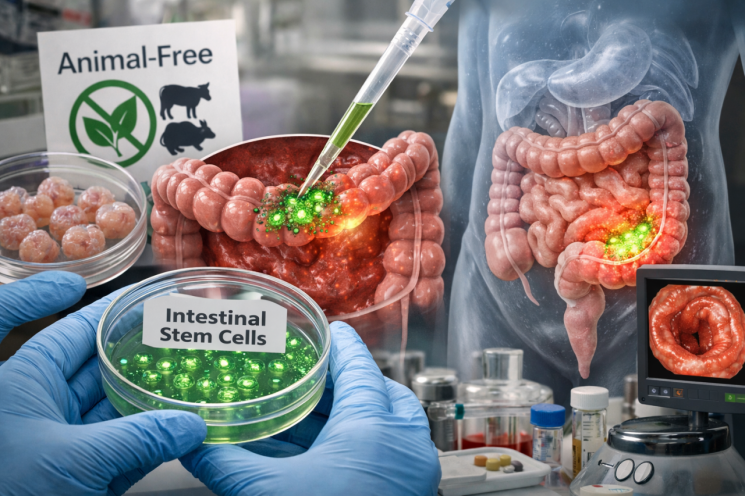
KAIST announced on December 23 that the research team led by Professor Seongkap Lim of the Department of Biological Sciences and Bioengineering, in collaboration with Dr. Taegul Lee’s team from the Nano-Bio Measurement Group at the Korea Research Institute of Standards and Science (KRISS), and Dr. Miyoung Son’s team from the Stem Cell Convergence Research Center at the Korea Research Institute of Bioscience and Biotechnology (KRIBB), has developed a “polymer-based cultivation platform” that enhances the migration and regenerative abilities of intestinal stem cells in a xenogeneic-free environment.
First, the joint research team developed “PLUS (Polymer-coated Ultra-stable Surface),” a polymer-based cultivation surface technology that can be used without animal-derived substances.
PLUS is a synthetic polymer surface coated by a vapor deposition method. Its key feature is the precise control of surface energy and chemical composition, which increases the adhesion and mass cultivation efficiency of intestinal stem cells. Additionally, it can be stored at room temperature for three years while maintaining the same cultivation performance, offering both industrial scalability and storage convenience for stem cell therapeutics.
The joint research team also identified through proteomics analysis that protein expression significantly increases during the cytoskeletal reorganization process of intestinal stem cells cultured in the PLUS environment. Proteomics analysis is a method that comprehensively analyzes the types and quantitative changes of all proteins present in cells or tissues.
Through this, the researchers confirmed that the increased expression of cytoskeletal protein-binding and actin-binding proteins leads to a more stable reorganization of the cell’s internal structure, forming the source of force that enables stem cells to move more rapidly and actively on the substrate.
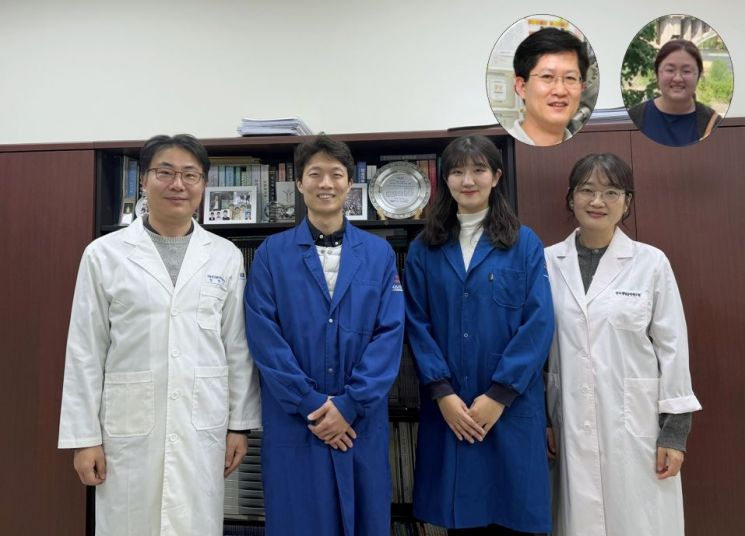 (From left) Professor Seongkap Lim, Dr. Sunghyun Park, Master Sangyu Seon of KAIST, Dr. Miyoung Son of KRIBB, (top right) Dr. Taegul Lee and Dr. Jinkyung Son of KRISS. Courtesy of KAIST
Notably, real-time observations using holotomography microscopy revealed that intestinal stem cells cultured on PLUS migrated at twice the speed compared to conventional surfaces, and in damaged tissue models, more than half of the injured area was restored within one week, demonstrating superior regenerative performance.
This proves that PLUS not only activates cytoskeletal activity in stem cells but also enhances their tissue regeneration capabilities.
The joint research team's PLUS cultivation platform is considered a technology that increases the potential for mass cultivation and clinical application of intestinal stem cells derived from human pluripotent stem cells (hPSC). Most importantly, by elucidating the mechanism that simultaneously enhances the survival, migration, and regenerative abilities of stem cells in a xenogeneic-free environment, the research lays the foundation for fundamentally resolving the safety, productivity, and regulatory challenges of stem cell therapeutics.
Professor Lim stated, "This study is significant in that it presents a synthetic cultivation platform that eliminates the dependency of stem cell therapeutics on xenogeneic components and maximizes the migration and regenerative abilities of stem cells," adding, "We hope the platform developed by the joint research team will serve as a catalyst for paradigm shifts in the field of regenerative medicine going forward."
© The Asia Business Daily(www.asiae.co.kr). All rights reserved.
![Clutching a Stolen Dior Bag, Saying "I Hate Being Poor but Real"... The Grotesque Con of a "Human Knockoff" [Slate]](https://cwcontent.asiae.co.kr/asiaresize/183/2026021902243444107_1771435474.jpg)
















