Lost in the 1960s, Revived by National Intangible Heritage Artisans
Open to the Public from the 24th
Restoring the Complete Aesthetics of the Royal Court
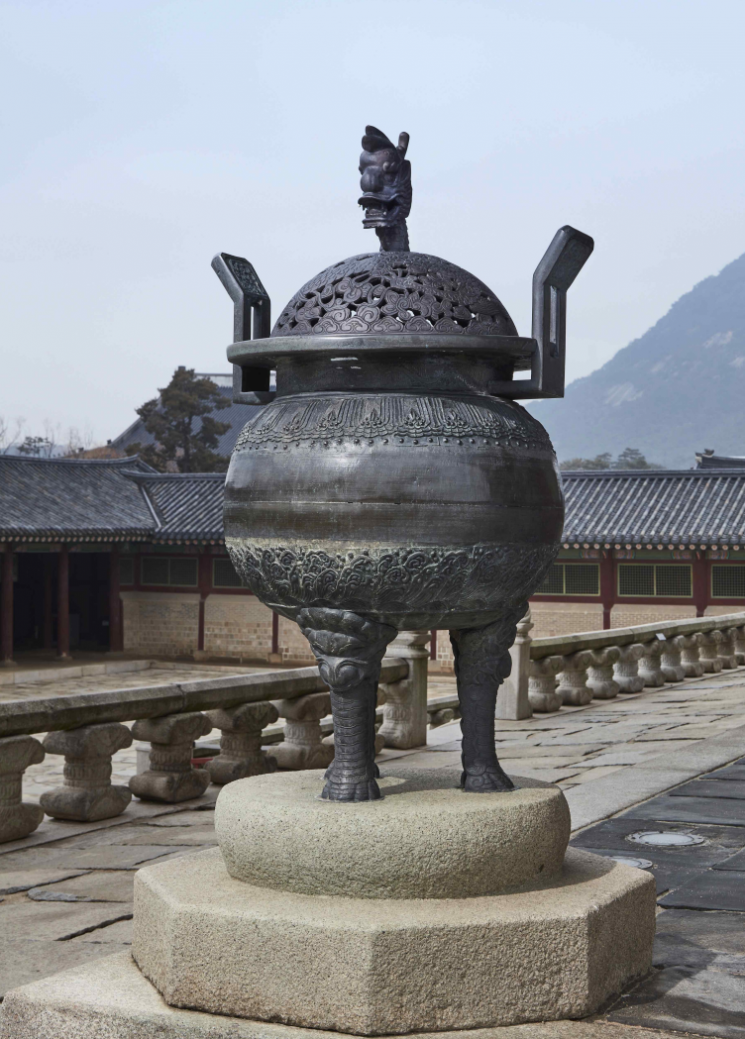
Geunjeongjeon Hall at Gyeongbokgung Palace, the very heart of royal authority during the Joseon Dynasty, stands proudly with two massive incense burners on either side of its vast courtyard. For over half a century, however, these incense burners were incomplete. The dragon-shaped lids, from which incense smoke was meant to rise, had vanished, leaving only the hollow bodies behind.
After more than 60 years, the damaged royal pride has finally been restored to its original form. The Gyeongbokgung Palace Management Office announced on the 23rd that it has reproduced the two lost lids and, starting from the 24th, will permanently display the fully restored incense burners to the public.
The incense burners themselves embody the turbulent history of Joseon. Cast in 1457 during the reign of King Sejo, they were made by melting down the Great Bell (Daejong) that once guarded the west side of Gwanghwamun Gate. The molten metal, imbued with ancestral spirit, was recast to forge the new authority of an era. Whenever state ceremonies were held, the rising smoke transformed Geunjeongjeon into a sacred space.
However, during the Japanese colonial period, the whereabouts of the lids became unknown, likely due to neglect. In black-and-white photographs from the time, the lids are either missing or appear precariously placed. Between 1961 and 1962, both lids disappeared entirely, leaving only the bodies behind and turning the incense burners into incomplete relics.
The lids, which vanished without a trace, have now been revived by the hands of national intangible heritage artisans. Won Gwangsik, a master of cast iron, and Won Cheonsu, his apprentice, undertook the reproduction after thorough consultation with an expert advisory panel. Every detail, down to the delicate dragon scales, was meticulously restored to ensure the dignity of the National Treasure, Geunjeongjeon, was upheld. An official from the National Heritage Administration stated, "This was not simply about making new lids, but about reconnecting the broken lineage of late Joseon metal craftsmanship."
At Geunjeongjeon, the incense burner lid is more than just a cover. It is a symbol invoking the spirit of the ascending dragon, expressing the wish for the dynasty's perpetuity. Now, visitors can admire the full aesthetics of the royal court, coming face-to-face with the proud head of the dragon, rather than staring into an empty hole.
Heo Min, Commissioner of the National Heritage Administration, stated, "Filling the long-empty space since liberation is an act of restoring the pride of our cultural heritage," and added, "We will continue our efforts to recover the true appearance of Gyeongbokgung Palace in the future."
© The Asia Business Daily(www.asiae.co.kr). All rights reserved.
![Clutching a Stolen Dior Bag, Saying "I Hate Being Poor but Real"... The Grotesque Con of a "Human Knockoff" [Slate]](https://cwcontent.asiae.co.kr/asiaresize/183/2026021902243444107_1771435474.jpg)
















