Six-Month Deposit Rates at Major Banks Exceed 24- and 36-Month Rates
Uncertainty Over Future Interest Rates Diminishes Customer Preference for Long-Term Deposits
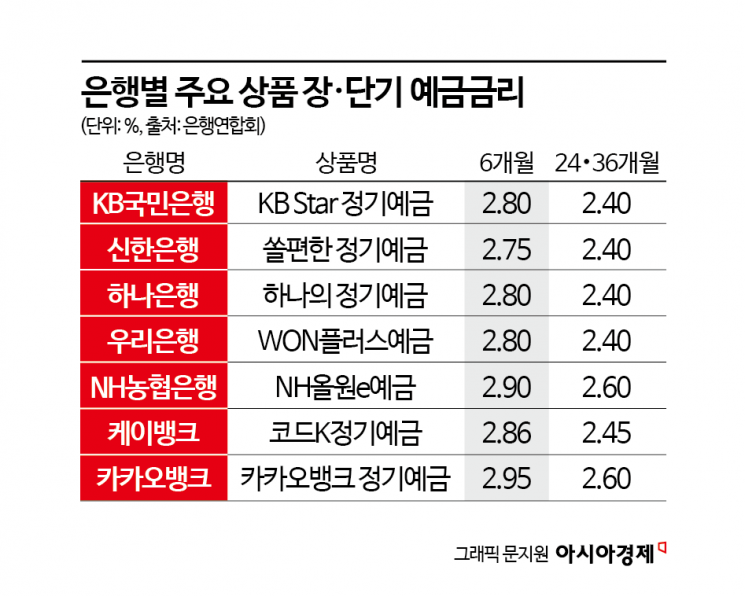
A "reverse interest rate" phenomenon is emerging in which the interest rates for short-term deposits at major commercial banks are higher than those for long-term deposits. Typically, longer-term deposits offer higher interest rates, but recently the opposite trend has drawn attention. Analysts attribute this to the uncertainty surrounding future interest rate fluctuations, which makes banks reluctant to lock in high rates for extended periods. In addition, the bullish stock market has led customers to prefer short-term deposits that allow them to move their funds at any time, rather than tying up their money in long-term deposits.
According to the Korea Federation of Banks on December 23, the six-month deposit interest rates (including preferential rates) at the five major commercial banks (KB Kookmin, Shinhan, Hana, Woori, and NH Nonghyup) are currently around 2.75% to 2.90% per annum. In contrast, the 24- and 36-month deposit rates (including preferential rates) are in the range of 2.40% to 2.60% per annum, with both the upper and lower bounds 0.35 to 0.30 percentage points lower than the six-month rates.
Looking at representative products from each bank, KB Kookmin Bank's "KB Star Regular Deposit," Hana Bank's "Hana Regular Deposit," and Woori Bank's "WON Plus Deposit" all offer a six-month maturity rate (including preferential rates) of 2.80% per annum, which is 0.40 percentage points higher than the 24- and 36-month rates (2.40%). Shinhan Bank's "SOL Easy Regular Deposit" also offers a six-month rate (including preferential rates) of 2.75% per annum, 0.35 percentage points higher than its 24- and 36-month rates (2.40%). NH Nonghyup Bank's "NH All-One e-Deposit" offers a six-month rate of 2.90% per annum, while the 24- and 36-month rates are 2.60%, resulting in a 0.30 percentage point advantage for the short-term rate.
This inversion of short- and long-term rates is also observed at internet banks. K Bank's "Code K Regular Deposit" offers a six-month rate of 2.86%, and Kakao Bank's "Kakao Bank Regular Deposit" offers 2.95%. In contrast, their 24- and 36-month rates are 2.45% and 2.60%, respectively, resulting in differences of 0.41 and 0.35 percentage points.
It is generally expected that longer deposit periods yield higher interest rates, as banks benefit from greater stability when customer funds are deposited for extended periods. However, this unusual reversal of short- and long-term rates is believed to be influenced by the recent trend of declining interest rates and developments in the bond market. Banks set deposit rates by adding a margin to market rates, but recently, long-term rates in the bond market-such as government bond and bank bond rates-have fallen below short-term rates, and this trend has been reflected in deposit rates, according to banking industry sources.
Uncertainty over future monetary policy has also led banks to adopt a conservative approach in setting interest rates. The Bank of Korea has maintained a cautious stance on further monetary easing, but if major economies such as the United States resume rate cuts, there is speculation that the Bank of Korea may also have room for additional cuts. Previously, at its Monetary Policy Board meeting in November, the Bank of Korea kept its base rate unchanged at 2.50% per annum and removed the phrase "rate cut stance" from its policy direction statement. As a result, government bond yields recently hit their highest levels of the year in the bond market.
With the stock market booming and deposit preference relatively low, banks are also employing strategies to attract customers with short-term products that involve less risk for the banks. Additionally, the banking sector's efforts to distribute funds into short-term deposits of less than one year for liquidity management purposes have also played a role.

A banking industry official explained, "With the average stock market return exceeding deposit interest rates, there is little preference for long-term deposits that tie up funds for two to three years. At the end of the year, it is also common to offer relatively higher rates on short-term deposits, as companies' bonus payments, dividends, and corporate tax payments can lead to outflows of funds."
© The Asia Business Daily(www.asiae.co.kr). All rights reserved.
![Clutching a Stolen Dior Bag, Saying "I Hate Being Poor but Real"... The Grotesque Con of a "Human Knockoff" [Slate]](https://cwcontent.asiae.co.kr/asiaresize/183/2026021902243444107_1771435474.jpg)

















