"Military Issued 2,400 Warning Broadcasts and 17 Warning Shots Since Last Year"
The Joint Chiefs of Staff have issued a directive to frontline units instructing them to respond based on the southernmost line when there is a discrepancy between the military demarcation line (MDL) shown on South Korean military maps and the MDL recognized by the United Nations Command, in the event of a North Korean military incursion across the MDL.
On December 22, the Joint Chiefs of Staff stated, "When a North Korean violation of the Armistice Agreement occurs in the Demilitarized Zone, our military prioritizes the 'identified MDL markers' on the ground to ensure decisive responses by field units and to prevent accidental clashes between the two Koreas. In areas where MDL markers are not identifiable, we make a comprehensive judgment by connecting the MDL on military maps and the coordinates of the United Nations Command's MDL markers."
In other words, if North Korean forces cross the MDL as marked on South Korean military maps but not according to the United Nations Command's standard, the latter is used as the basis for response. Conversely, if the United Nations Command's standard indicates a violation but the South Korean military map does not, the response is still based on the latter. A Ministry of National Defense official explained, "If we ignore the United Nations Command's standard-which is located further south than our MDL-and take military action in the event of a North Korean incursion, it could lead to conflict with the United Nations Command and result in violations of the Armistice Agreement. We have found a way to respect both our military's and the United Nations Command's MDL."
The MDL is the armistice line established through the Korean War Armistice Agreement. After the agreement was signed in 1953, the Military Armistice Commission installed approximately 1,292 concrete markers, each about one meter high, along the MDL. Over time, only about 200 of these markers-about one-sixth of the total-are currently identifiable by the South Korean side. As a result, there are significant discrepancies between the MDL lines on South Korean military maps and those recognized by the United Nations Command, with differences in some areas reaching several dozen meters.
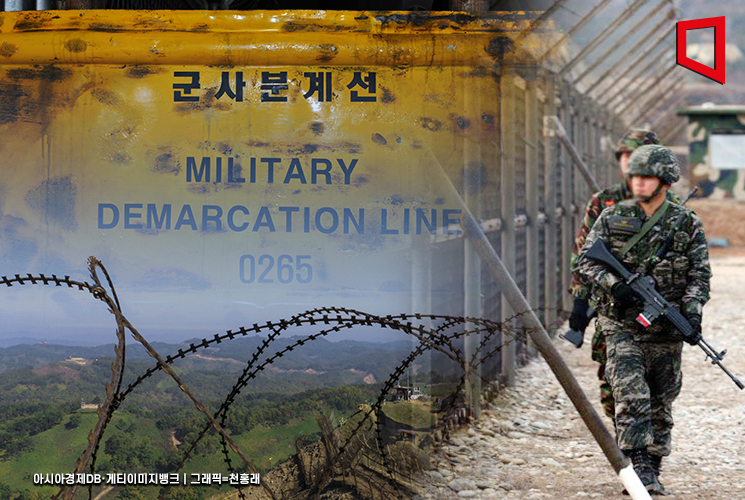
A Ministry of National Defense official explained, "Our military maps were produced in collaboration with the U.S. National Geospatial-Intelligence Agency (NGA) in 2004 and have been in use since 2011, while the United Nations Command's standard was developed between 2014 and 2015 and has been applied since 2016. There are more points of discrepancy than agreement, with about 60% of the total not matching."
Previously, the differing recognition of the MDL among South Korea, North Korea, and the United Nations Command had not been a major source of dispute. However, after Kim Jong Un, Chairman of North Korea's State Affairs Commission, defined inter-Korean relations as those of "two hostile states" in December 2023 and began so-called "borderline work" in the DMZ, the issue has come to the forefront. In fact, North Korean MDL incursions have become frequent since the North began desertification and landmine installation-part of its borderline work-in the DMZ starting in April. This year alone, there have been 17 MDL incursions, with 11 occurring just last month. Since last year, the South Korean military has responded to all North Korean incursions by broadcasting approximately 2,400 warnings and conducting 21 warning fire incidents in 36 instances, successfully forcing the North Korean troops to retreat northward each time.
In response, the South Korean military issued new operational guidelines in June last year, during the Yoon Suk-yeol administration, changing the standard for MDL incursions. In September, these changes were incorporated into the border operation manual. A Ministry of National Defense official explained, "The operational guidelines were distributed in writing in June last year, and the key personnel were briefed during field visits. Considering the issues that arose after applying the new guidelines, it was deemed appropriate to specify them in the border operation manual, which was done in September."
Going forward, the military plans to resolve the MDL standard discrepancy through consultations with the United Nations Command. The Ministry of National Defense official stated, "Both our military and the United Nations Command are aware of the differences in our recognition of the MDL, and we have recently agreed once again to discuss this issue. Discussions will be held next year through consultations between South Korea and the United States."
The main problem remains North Korea, which has been causing issues through its borderline work on the MDL. North Korean forces use the old Soviet mapping system and the Russian GLONASS satellite navigation system, resulting in significant differences from the South Korean side. On November 17, the South Korean military proposed inter-Korean military talks to discuss the MDL standard with the North, but there has been no response. In a regular briefing, Ministry of National Defense spokesperson Jeong Bitna stated, "As far as I know, there has been no response yet."
Given the high likelihood that North Korea will resume its borderline work after completing its winter training in March next year, the possibility of further clashes cannot be ruled out. Currently, only 20% to 30% of the work has been completed. The Ministry of National Defense official said, "As North Korea is expected to resume related activities from March next year, we will reconsider what the optimal approach is. For now, we believe that inter-Korean military talks or some form of dialogue are necessary to prevent accidental clashes, and we will continue to make such efforts."
© The Asia Business Daily(www.asiae.co.kr). All rights reserved.
![Clutching a Stolen Dior Bag, Saying "I Hate Being Poor but Real"... The Grotesque Con of a "Human Knockoff" [Slate]](https://cwcontent.asiae.co.kr/asiaresize/183/2026021902243444107_1771435474.jpg)















