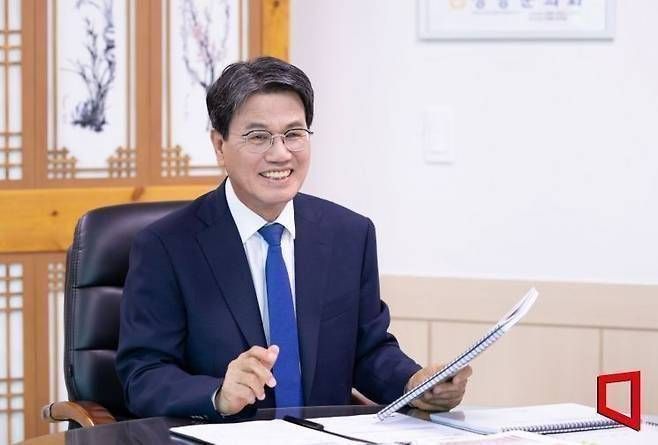
Rural areas in South Korea are undergoing rapid change. Population decline, an aging agricultural workforce, and the shrinking of local economies are challenges faced by all regions. Cheongyang County started out grappling with these same issues. However, we turned this crisis into an opportunity. We redefined the assets of our region and placed agriculture and food at the center of our local development strategy. This choice is what we call the "Cheongyang-style Food Plan."
Maintaining a top ranking for four consecutive years in an evaluation where 159 local governments nationwide compete is by no means a small achievement. However, this accomplishment should not remain solely Cheongyang’s. Rather, I believe it should become a new standard for local policies that should be spread and developed by local governments across the country.
The core of the Cheongyang-style Food Plan is not complicated. It is about linking production, distribution, consumption, welfare, and jobs into a single flow.
The systems that Cheongyang County is establishing are policies that any local government can pursue. What matters most is a "philosophy" and "consistency" regarding agriculture.
The integrated infrastructure known as the Comprehensive Food Town is a symbol of the Cheongyang model, but it is not the goal itself. The essence lies in the system. We have created a model in which safety inspections, processing, public meal services, and welfare connections all operate within a single structure. Any local government can implement this system at a scale appropriate to its circumstances. The key is the operational principle of seamlessly connecting production and consumption.
Connecting with urban consumers is also an area that local governments can pursue together. Cheongyang County has opened up markets through various methods, such as direct stores in the Daejeon area, specialty product sections in department stores, and promotional events at Hyundai Outlets. This structure, in which local agricultural products are delivered to cities and cities, in turn, remember the region, can be fully applied in other regions as well. Expanding market accessibility is an area that local administrations must actively pioneer.
The power of the Food Plan is also evident in welfare and the local economy. Public meal services at senior centers, side dish support for vulnerable groups, and the linkage of child and school meal services create a structure in which local food directly improves the lives of local residents. The virtuous cycle of Cheongyang-grown agricultural products returning to the tables of Cheongyang residents is a policy that can be implemented anywhere in the country, as long as the local government is willing.
The jobs created based on the Food Plan are no different. This demonstrates that agriculture and the local economy are not separate, but operate as a single ecosystem. If each local government establishes a system that connects agriculture, processing, and distribution, they can certainly achieve similar changes.
The Cheongyang-style Food Plan is not a secret strategy exclusive to Cheongyang. Rather, it is a model that shows how a region can structure its own strengths. It proves that a region can design its own future and produce results, rather than passively following central government policies.
I hope that local governments across the country do not view Cheongyang’s case as a "model answer." Instead, I hope each local government creates its own food plan based on its unique resources and regional characteristics. The model created by Cheongyang is not a method, but a direction. That direction is clear: protecting agriculture is the same as protecting the region, and policies centered on food are the path to enhancing regional sustainability.
If local governments join forces and local food-based policies spread throughout the country, the future of rural South Korea can change. Cheongyang has merely been the starting point. Now, it is time for the whole nation to move forward together.
Kim Donggon / Governor of Cheongyang County
© The Asia Business Daily(www.asiae.co.kr). All rights reserved.
![Clutching a Stolen Dior Bag, Saying "I Hate Being Poor but Real"... The Grotesque Con of a "Human Knockoff" [Slate]](https://cwcontent.asiae.co.kr/asiaresize/183/2026021902243444107_1771435474.jpg)















