NHIS Launches Record Inquiry Service to Promote Rational Use of Imaging Tests
CT Usage Nearly Twice the OECD Average... Misconceptions Persist About "Radiation-Free" MRI
The use of medical imaging tests (CT) by Korean citizens continues to rise, reaching the highest level among member countries of the Organisation for Economic Co-operation and Development (OECD). However, a recent survey shows that proper knowledge and understanding of medical radiation remain insufficient.
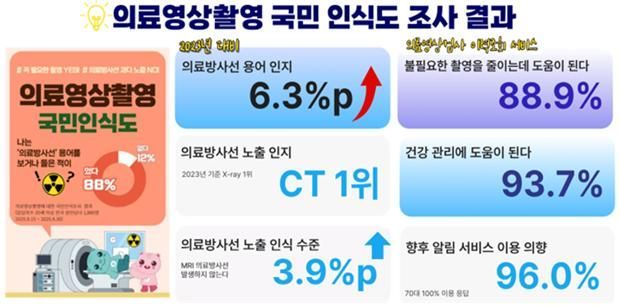
According to the National Health Insurance Service (NHIS) on December 22, the results of a “Public Awareness Survey on Medical Imaging” conducted online in September with 1,880 adults nationwide showed that 87.8% of respondents said they had “seen or heard” about medical radiation. Compared to the 2023 survey, awareness of the term “medical radiation” increased by 6.3 percentage points.
When asked if they knew that medical radiation is generated during a CT scan, 82.8% responded that they were aware. For general X-rays, 79.3% were aware, and for mammography, 73.6% recognized this fact.
However, 71.4% of respondents still mistakenly believed that MRI (magnetic resonance imaging) also involves radiation exposure. MRI uses a magnetic field, not radiation, so there is no radiation exposure. Regarding experience with medical radiation, 91.8% of respondents reported having undergone a general X-ray, followed by ultrasound at 72.9%, dental panoramic X-ray at 60.7%, CT at 58.8%, MRI and mammography at 43.6%, and gastrointestinal fluoroscopy at 28.1%.
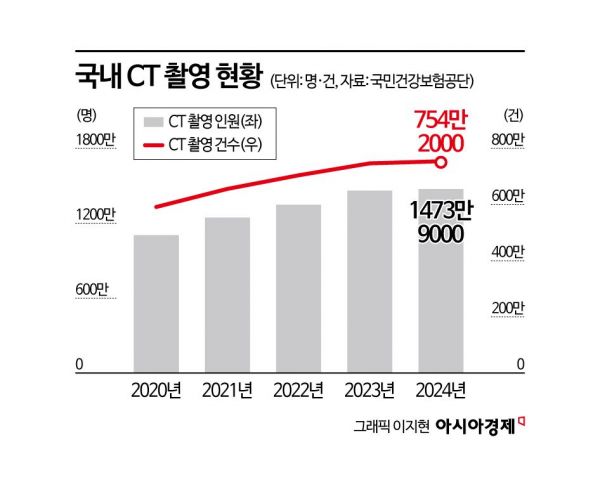
The number of imaging tests involving exposure to medical radiation continues to increase. According to the NHIS analysis of “CT Utilization and Overuse Status,” as of 2023, the number of CT scans per 1,000 people in Korea was 333.5. This is about 1.9 times higher than the OECD average of 177.9, making it the highest among member countries.
Furthermore, over the past five years (2020-2024), the number of people undergoing CT scans increased by 27.5%. However, the number of people whose radiation exposure exceeded the risk threshold of 100 mSv (millisieverts) surged by 37.6%, outpacing the overall growth rate of tests. The annual average radiation dose for Korean citizens is 2.1 mSv, surpassing that of airline crew members (1.72 mSv) and about eight times higher than that of radiation workers (0.28 mSv).
The International Commission on Radiological Protection (ICRP) reports that if radiation exposure exceeds 100 mSv, the risk of developing cancer increases by 0.5%. Notably, a recent survey revealed that a patient who underwent 130 CT scans in one year was exposed to approximately 234 mSv of radiation, which is about 836 times the annual average exposure for radiation workers. An NHIS official cautioned, “Even a single abdominal CT scan exposes a person to 24 times more radiation than the annual average for radiation workers.”
In response, the NHIS is strengthening its system to allow citizens to manage their own imaging test history. Since January, services have been available through the “The National Health Insurance” mobile app and the NHIS website, enabling users to check their CT and mammography records. Recently, the service scope was expanded to include X-ray records for children under 12, who are particularly vulnerable to radiation.
Jung Ki-seok, President of the NHIS, stated, “We will strengthen public campaigns to raise awareness of the risks of excessive radiation exposure and strive, as the insurer, to ensure that citizens use medical services rationally and avoid unnecessary exposure to medical radiation.”
© The Asia Business Daily(www.asiae.co.kr). All rights reserved.
![Clutching a Stolen Dior Bag, Saying "I Hate Being Poor but Real"... The Grotesque Con of a "Human Knockoff" [Slate]](https://cwcontent.asiae.co.kr/asiaresize/183/2026021902243444107_1771435474.jpg)
















