Gangneung City Confirms Ancient Yemaek Burial Practices
at the Hasidong-ri Ancient Tombs
Gangneung City in Gangwon Province (Mayor Kim Hong-kyu) and the Gangwon Archaeological and Cultural Research Institute (Director Ji Hyeon-byeong) announced that, with the approval of the National Heritage Administration (Administrator Heo Min), they have confirmed the first stone-covered burial mound in the Yeongdong region of Gangwon Province at the precise excavation site of the Hasidong-ri Ancient Tombs in Gangdong-myeon, Gangneung City (a Gangwon Special Self-Governing Province Monument).
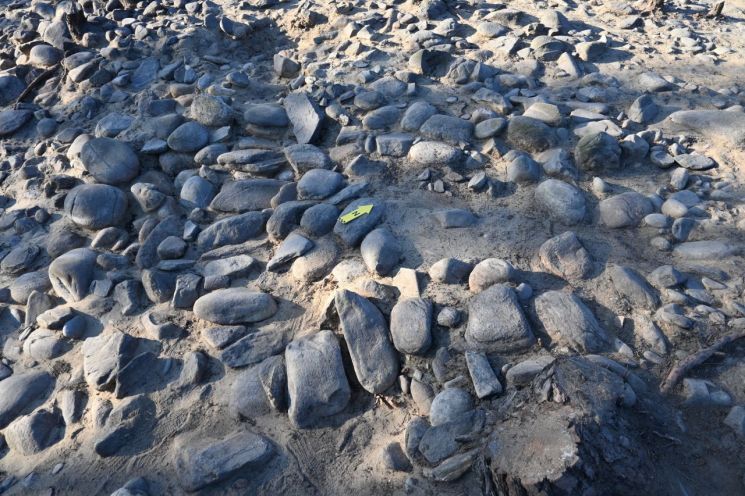 First Confirmed Dolmen Burial Mound in the Yemak Historical and Cultural Area on the East Coast (View of the Burial Pit). Provided by Gangneung City
Previously, Gangneung City was selected for the 2024 National Heritage Administration's Important Historical and Cultural Sites Excavation Support Project under the Special Act on the Maintenance of Historical and Cultural Areas. On December 3, an academic advisory meeting was held at the site to investigate the burial practices of the Yemaek historical and cultural area.
This investigation included an external survey to understand the overall construction pattern of the stone-covered burial mound. In the future, a detailed study of the burial chamber will be conducted to further clarify the construction methods and burial rituals.
The stone-covered burial mound is generally referred to as a stone mound tomb. In the Yemaek historical and cultural area, these tombs are constructed by leveling sand dunes and building the burial chamber (main burial area) with large or broken stones. Recently, researchers have begun using the term "stone-covered burial mound" to reflect the unique characteristics of these structures.
According to current findings, the stone-covered burial mound was built on a coastal sand dune at an elevation of 7 meters above sea level, with a rectangular layout. The mound measures approximately 42.6 meters from north to south and 18.5 meters from east to west. The burial chamber (main burial area) has currently been identified in both straight and L-shaped forms, but further investigation will be conducted to clarify the detailed construction methods and sequence. Based on the types of artifacts discovered, the tomb is estimated to have been constructed between the late 3rd century and the early 4th century CE.
Until now, stone-covered burial mounds had mainly been found in the Yeongseo region. This excavation marks the first confirmation of such a burial structure in the Yeongdong region of Gangwon Province, and is significant because it has also revealed the burial practices of the groups that constructed the Lyeo- and T-shaped dwellings, which had not been previously excavated.
Furthermore, future excavations are expected to shed light on the interactions between the Yemaek historical and cultural area in Yeongdong and the Dan-gyeol-Krounovka Culture (Okjeo), as well as exchanges with the Silla cultural area.
Gangneung City plans to conduct a systematic and precise excavation to clarify the characteristics and scale of the Hasidong stone-covered burial mound. Through restoration and maintenance, the site will be actively utilized as a resource for cultural tourism and historical education.
© The Asia Business Daily(www.asiae.co.kr). All rights reserved.
![Clutching a Stolen Dior Bag, Saying "I Hate Being Poor but Real"... The Grotesque Con of a "Human Knockoff" [Slate]](https://cwcontent.asiae.co.kr/asiaresize/183/2026021902243444107_1771435474.jpg)















