The Gyeonggi-do Economic Science Promotion Agency has published a research report advocating for the secondary battery industry to be fostered as a strategic sector in Gyeonggi Province.
The secondary battery industry represents the largest future growth engine for South Korea. Globally, it is the second largest consumer goods market after the oil market (3,300 trillion won), with a market size of 3,000 trillion won. This estimate is based on the assumption that 10 million new cars (with an average price of 30 million won) are launched annually. The battery market is several times larger than the combined memory (300 trillion won) and non-memory (600 trillion won) semiconductor markets. Samsung Electronics and SK Hynix account for 70% of the memory market, which itself comprises one-third of the total semiconductor market.
In particular, South Korea is the world’s leading battery manufacturing powerhouse. While there are widespread claims that lithium iron phosphate (LFP) batteries are dominant and that China is the best at making batteries, the truth cannot be concealed.
South Korea entered the battery business in 1992, when LG Chem launched its battery operations. In contrast, China’s CATL, which is now the world’s number one, only entered the battery industry in 2009-a difference of 17 years. Battery technology relies heavily on powder processing, a field with technical barriers that cannot be overcome overnight, unlike digital technology. Despite this, some groups continue to praise Chinese batteries as the world’s best, but it is time to face reality.
From January to September this year, 16.9 million electric vehicles were sold worldwide, with 10.3 million sold in China. This means that 70% of global electric vehicle sales occurred in China. China’s early entry into the electric vehicle market was due to its lack of technological expertise in internal combustion engine vehicles, especially engines. As a result, China abandoned internal combustion engine vehicles and pivoted to electric vehicles, and CATL, with full support from the Chinese Communist Party, naturally grew alongside the expansion of the Chinese electric vehicle market.
The real challenge lies ahead. The United States recently acknowledged in its National Security Strategy (NSS) that it was a mistake to support China’s accession to the World Trade Organization (WTO) and its subsequent growth. The U.S. has now adopted a new strategy to thoroughly contain and exclude China. Even before this, Chinese batteries already faced trade barriers in the U.S. that are higher than the Berlin Wall, making it nearly impossible for Chinese batteries to enter the American market.
What about Europe? Europe has also begun to contain China. The relationship between Europe and China started to crack following the close ties between former German Chancellor Angela Merkel (who was from East Germany’s Communist Party) and Chinese President Xi Jinping. Last year, Europe imposed tariffs as high as 40% on Chinese electric vehicles.
Globally, South Korea is the strongest player in the battery industry. Domestically, there are three major companies: LG Energy Solution, Samsung SDI, and SK On. In China, there are CATL and BYD, while Japan has only Panasonic. In terms of technology and the status of factories in the U.S. and Europe, South Korean battery companies have an overwhelming advantage over their Chinese and Japanese counterparts. It is only a matter of time before these three Korean battery companies dominate the U.S. and European markets, which together account for 60% of the global automotive market.
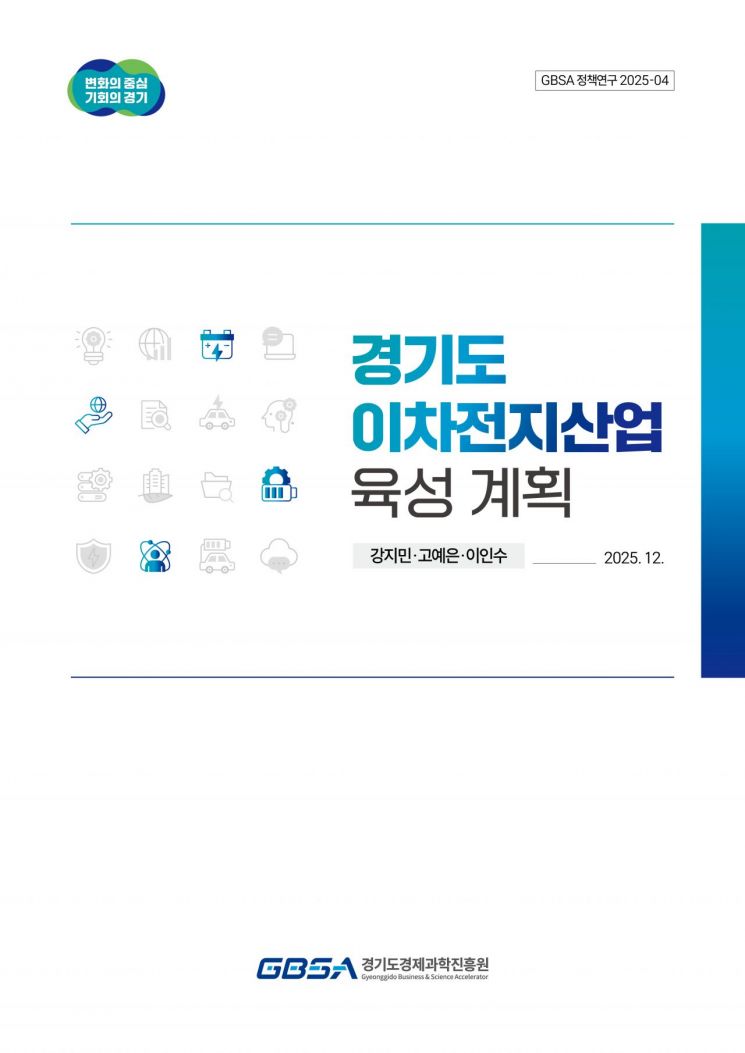 Cover of the Secondary Battery Industry Development Plan Report by Gyeonggi-do Economic Science Promotion Agency
It is in this context that the secondary battery industry strategy proposed by the Gyeonggi-do Economic Science Promotion Agency is particularly significant.
The agency’s report emphasizes the need to prepare for the strategic importance of the secondary battery industry and to support Gyeonggi Province in becoming a key hub for the next-generation secondary battery sector.
The report further notes that overcoming the electric vehicle chasm, increasing demand for energy storage systems (ESS), and the strengthening of carbon neutrality policies are driving a structural transformation of the global battery industry and market environment. In this context, it is crucial for Gyeonggi Province to become an innovation hub for the next-generation secondary battery industry.
The report presents three main strategies for Gyeonggi Province to become a “next-generation K-battery global innovation hub”: securing industrial bases for the secondary battery sector, strengthening technology and corporate competitiveness in specialized fields, and building a cooperative ecosystem among industry, academia, and research institutions.
To implement these three strategies, the report proposes ten key initiatives: establishing a specialized secondary battery R&D cluster, building a testbed platform, enhancing the competitiveness of next-generation secondary battery AI-based technologies, supporting the development and commercialization of used battery technologies, expanding joint R&D and demonstration support among industry, academia, and research institutions, and operating specialized workforce training programs in partnership with secondary battery-focused universities, among others.
Kim Hyungon, President of the Gyeonggi-do Economic Science Promotion Agency, stated, “The temporary slowdown in the electric vehicle market is an important opportunity to secure global technological competitiveness. Based on Gyeonggi Province’s research and development capabilities and industrial foundation, we will continue to identify policy tasks to enhance technological competitiveness in the province’s secondary battery sector and strive to address challenges on the ground.”
© The Asia Business Daily(www.asiae.co.kr). All rights reserved.
![Clutching a Stolen Dior Bag, Saying "I Hate Being Poor but Real"... The Grotesque Con of a "Human Knockoff" [Slate]](https://cwcontent.asiae.co.kr/asiaresize/183/2026021902243444107_1771435474.jpg)















