Establishing the Theory of "Multipartite Quantum States Over Time"
A Mathematical Tool Connecting the Two Pillars of Modern Physics
Unique Background in Both Mathematics and Physics Contributed to the Achievement
Published in Physical Review Letters
The key to simultaneously explaining quantum mechanics and the theory of relativity has always seemed elusive, like a mirage.
The two pillars of modern physics, quantum mechanics and the theory of relativity, have struggled to reconcile their perspectives on space and time.
While the theory of relativity treats space and time as a unified entity called "spacetime," quantum mechanics defines the "quantum state" only for space, leaving time merely as a process of change (a channel) that flows forward.
This difference has led to an awkward coexistence between quantum mechanics and the theory of relativity for over a century, like two families under one roof. Now, a new theoretical framework proposed by a Korean research team offers a solution to this longstanding mismatch.
The protagonist is Seokhyung Lee, a young researcher who has been at UNIST for less than two years and is only 32 years old.
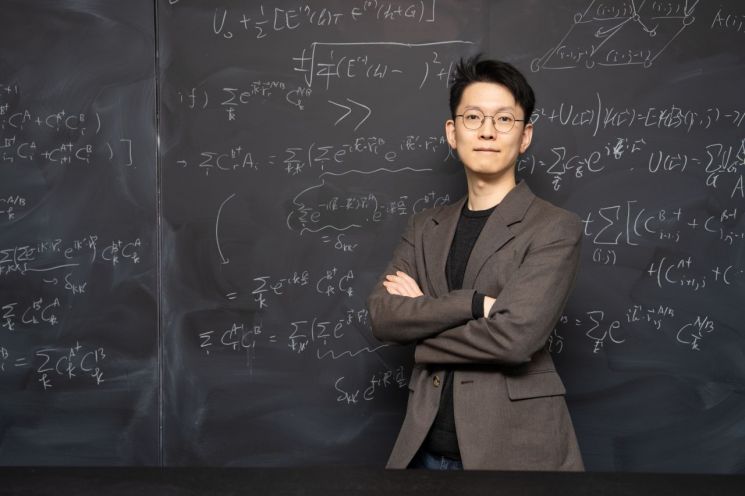
On the 22nd, UNIST announced that Professor Seokhyung Lee of the Department of Physics has established a new theory that treats the entire quantum mechanical dynamics occurring over time as a single, large "quantum state." This research has been published in the journal Physical Review Letters.
The main concept of the theoretical framework proposed by Professor Lee is "multipartite quantum states over time." This approach expresses all quantum processes occurring at multiple points in time as a single, large quantum state, enabling both spatially separated and temporally separated systems to be described within the same mathematical structure.
Professor Lee explained that he has described quantum "states" in space and quantum "processes" in time-previously written in different languages-using a single, unified mathematical language.
Physical Review Letters, where this research was published, is a highly influential journal in the field of physics. While publication in Nature or Science often makes the news, there is a saying that publication in PRL changes physics textbooks. In fact, according to the research statistics site Nature Index, more than a quarter (about 28.5%) of Nobel Prize-winning achievements in physics from 1995 to 2017 were based on papers published in this journal. As a single journal, it has the highest number of Nobel-winning achievements, far surpassing Nature (4.7%) and Science (5.6%).
This achievement is rooted in Professor Lee’s unique background, having double-majored in physics and mathematics as an undergraduate. His mathematical rigor particularly stood out in his approach to problem-solving. Rather than adding complex assumptions as in previous theories, he established only two physically natural and intuitive assumptions, and proved that the mathematical structure of temporal quantum states satisfying both conditions is uniquely determined. This means that the temporal quantum state presented by the research team is the only "correct answer" under the given physical conditions.
It was also proven that the newly established multipartite quantum states over time correspond one-to-one with the Kirkwood-Dirac quasi-probability distribution. As a result, phenomena involving temporal quantum states can now be directly observed using advanced measurement techniques such as quantum snapshots.
Professor Seokhyung Lee stated, "I hope this will become a new tool not only for quantum information science and quantum metrology, but also for the ultimate unified theory that integrates quantum mechanics and the theory of relativity, such as quantum gravity."
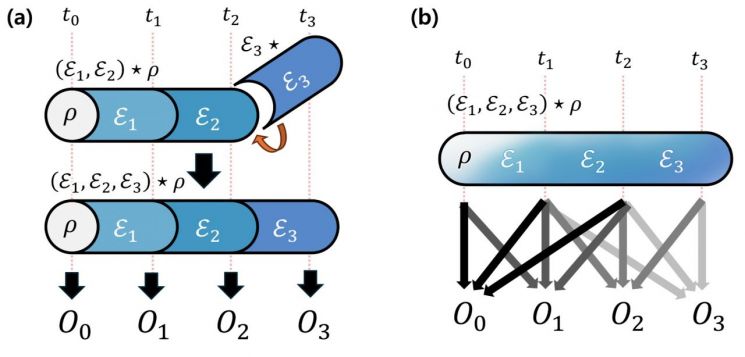
This research was conducted with James Fullwood, Professor of Mathematical Statistics at Hainan University in China, as the corresponding author. The work was supported by UNIST and the Institute for Information & Communications Technology Planning & Evaluation.
© The Asia Business Daily(www.asiae.co.kr). All rights reserved.
![Clutching a Stolen Dior Bag, Saying "I Hate Being Poor but Real"... The Grotesque Con of a "Human Knockoff" [Slate]](https://cwcontent.asiae.co.kr/asiaresize/183/2026021902243444107_1771435474.jpg)
















