Acquisition of GSK Plant in Rockville, Maryland
60,000L Capacity and 410 Billion KRW Scale; Additional Investments Planned
Hedging Risks from U.S. Biosecurity Law and Tariffs
Samsung Biologics has secured its first production base in the United States. This move is interpreted as a strategic decision to proactively diversify risks amid global trade and security policies that are restructuring the biopharmaceutical supply chain. As the United States intensifies its efforts to exclude China from the biotech sector and increases policy leverage to bring advanced manufacturing onshore, having a "production option in the U.S." has become a critical factor for global contract competitiveness.
First U.S. Production Facility Secured... 60,000L Capacity and 410 Billion KRW Scale
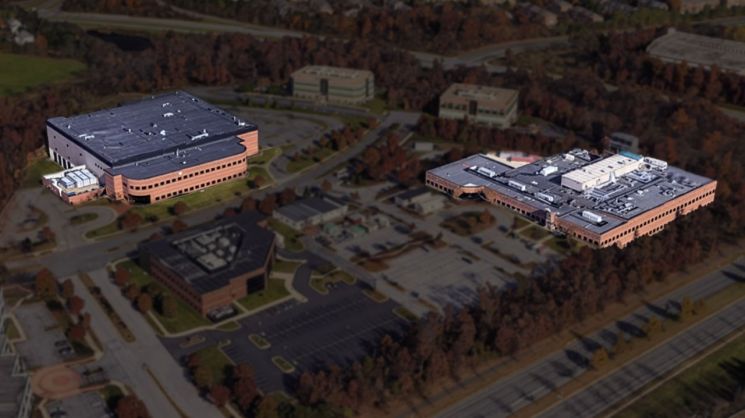 Aerial view of Humangenomics Science Biopharmaceutical Manufacturing Facility located in Rockville, Maryland, USA. Samsung Biologics
On December 22, Samsung Biologics announced that it had signed an agreement with GlaxoSmithKline (GSK) to acquire the "Human Genome Sciences (HGS)" biopharmaceutical manufacturing facility located in Rockville, Maryland, USA. The acquisition will be carried out by Samsung Biologics' U.S. subsidiary, "Samsung Biologics America," with a purchase price of $280 million (approximately 414.7 billion KRW). The asset acquisition process is expected to be completed within the first quarter of next year.
The Rockville facility is a drug substance (DS) manufacturing plant with a total capacity of 60,000 liters, located at the heart of the Maryland bio cluster. It consists of two manufacturing buildings and features infrastructure capable of supporting antibody drug production at various scales, from clinical to commercial stages. Through this acquisition, Samsung Biologics plans to take over existing production contracts, thereby securing a stable volume of large-scale contract manufacturing (CMO) orders. All 500 local employees with operational experience and expertise will be retained, ensuring operational stability. The company is also considering additional investments, such as expanding production capacity, based on mid- to long-term demand and facility utilization. The combination of proven facilities, skilled personnel, and the ability to maintain existing contracts made the Rockville site an optimal target for Samsung Biologics' first U.S. production facility.
With this acquisition, Samsung Biologics will establish a dual production system connecting Songdo, Korea, and Rockville, USA. While maintaining economies of scale through its large-scale production capabilities in Songdo, the company can now offer North American clients the option of U.S.-based manufacturing. This enhances the company's ability to respond to changes in regional supply environments and expand its collaboration base with North American clients, thereby strengthening its contract development and manufacturing (CDMO) competitiveness.
This move is expected to accelerate the company's "three-pronged expansion strategy" of global site expansion, portfolio diversification, and increased production capacity. On November 28, Samsung Biologics secured additional land in Zone 11 of Songdo International City, Incheon, and began developing its third bio campus. The third bio campus is a strategic base aimed at expanding the business portfolio beyond antibody drugs to next-generation modalities such as cell and gene therapies (CGT), antibody vaccines, and peptides. Through this initiative, Samsung Biologics plans to proactively respond to the diversification of pipelines among global pharmaceutical and biotech companies and gradually secure next-generation growth engines.
'Excluding China'-Proactive Response to Biosecurity Law and Tariffs
Samsung Biologics' decision comes immediately after the passage of the U.S. "Biosecurity Law." The U.S. Congress has been discussing the exclusion of "entities of concern" from the bio supply chain connected to federal procurement and support. Major Chinese CDMO and clinical trial outsourcing (CRO) companies, such as WuXi Biologics and WuXi AppTec, are expected to be included on this list. The law is effectively targeted at Chinese companies. The National Defense Authorization Act, which includes the biosecurity law, was passed by both chambers of Congress this month and received final approval from President Trump on December 18, giving it legal force.
When biopharmaceuticals are manufactured by CDMO companies, sensitive data such as cell lines, gene sequences, process conditions, and analytical methods-the "recipes" for products-are transferred externally. The U.S. Congress and administration have identified the potential mass transfer of such sensitive data and intellectual property (IP) as a concern, specifically pointing to Chinese companies. As Chinese CDMO companies are excluded, demand for Korean CDMO companies like Samsung Biologics is expected to rise further.
The tariff policies of the Trump administration remain a risk factor, further highlighting the need for a U.S. production facility. If tariffs are imposed on pharmaceuticals, the unique nature of these products-where supply disruptions can immediately become social and political issues-means that clients have a strong incentive to shift production options to the U.S. to mitigate regulatory, tariff, and procurement risks. As a result, global pharmaceutical companies are now considering not only quality, cost, and delivery, but also geopolitical risks when selecting production partners.
John Rim, CEO of Samsung Biologics, stated, "This acquisition is a strategic decision by the company to advance the global healthcare industry and strengthen manufacturing capabilities in the United States. Based on collaboration with various stakeholders, including federal, state, and local governments, we will enhance customer support and the stability of biopharmaceutical supply, and continuously improve the competitiveness of the Rockville facility through cooperation with experienced local personnel." Regis Simard, President of Global Supply Chain at GSK, commented, "With Samsung Biologics acquiring the Rockville facility, we can ensure stable U.S.-based production of key medicines for American patients. GSK will also be able to further strengthen the stability and responsiveness of its global supply chain operations."
Meanwhile, on the same day, Samsung Biologics announced three contract manufacturing agreements with a European pharmaceutical company totaling 1.22 trillion KRW. The client and product names have not been disclosed, and the contract period runs until the end of 2030.
© The Asia Business Daily(www.asiae.co.kr). All rights reserved.
![Clutching a Stolen Dior Bag, Saying "I Hate Being Poor but Real"... The Grotesque Con of a "Human Knockoff" [Slate]](https://cwcontent.asiae.co.kr/asiaresize/183/2026021902243444107_1771435474.jpg)
















