WSJ Podcast Interview
Beth Hammack, President of the Federal Reserve Bank of Cleveland, stated that, for now, the basic scenario is for the Federal Reserve (Fed) to pause interest rate cuts and assess the effects of its policies.
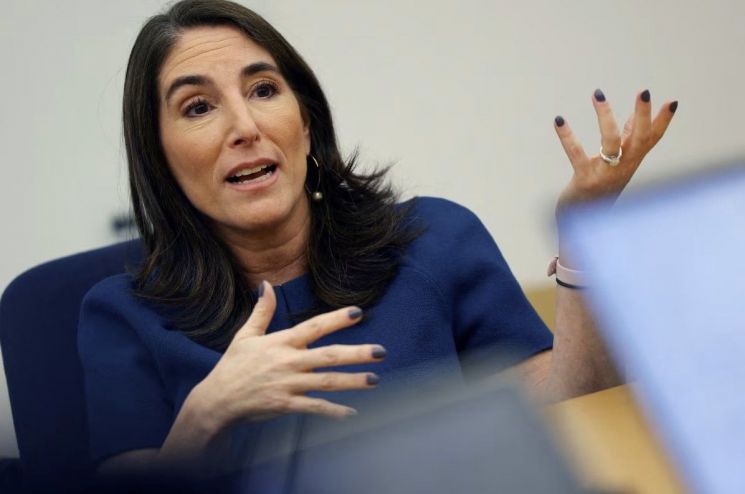
In an interview released on December 21 (local time) on the Wall Street Journal (WSJ) podcast "Take on the Week," President Hammack said, "My baseline scenario is that the current situation could be maintained for a period of time until there is clear evidence that inflation is returning to target or that the employment situation is weakening further."
She explained that, after three consecutive interest rate cuts of 0.25 percentage points each in September, October, and December 10-totaling a 0.75 percentage point reduction-it is now an appropriate time to pause and evaluate how these changes are affecting the broader economy.
President Hammack said, "Lowering the policy rate by 0.75 percentage points will help support our mandate to bolster the labor market," but emphasized, "I am very focused on bringing inflation back to our target of 2%. This is one of our main objectives and a task that must be accomplished."
Regarding the slowdown in last month's Consumer Price Index (CPI) growth, she cautioned against placing too much emphasis on a single indicator. The core CPI, which excludes the more volatile food and energy components and reflects the underlying trend in prices, rose 2.6% year-on-year in November, marking the lowest level since 2021.
President Hammack said, "That is just one number, and I would like to take more time," adding, "Since there is ample time before the next meeting, we will be able to examine the broader situation."
She also expressed concerns about the possibility of inflation rebounding, noting that inflation has stagnated at around 3% over the past year and a half, and that input costs for companies continue to rise.
Starting next year, President Hammack will have voting rights on interest rate decisions at the Federal Open Market Committee (FOMC) regular meetings. As she is classified as a "hawk" (favoring monetary tightening), her active participation in rate decisions from next year could have a tangible impact on debates within the Fed over the appropriate policy rate and the future path of interest rates.
© The Asia Business Daily(www.asiae.co.kr). All rights reserved.
![Clutching a Stolen Dior Bag, Saying "I Hate Being Poor but Real"... The Grotesque Con of a "Human Knockoff" [Slate]](https://cwcontent.asiae.co.kr/asiaresize/183/2026021902243444107_1771435474.jpg)
















