63.9% of Budget Focused on Welfare: 697.6 Billion Won Allocated
11 Billion Won Invested in Economy and Jobs
On December 21, the Gwanak District Office in Seoul (Mayor Park Junhee) announced that it had finalized the 2026 main budget at 1.0922 trillion won after approval by the district council on the 18th. This is an increase of 37.2 billion won (3.5%) compared to this year. The budget consists of a general account of 1.0799 trillion won and a special account of 10.3 billion won. The district has maintained its "1 trillion won main budget era" for three consecutive years.
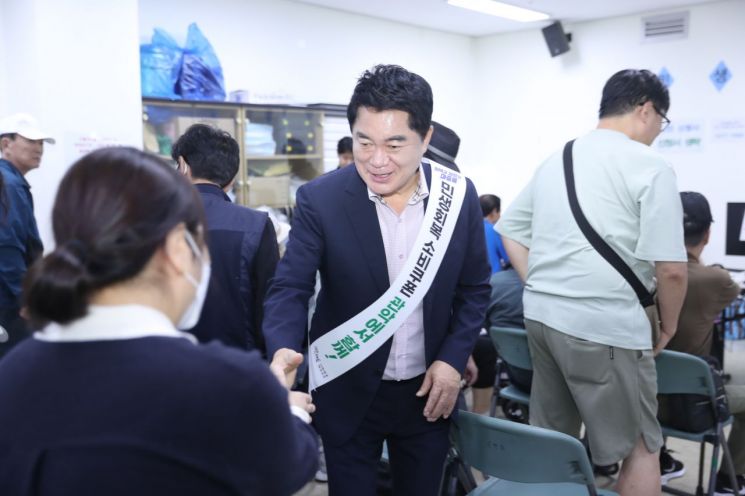 Gwanak District finalized the 2026 main budget of 1.0922 trillion won on the 18th. Park Junhee, Mayor of Gwanak District, visited the Euncheon-dong Community Center to assist with the smooth reception of the livelihood recovery consumption coupons. Provided by Gwanak District.
Despite an uncertain revenue outlook, the district blocked wasteful spending through zero-based expenditure restructuring and prioritized the allocation of resources to projects directly impacting residents' quality of life using a "selection and concentration" strategy.
A total of 11 billion won will be invested in the economy and jobs sector. The Gwanak Small and Venture Business Promotion Agency, launched in July, has been allocated 1.8 billion won to strengthen support for ventures and startups. Public job creation initiatives, including the Companion Job Program (2.76 billion won), and the issuance of Gwanak Love Gift Certificates and public delivery app-exclusive gift certificates (1.87 billion won), are designed to ease the management burden on small business owners and revitalize local commercial districts.
The welfare budget has been set at an unprecedented 697.6 billion won, accounting for 63.9% of the total budget. In line with the "Integrated Care Support Act" to be implemented in 2026, 300 million won will be invested in seven new projects, including community-based integrated care work (130 million won), home medical care, and smart home pharmacy services (80 million won). New initiatives include a social welfare field worker recognition allowance (250 million won) and a pilot project for the individual budget system for people with disabilities (140 million won). The district will also focus on strengthening the social safety net through projects such as the construction of a district-run comprehensive welfare center for seniors (1.6 billion won), basic pension (219.2 billion won), and livelihood and housing benefits (178.4 billion won).
The health sector will receive 27.5 billion won. The district will promote the establishment of a Health Longevity Center (80 million won) and the expansion of Dementia Safe Villages (90 million won) to all neighborhoods. The Agricultural Food Voucher program (1.25 billion won) will be expanded to include vulnerable youth, addressing gaps in the welfare system.
A total of 32.2 billion won has been allocated to transportation and regional development projects closely related to residents' daily lives. These include road and road facility management (3.12 billion won), sewage facility management (1.79 billion won), flood and disaster prevention (1.03 billion won), and the creation and maintenance of urban parks (3.84 billion won) to improve the urban environment. Disaster prevention funding has also been strengthened, including the creation of a disaster management fund (1.23 billion won), the establishment and operation of a safety management system for aging and hazardous facilities (280 million won), and the establishment of a safety and health management system and prevention of serious accidents (60 million won).
By securing national funding, the district will also steadily implement projects responding to future societal changes, such as laying the groundwork for a youth-friendly city (500 million won) and providing artificial intelligence (AI) competency training for residents (30 million won).
During the budget review process, funding for some projects, such as local newspaper subscription fees and compensation improvements for village bus drivers, was reduced, while 32 field-oriented projects, including the operation of the Facility Management Corporation and Seoul Companion Job Program, received increased allocations.
Mayor Park Junhee stated, "In the face of difficult economic conditions both at home and abroad, we prioritized protecting the daily lives of our residents in this budget," adding, "We will mobilize all administrative resources to ensure the timely and swift execution of the finalized budget so that residents can experience real changes in their lives."
© The Asia Business Daily(www.asiae.co.kr). All rights reserved.
![Clutching a Stolen Dior Bag, Saying "I Hate Being Poor but Real"... The Grotesque Con of a "Human Knockoff" [Slate]](https://cwcontent.asiae.co.kr/asiaresize/183/2026021902243444107_1771435474.jpg)
















