Permanent Residency Granted for $1 Million Payment
Over 1,300 Applicants Estimated
ESTA Screening Requirements Significantly Tightened
The administration of U.S. President Donald Trump announced on December 19 (local time) that the so-called "Trump Gold Card," an immigration program targeting high-net-worth individuals, recorded sales of $1.3 billion (approximately 1.91 trillion won) just ten days after its launch. Based on the total sales amount, it is estimated that more than 1,300 people have utilized the program.
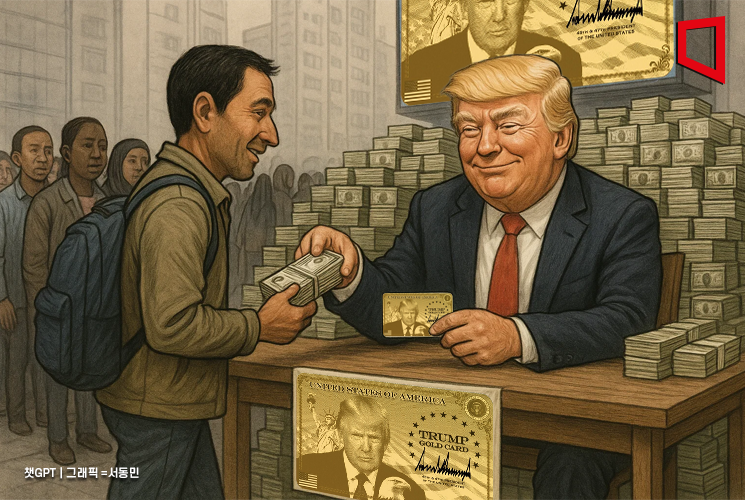
The Trump Gold Card is a system that grants permanent residency or long-term stay status to individuals who pay $1 million (about 1.47 billion won) to the U.S. government. Applications began on December 10. In the related announcement, President Trump stated, "Companies can now purchase the card to attract and settle talent in the United States," adding, "All funds raised through this program will be used exclusively to reduce the national debt."
President Trump explained that the recent rise in the U.S. unemployment rate to 4.6%, the highest level since 2021, is due to the reduction of unnecessary federal government personnel. He asserted, "All new jobs created in recent months have been in the private sector," and argued, "If we increased useless public sector jobs, we could bring the unemployment rate down to nearly 0%, but that is not a sustainable solution."
The Trump administration also significantly tightened the screening requirements for the Visa Waiver Electronic System for Travel Authorization (ESTA). ESTA allows citizens of 42 countries, including South Korea, to stay in the United States for up to 90 days without a visa.
The U.S. Customs and Border Protection (CBP) announced in the official gazette that applicants for ESTA are now required to submit information on their social network service (SNS) accounts from the past five years. If necessary, applicants may also be required to provide phone numbers from the past five years, email addresses from the past ten years, and the names and contact information of family members. The collection of biometric information such as fingerprints, iris scans, and DNA is also permitted. The application process will be unified to a mobile application instead of the existing website, and in addition to a passport photo, applicants will be required to submit a self-taken photograph.
U.S. media outlets are predicting that these measures could increase the time required for ESTA approval and that a significant number of applicants may be subject to more rigorous screening. The Trump administration has already expanded online activity verification in the screening processes for professional (H-1B) and student visas.
© The Asia Business Daily(www.asiae.co.kr). All rights reserved.
![Clutching a Stolen Dior Bag, Saying "I Hate Being Poor but Real"... The Grotesque Con of a "Human Knockoff" [Slate]](https://cwcontent.asiae.co.kr/asiaresize/183/2026021902243444107_1771435474.jpg)
















