Agreement Reached to Cut 70 Workers on Ioniq 5 and Kona EV Production Line
Hourly Output Reduced to 17.5 Units
Sluggish Sales and Subsidy Exhaustion Take Toll
Increased Local Production at HMGMA in the US
Shift Toward Hybrid-Focused St
Hyundai Motor Company, which had previously reduced overtime shifts on its electric vehicle production line at the Ulsan Plant, has ultimately decided to cut the number of workers on its daytime production shifts as well. Despite multiple suspensions of operations this year, the situation has shown little improvement, prompting the company to make the bold move of workforce restructuring. Following recent decisions by global automakers such as Ford in the United States to halt electric vehicle production, and the European Union’s withdrawal of its plan to ban internal combustion engine vehicle sales, negative developments in the electric vehicle sector are now directly impacting domestic production.
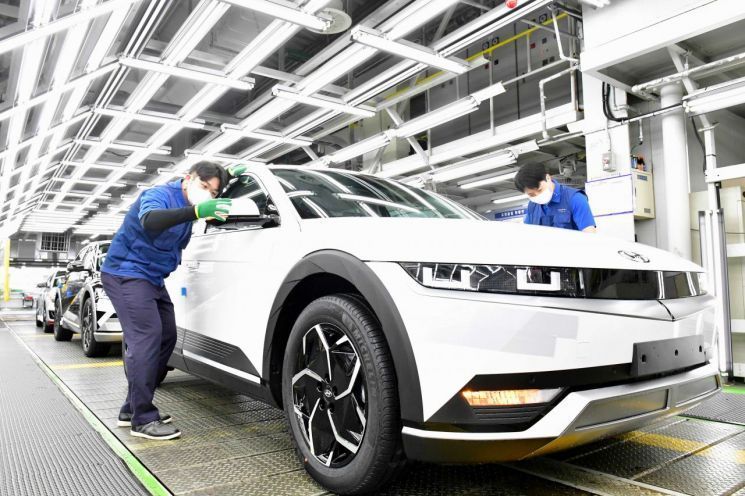
According to industry sources on December 22, Hyundai Motor Company’s management and labor union recently agreed to cut 70 workers per shift from the assembly section (parts assembly process) of Line 12 at Ulsan Plant 1, where the Ioniq 5 and Kona Electric are produced. This reduction accounts for more than 20% of the 327 production workers on that line. The workers affected by the reduction will be reassigned to other production lines based on workforce demand analysis.
In addition, the management and union agreed to reduce the line’s units per hour (UPH) from 27.5 to 17.5. A Hyundai Motor Company representative explained, “Starting today, we are temporarily implementing a ‘pitch-down’ to lower the UPH without changing the number of workers, and once the reassignment is finalized this week, the workforce reduction will take effect from next year.”
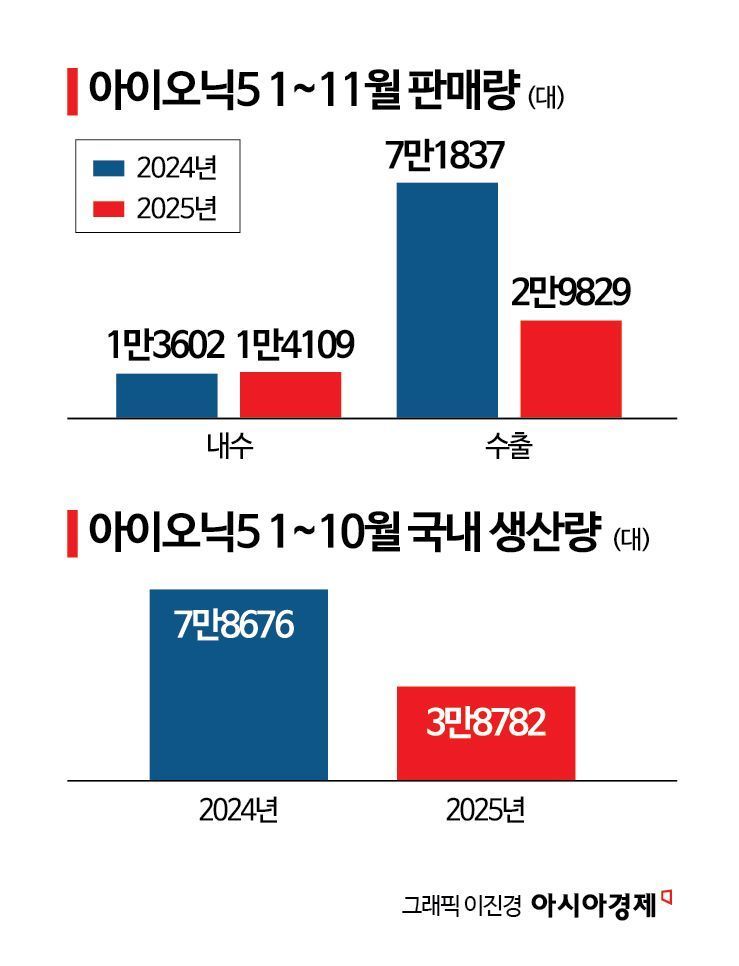
The primary reason for Hyundai Motor Company’s significant reduction in electric vehicle production capacity is sluggish electric vehicle sales. For the Ioniq 5, domestic sales last year reached 13,602 units, with 71,837 units exported. This year, domestic sales slightly increased to 14,109 units, but exports plummeted to 29,829 units as of last month, a sharp drop of over 40,000 units.
In particular, increased local production in the United States, a key market, due to tariffs has negatively impacted exports. At Hyundai Motor Group Meta Plant America (HMGMA) in Georgia, USA, which began full-scale operations this year, cumulative production of the Ioniq 5 reached 39,467 units by the third quarter, surpassing the output of the Ulsan Plant. The Ulsan Plant produced 33,967 Ioniq 5 units in the first to third quarters of this year, just half the 70,943 units produced during the same period last year.
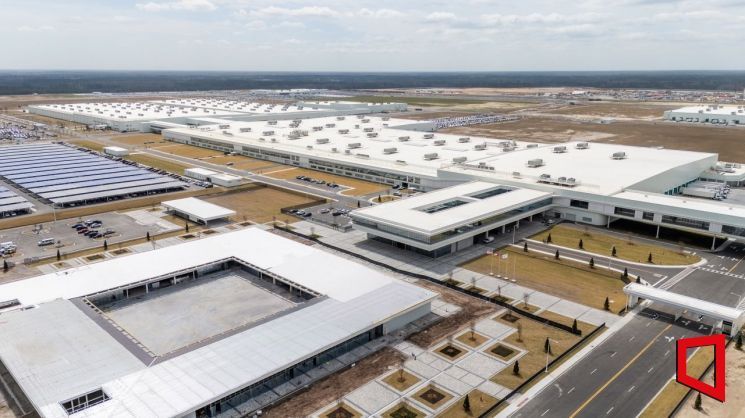 Exterior view of Hyundai Motor Group Meta Plant America (HMGMA) located in Georgia, USA. Hyundai Motor Group
The downturn in the electric vehicle market is already manifesting rapidly overseas. In September, the United States eliminated electric vehicle purchase subsidies, and the European Union has withdrawn its plan to ban sales of internal combustion engine vehicles starting in 2035, effectively slowing the pace of electrification.
Automakers, which had previously ramped up investment in electric vehicles, are now responding with restructuring measures or by delaying the launch of new electric vehicle models. General Motors (GM) recently laid off 1,200 workers at its electric vehicle plant, and Nissan of Japan is postponing the start of its electric vehicle production. Ford is shifting its business focus to hybrid and internal combustion engine models. Ford announced plans to scale back its electric vehicle business and pivot its electrification strategy toward hybrids (HEVs) and extended-range electric vehicles (EREVs). The company also plans to convert its all-electric F-150 Lightning pickup truck into an EREV model instead of a pure electric vehicle.
In response to shrinking electric vehicle demand, Hyundai Motor Company and Kia are increasing the number of hybrid models among their popular vehicle lines. Hyundai Motor Company has begun selling the Palisade Hybrid in the United States, and Kia is set to launch the Telluride Hybrid in the first quarter of next year. The newly released Seltos also features a hybrid model for the first time.
An industry insider commented, “In most markets around the world, except for China, the pace of electrification is falling short of expectations due to pricing and various other factors. As a result, automakers have no choice but to diversify their portfolios by appropriately mixing hybrid and internal combustion engine models to adapt to changing demand.”
© The Asia Business Daily(www.asiae.co.kr). All rights reserved.
![Clutching a Stolen Dior Bag, Saying "I Hate Being Poor but Real"... The Grotesque Con of a "Human Knockoff" [Slate]](https://cwcontent.asiae.co.kr/asiaresize/183/2026021902243444107_1771435474.jpg)

















