"Attempted Engagement with China... Unsuccessful"
China: "No Need to Revisit the Consensus"
The head of Taiwan's negotiation body with China revealed that he had proposed to clarify the "1992 Consensus" to the Chinese side, but his proposal was rejected. The "1992 Consensus" refers to an agreement reached in 1992 in which both sides recognized "One China" while agreeing to use their respective names.
On December 19, Taiwanese media outlets such as China Times and Liberty Times reported that Wu Fengshan, Chairman of the Straits Exchange Foundation (SEF), stated at a board meeting the previous day that he had attempted to engage with China during his tenure as he announced his intention to resign.
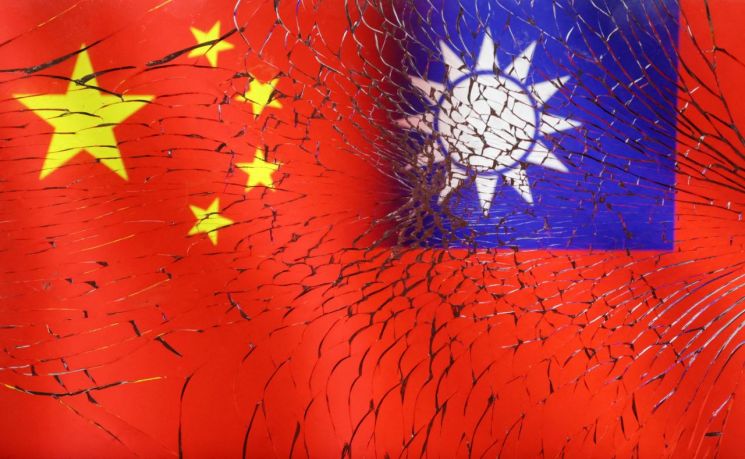 Chinese flag and Taiwanese flag. Photo for article understanding, unrelated to content. Photo by Reuters and Yonhap News.
Chairman Wu said that after taking office in November of last year, even as cross-strait tensions escalated, he requested a meeting with Zhang Zhijun, Chairman of the Association for Relations Across the Taiwan Straits (ARATS), China's cross-strait negotiation body.
In particular, he said he had proposed to resolve the controversy surrounding the "1992 Consensus," but the attempt was unsuccessful. After several exchanges, the mainland Chinese side responded that "we should seek common ground while shelving differences and set aside disputes."
He continued that, through unofficial channels, he again proposed to Chairman Zhang Zhijun of ARATS to clarify the issues related to the "1992 Consensus." Wu stated, "I insisted only on equality and dignity between the two sides, leaving the timing, location, and whether the meeting would be public entirely up to the other party." However, the response he received was, "We understand your concerns, but there is no need to revisit the 1992 Consensus." He added, "Through another channel, I received the message, 'If you do not want the 1992 Consensus, then propose a new agreement.' I made efforts in various ways regarding this, but the outcome was similar."
The core of the "1992 Consensus" is to acknowledge "One China" but allow each side to use its own interpretation and terminology (yi zhong ge biao). China emphasizes "One China" and uses the 1992 Consensus as the basis for its claim that Taiwan is part of China. However, Taiwan places more weight on the "respective interpretations" aspect. In particular, the ruling Democratic Progressive Party, which favors independence, regards the 1992 Consensus as denying Taiwan's sovereignty and maintains that it cannot accept it.
ARATS and SEF were both established in 1991 by China and Taiwan, respectively, to promote cross-strait exchanges. Legally, they are private organizations, but in practice, they are semi-official bodies under government control. The "1992 Agreement," which forms the foundation of cross-strait exchanges, was also reached through unofficial talks between ARATS and SEF, not through government authorities. However, since the inauguration of former President Tsai Ing-wen of the Democratic Progressive Party in May 2016, regular communication such as the "hotline" between ARATS and SEF has been cut off, and exchanges have been suspended.
© The Asia Business Daily(www.asiae.co.kr). All rights reserved.

















