Tariff Refund Concerns Grow Among Korean Exporters
Need to Review Liquidation Schedules for Each Import Declaration
Difficult to Predict Court Ruling and Refund Eligibility
With the U.S. Supreme Court set to rule on the constitutionality of tariffs imposed under the International Emergency Economic Powers Act (IEEPA), domestic export companies are increasingly focusing on strategies to secure tariff refunds. Experts have emphasized the importance of advance preparation, noting that refund strategies may vary depending on the timing of the ruling and the tariff liquidation schedule.
The Korea International Trade Association held the "US IEEPA Tariff Litigation Outlook and Tariff Refund Response Strategy Briefing" on the 19th at COEX in Samseong-dong, Seoul.
This briefing was organized to address concerns among domestic export companies regarding tariff refunds ahead of the U.S. Supreme Court’s final ruling on the constitutionality of the IEEPA, which is expected in early next year, and to provide practical response strategies. Around 200 representatives from export companies attended the event.
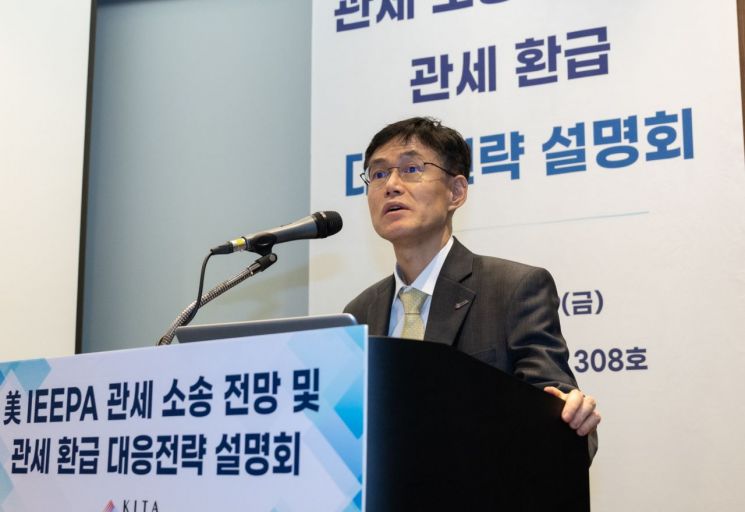 Jang Sangsik, President of the Korea International Trade Association's Institute for International Trade and Commerce, is delivering the opening remarks at the "US IEEPA Tariff Litigation Outlook and Tariff Refund Response Strategy Seminar" held on the 19th at COEX, Samseong-dong, Gangnam-gu, Seoul. Korea International Trade Association.
Yoon Youngwon, an attorney at Shin & Kim LLC who delivered the first presentation, stressed that "the approach to tariff refunds varies depending on the timing of 'liquidation.'" He explained, "Before liquidation, refunds can be obtained simply by amending the import declaration, but after the duty amount is finalized at liquidation, a formal 'protest' must be filed with U.S. Customs and Border Protection (CBP) within 180 days of the liquidation date to secure a refund."
Yoon further advised, "If the Supreme Court rules the tariffs unconstitutional and refunds proceed, liquidation of tariffs imposed on Korean products since April 5 of this year will begin sequentially around February 13 next year. Since the ruling may be issued close to the liquidation dates, it is important to check the liquidation schedule for each import declaration in advance and systematically manage supporting documents such as customs declarations and payment records."
John Leonard, advisor at Kim & Chang and former Deputy Assistant Commissioner of Trade at the U.S. CBP, highlighted several practical considerations. He noted, "In principle, the party eligible to apply for a tariff refund is the U.S. importer," and pointed out that "Korean companies must clearly confirm in their contracts who bears the tariff burden and who is entitled to the refund." He added, "Recently, there has been an increase in DDP (Delivered Duty Paid) transactions, which shift the tariff burden to the exporter. In such cases, the exporter may be able to apply for the refund directly, so prior verification is necessary."
Jang Sangsik, President of the Korea International Trade Association's Institute for International Trade and Commerce, stated, "At this point, it is difficult to predict the court's decision and the likelihood of tariff refunds," and advised, "Rather than excessive expectations or concerns, it is important to thoroughly understand the refund procedures and conduct practical reviews and preparations tailored to each company’s circumstances."
© The Asia Business Daily(www.asiae.co.kr). All rights reserved.
![Clutching a Stolen Dior Bag, Saying "I Hate Being Poor but Real"... The Grotesque Con of a "Human Knockoff" [Slate]](https://cwcontent.asiae.co.kr/asiaresize/183/2026021902243444107_1771435474.jpg)















