CIO Assigns Case to 4th Investigation Division
Special Prosecutors Themselves Not Subject to Investigation Under CIO Act
Investigation Possible if Dispatched Prosecutor’s Accomplice
The Corruption Investigation Office for High-ranking Officials (CIO) launched an investigation on December 19 into a complaint related to the alleged biased investigation by Special Prosecutor Min Junggi’s team regarding the Unification Church bribery case.
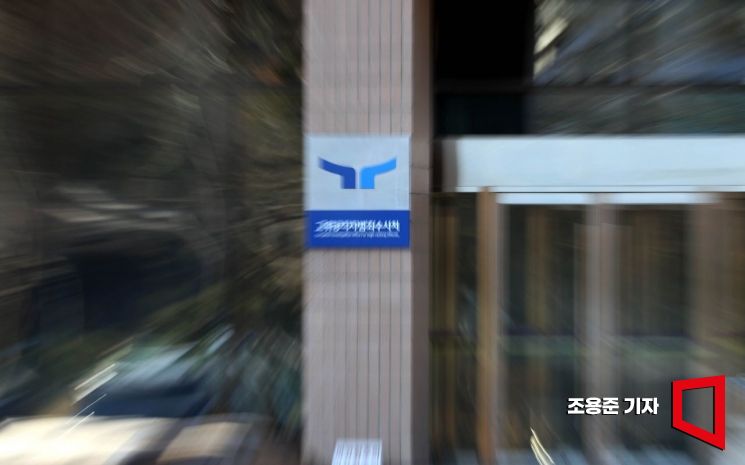 On the 10th, the Public Officials Corruption Investigation Office, which reissued an arrest warrant for President Yoon Suk-yeol, is continuing to deliberate on the timing of re-execution, as seen at the Government Complex Gwacheon in Gyeonggi Province.
In a press release on the same day, the CIO announced, “We have assigned the case, which involves allegations of dereliction of duty against Special Prosecutor Min and others, to the 4th Investigation Division (headed by Chief Prosecutor Cha Jeonghyeon),” adding, “This decision follows an internal legal review on whether a prosecutor dispatched to a special prosecutor’s office, which is an independent body, can be considered a subject of investigation under the CIO Act.”
On December 17, the National Police Agency’s special investigation team transferred the case to the CIO. The case concerns allegations that the special prosecutor’s team conducted a ‘biased investigation’ by focusing only on politicians from the People Power Party, despite having received statements that politicians from the Democratic Party of Korea had also accepted money from the Unification Church. Under the CIO Act, prosecutors dispatched to the special prosecutor’s office are subject to investigation by the CIO.
After reviewing its internal regulations, the CIO stated on the same day, “Even if a prosecutor is dispatched to a special prosecutor’s office under the Prosecutors’ Office Act, they retain their status as prosecutors and continue to carry out investigation, indictment, and prosecution work. Therefore, dispatched prosecutors are considered subjects of investigation.”
The CIO determined that special prosecutors and assistant special prosecutors are not included among the subjects of investigation explicitly specified in the CIO Act, and, based on legal precedent, special prosecutors are seen as having a status distinct from regular prosecutors. However, the CIO concluded that it is possible to investigate special prosecutors as accomplices in cases such as dereliction of duty by dispatched prosecutors.
This means that while Special Prosecutor Min cannot be directly considered a subject of investigation, if evidence of abuse of authority or similar offenses emerges, he could be investigated as an accomplice. According to the CIO Act, crimes committed by persons in joint principal offender relationships with high-ranking officials can be investigated as ‘related crimes.’
© The Asia Business Daily(www.asiae.co.kr). All rights reserved.
![Clutching a Stolen Dior Bag, Saying "I Hate Being Poor but Real"... The Grotesque Con of a "Human Knockoff" [Slate]](https://cwcontent.asiae.co.kr/asiaresize/183/2026021902243444107_1771435474.jpg)















