The Financial Services Commission is set to reform its system to foster securities firms as specialized financial institutions for venture capital, and to enhance access to capital markets for unlisted and small- to medium-sized enterprises. The Commission also plans to strengthen regulations to eradicate unfair trading practices and to enhance shareholder value.
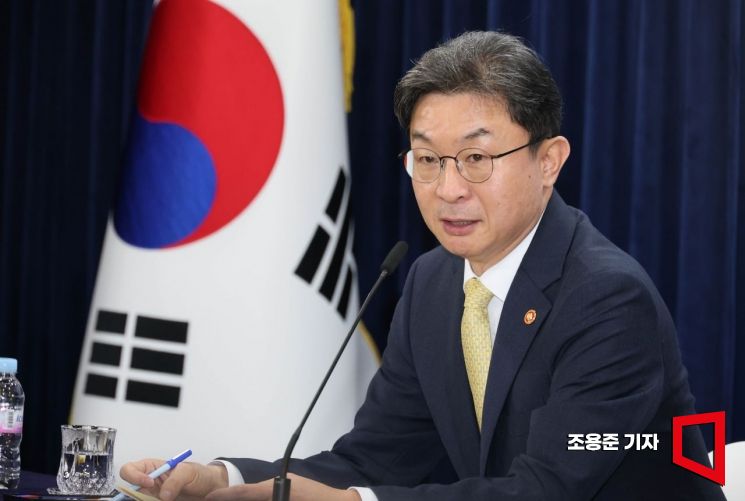 Lee Eokwon, Chairman of the Financial Services Commission, is speaking about recent issues at a press conference with reporters at the Government Seoul Office in Jongno-gu, Seoul on November 12, 2025. Photo by Jo Yongjun
On December 19, the Financial Services Commission announced during a presidential work report themed "A Grand Financial Transformation, Establishment of a Fair Economy, and a Solid Foundation for Economic Leap Forward" that it will pursue new licenses for comprehensive investment business operators to strengthen the investment banking functions of major securities firms, and will monitor the fulfillment of their venture capital supply obligations.
Accordingly, the Commission projects that approximately 26.7 trillion won in additional venture capital will be supplied by the end of 2028. For small- and medium-sized securities firms, incentives for those specializing in small- and medium-sized enterprises will be improved to strengthen their capacity to support small and venture businesses.
To improve the investment practices focused on short-term profits, the Commission will accelerate the development of funds that make long-term investments in corporate growth. It will also promote the early establishment of Business Development Companies (BDCs). In addition, by the first half of next year, the Commission plans to promote productive investment by asset management companies through improvements to the private equity fund (PEF) system.
For the KOSDAQ market, the Commission aims to pursue both the restoration of trust and innovation. It plans to enhance the independence and autonomy of the KOSDAQ division, redesign listing and delisting criteria, and transition to a more dynamic market structure. The participation conditions for pension funds and collective investment vehicles will be improved. At the same time, the objectivity of public offering price assessments will be strengthened to enhance investor protection.
The Commission will also support unlisted and small- to medium-sized enterprises in raising funds smoothly in the capital market. It is preparing for the institutionalization of security token offerings (STOs) through detailed system designs, such as establishing blockchain-based securities infrastructure and investor protection measures. The aim is to establish STOs as a new funding channel for early-stage venture and innovative companies. In addition, the scope of small public offerings will be expanded, a venture capital brokerage platform will be established, and entry into the electronic registration system for unlisted shares will be permitted, thereby lowering the barriers to capital market entry for unlisted and small- to medium-sized enterprises.
Policies to increase the attractiveness of the domestic stock market will also be pursued in parallel. The Commission is considering tax benefits for funds that invest in corporate growth, aiming to encourage both investment and reinvestment. A "Korea Premium Week" will be newly established to regularly promote capital market policies. In addition, the obligation for English-language disclosures will be expanded to include KOSPI-listed companies with assets of 2 trillion won or more. In the second half of next year, the Commission will also improve the listing and delisting requirements for the domestic exchange-traded fund (ETF) market.
Efforts to establish market order will include stronger measures against unfair trading. The Commission will enhance preventive mechanisms against unfair trading by insiders such as executives, and will consider institutionalizing a joint response system among relevant agencies to eradicate stock price manipulation. Improvements will also be made to enhance the fairness and transparency of sanction procedures.
To establish a capital market order where investors can fairly and transparently benefit from their investments, the Commission will work to eradicate unfair trading and strengthen shareholder protection. First, to entrench a "one-strike-out" principle for stock price manipulation, the Commission will improve systems for prevention, monitoring, and sanctions.
To preemptively block unfair trading by insiders such as executives of listed companies, the Commission will mandate the return of short-swing profits. Even if not directly related to their work, executives with serious criminal records such as fraud, breach of trust, or embezzlement will be required to disclose such records. Fines for disclosure violations will be adjusted to enhance the effectiveness of sanctions.
For serious unfair trading cases, the Commission will consider extending and institutionalizing the "Joint Task Force for Eradicating Stock Price Manipulation," which is currently operated by relevant agencies. The plan is to speed up responses to market-disrupting activities through swift investigations and sanctions.
Improvements to the fairness and transparency of sanction procedures will also be pursued in parallel. The Commission will refine forensic procedures, reporting and notification standards, and criteria for imposing fines in unfair trading cases, and will expand the reward system. Regarding accounting fraud, the Commission will rationally supplement the rights of the parties subject to sanctions, such as guaranteeing the "right to know" about planned sanctions and the "right to dispute" differences in accounting standard interpretations.
Improvements to systems for enhancing shareholder value will also be promoted. The Commission will support the principle of retiring treasury shares and strengthen related disclosures. It also plans to improve the fairness of merger price assessments. In addition, the Commission will strengthen shareholder protection principles, for example, by allocating new shares to parent company shareholders in the case of spin-off listings. Disclosure of voting results at general meetings of shareholders and executive compensation will also be expanded to improve investor access to information.
Furthermore, through the revision of the Stewardship Code, the Commission will promote a culture of responsible investment among institutional investors. The scope of application will be expanded from listed stocks to include bonds and alternative investments. Considerations will also be broadened from a focus on governance (G) to the overall scope of environment, social, and governance (ESG). The targets for implementation checks will also be gradually expanded from asset management companies to include pension funds and private equity funds.
The Financial Services Commission is also considering the enactment of a "Basic Act on Accounting" to establish consistent principles across accounting and disclosure for greater transparency throughout society. The plan is to legislate standards and procedures for the preparation of financial statements, external audits, disclosures, and supervision that apply uniformly regardless of organizational type or relationship.
© The Asia Business Daily(www.asiae.co.kr). All rights reserved.
![Clutching a Stolen Dior Bag, Saying "I Hate Being Poor but Real"... The Grotesque Con of a "Human Knockoff" [Slate]](https://cwcontent.asiae.co.kr/asiaresize/183/2026021902243444107_1771435474.jpg)

















