Sharp Drop in Accommodation Prices at Major Japanese Tourist Destinations Including Kyoto
Impact of Prime Minister's Remarks on "Intervention in the Event of a Taiwan Contingency"
Suspension of China Routes... "Difficult to Recover in the Short Term"
Accommodation prices at major tourist destinations in Japan, which had risen due to an influx of foreign tourists, are now showing a downward trend. In Kyoto, one of Japan's most popular tourist destinations, the average nightly rate was around 200,000 won a year ago, but recently, some hotels have lowered their rates to as little as 20,000 won per night.

On December 19 (local time), TBS News in Japan reported, "Accommodation prices at popular Japanese tourist destinations, which had soared due to foreign demand, have recently dropped significantly."
According to the report, as of December 18, many hotels in central Kyoto listed nightly rates under 10,000 yen (95,000 won) on Google Maps, with some dropping as low as the 3,000-yen range (28,000 won).
The average room rate at major hotels in Kyoto temporarily declined during the COVID-19 pandemic, but reached a record high of 20,195 yen (190,000 won) last year. Even in December last year, the average remained at 20,601 yen (195,000 won). Compared to these figures, current accommodation prices have dropped to less than half.
A tourist visiting from Tokyo said, "I paid just over 10,000 yen for two nights," adding, "Now, it's a price where you can stay without much burden."
Aviation and travel analyst Takaro Doriiumi commented, "Not only Kyoto, but accommodation prices are falling mainly in urban areas," and analyzed, "This is affecting regions such as Osaka, Nagoya, Hiroshima, Fukuoka, and Kanazawa, where there is a high proportion of Chinese tourists or direct flights from China."
This price trend is expected to continue for the time being. Doriiumi stated, "It is highly likely that this situation will persist until next spring," and explained, "Chinese airlines have decided to suspend many routes, and since they are unlikely to resume at least until the end of March, a quick recovery is difficult."
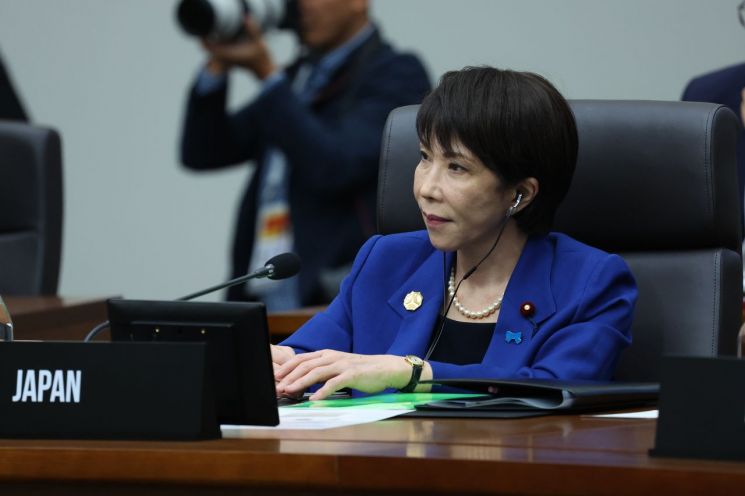 Japanese Prime Minister Sanae Takaichi is listening to President Jae-myung Lee's remarks at the first session of the 2025 Asia-Pacific Economic Cooperation (APEC) Summit held at the Gyeongju HICO Convention Center on October 31. Photo by Yonhap News
After Takaichi's Remarks on 'Intervention in the Event of a Taiwan Contingency'... Noticeable Drop in Chinese Group Tourists
According to Kamakura City in Kanagawa Prefecture, near Tokyo, which attracted more than 15 million tourists last year, Chinese tourists accounted for the largest share of foreign visitors to tourist information centers last year. However, after Japanese Prime Minister Sanae Takaichi made remarks about 'intervening in the event of a Taiwan contingency,' the Chinese authorities urged their citizens to refrain from traveling to Japan, leading to a decrease in Chinese visitors.
An employee at a famous ice cream shop known for its premium matcha soft serve said that about 70% of the foreign tourists visiting the store used to be Chinese, but recently, there has been a noticeable increase in tourists from other Asian countries such as Taiwan and Indonesia. The employee said, "About a week after China told its citizens not to come to Japan, the number of visitors dropped significantly."

Chinese New Year in February Next Year... "Prolonged Situation Could Have Greater Impact"
Japan's tourism industry is closely monitoring the situation ahead of the Chinese New Year, the country's biggest holiday, in February next year. An employee at a soap shop in Kamakura said, "Chinese tourists kept coming, but recently there have been days when not a single one visited," adding, "Since Chinese customers accounted for a large portion of our sales, the drop in revenue is significant." The employee continued, "We are preparing Chinese-language signs for the New Year, but if this situation persists, the impact could be even greater."
However, some see a positive side, noting that the decrease in tourists has made the streets quieter. An employee at a store in Kamakura said, "Especially on weekdays, the streets have become much easier to walk, and you can browse the shops at your leisure," adding, "It's a good time to enjoy sightseeing and shopping in a relaxed atmosphere."
© The Asia Business Daily(www.asiae.co.kr). All rights reserved.



















