Financial Services Commission Briefs President
150 Trillion Won National Growth Fund to Launch in Earnest Next Year
Driving Financial Transformation: Productive, Inclusive, and Trusted Finance
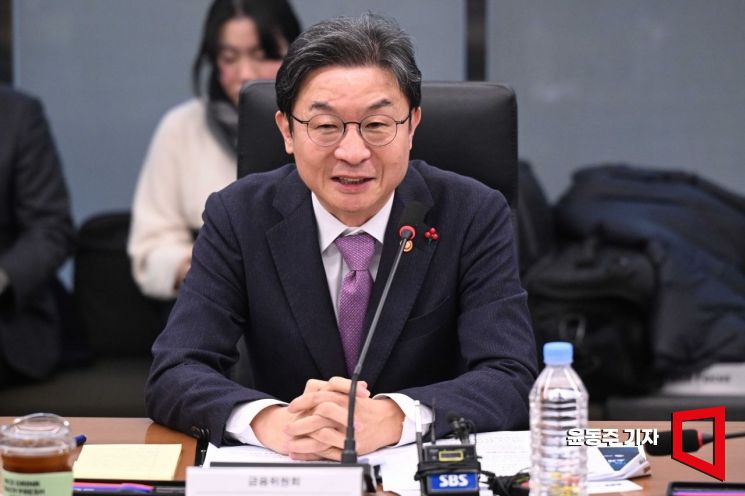
Lee Eokwon, Chairman of the Financial Services Commission, announced during a presidential work briefing that seven projects, including artificial intelligence (AI), semiconductors, and secondary batteries, have been selected as the first mega projects to receive support from the 150 trillion won National Growth Fund.
AI, Semiconductors, and More Selected for the First Mega Projects of the National Growth Fund
On the 19th, during a Financial Services Commission work briefing held at the Government Complex Seoul, Chairman Lee stated, "We have selected seven projects, including AI, semiconductors, and secondary batteries, as candidates for the first mega projects, given their significant economic ripple effects across regions and the entire industrial ecosystem."
The 150 trillion won National Growth Fund will provide broad support for advanced strategic industries such as AI, semiconductors, bio, and robotics, as well as their related ecosystems. Starting next year, 30 trillion won will be supplied annually for the next five years.
More than 40% of the total funds will be allocated to regional areas. The initiative will also promote advanced industrialization by improving the efficiency of policy finance, such as public guarantees to enhance industrial support, and by driving AI transformation within the financial industry itself.
Efforts will also be strengthened to support regional economies, carbon reduction, and financial support for small business owners to promote a sustainable economy. For regional finance, the goal is to expand the local supply of policy finance (from 40% in 2025 to 45% in 2028) and to implement regulatory improvements that favor regional areas, thereby ensuring that more funds are supplied to regions on better terms.
For climate finance, the supply of policy finance will be gradually expanded, and ESG disclosure standards and a roadmap will be established to actively support the implementation of the national greenhouse gas reduction target (NDC) by 2035. Additionally, the overall financial supply system for small business owners will be improved through the establishment of a credit assessment model and integrated information center, as well as the activation of supply chain finance.
Inclusive Finance Continues, Including Support for the Financially Marginalized
This year, the Financial Services Commission provided emergency support such as the write-off of long-term delinquent bonds and credit amnesty, and next year, it will continue to pursue inclusive finance by addressing structural issues such as the high-interest burden and long-term or excessive debt collection faced by the financially marginalized.
To this end, the policy of providing low-interest (3-6%) policy finance for the financially marginalized will continue next year. A new youth-exclusive microcredit product will be launched, offering up to 5 million won at an annual interest rate of 4.5%. This loan product, which assesses potential rather than current ability, will support young people preparing to enter society (such as academy fees and start-up funds). A similar loan product for living expenses will also be introduced for vulnerable groups under the same conditions. This product targets recipients of basic livelihood security, those in the near-poor class, other socially disadvantaged groups, and those who have repaid illegal private loans, providing them with living expense support.
Small loans for those faithfully fulfilling debt adjustment agreements will also be expanded. The supply of these products will be increased more than threefold, from the current 120 billion won per year to 420 billion won per year, and eligibility will be expanded from current debt adjustment and personal rehabilitation participants under the Credit Counseling and Recovery Service to include those who have fulfilled debt adjustment programs with other financial companies as well.
A tax-free Youth Future Savings Account will be launched in June next year to help young people build seed money, and the housing pension for the elderly will be improved to support asset formation by generation.
Regarding household debt, the commission announced that it will maintain a consistent approach next year, focusing on total volume management, enhancement of credit management centered on the Debt Service Ratio (DSR), and strengthened oversight of large mortgage loans, as was done this year. Various market risk factors will be closely monitored, and preemptive market stabilization measures will be implemented if necessary.
To prevent a recurrence of hacking incidents, the "Digital Financial Safety Act" will be enacted, introducing punitive fines and establishing a robust financial security system through regular joint training and simulated hacking exercises in the financial sector. A one-stop support system will also be set up so that victims of illegal private lending can receive all necessary assistance-including suspension of collection, appointment of a debtor representative, account suspension, and investigation-through a single report.
Chairman Lee Eokwon emphasized, "Next year, we will pave the way for a major leap forward in the economy through a grand transformation of the financial sector," adding, "We will create finance that truly benefits people's lives."
© The Asia Business Daily(www.asiae.co.kr). All rights reserved.
![Clutching a Stolen Dior Bag, Saying "I Hate Being Poor but Real"... The Grotesque Con of a "Human Knockoff" [Slate]](https://cwcontent.asiae.co.kr/asiaresize/183/2026021902243444107_1771435474.jpg)















