Real-Time Systems Theory Leading Academia and Industry for 20 Years
Recognized at the World’s Most Prestigious Academic Conference
Sinsik Shin, Professor in the School of Computing at Korea Advanced Institute of Science and Technology (KAIST), has received the "Influential Paper Award 2025" at the IEEE Real-Time Systems Symposium (RTSS), the world’s most prestigious international conference in the field of real-time systems. This marks the first time a Korean researcher has received this award.
On December 21, KAIST announced that Professor Shin’s paper was selected for what is known as the "Test-of-Time Award," which is given to research that has had a lasting impact on both academia and industry for over a decade. The award ceremony took place at IEEE RTSS 2025 in Boston, United States, on December 4 (local time).
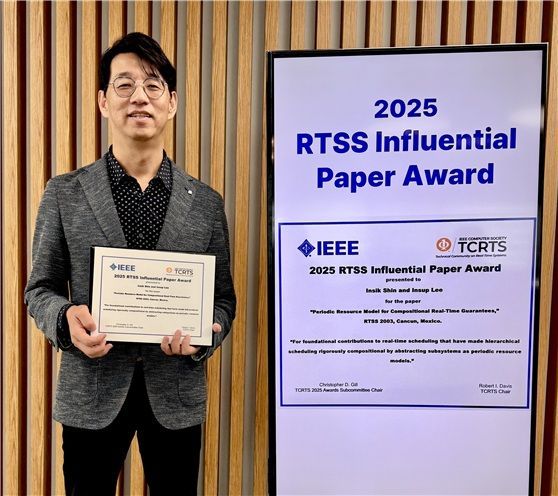 Sinsik Shin, Professor in the School of Computing at Korea Advanced Institute of Science and Technology (KAIST). Provided by KAIST
The award-winning paper, "Periodic Resource Model for Compositional Real-Time Guarantees (DOI: 10.1109/REAL.2003.1253249)," was co-authored by Professor Shin and Professor Insup Lee of the University of Pennsylvania in 2003.
This research introduced a new approach that departs from the traditional method of verifying an entire complex system at once. Instead, it divides the system into small modules, verifies whether each module meets its timing constraints, and then proves that the overall system remains safe when these modules are integrated. The research team mathematically demonstrated this approach, establishing a new standard for real-time system design.
Thanks to this so-called "Lego block" method, it has become possible to design highly reliable real-time systems-such as autonomous vehicles, aircraft, and industrial robots, where even momentary delays are unacceptable-with greater accuracy and safety. Experts have noted that this model has overcome the limitations of traditional real-time scheduling theory, which required analyzing the entire system as a whole, especially in today’s environment where system complexity has increased dramatically.
When it was first presented in 2003, this paper also became the first by a Korean researcher to win the "Best Paper Award" at IEEE RTSS. Now, 20 years later, its academic and industrial value has been officially recognized once again, solidifying its status as a standard theory in the field.
The IEEE Technical Committee commented, "The periodic resource model has become a core language for modern real-time system design and has guided the direction of research and industry over the past 20 years." This theory is now included in textbooks at major universities in the United States and Europe.
Professor Shin stated, "As a scholar, this is the award I have always wanted to receive in my lifetime. I am honored that research from 20 years ago has been recognized as having a meaningful impact on the world, and I owe this to the many researchers and companies who have applied this theory to real systems."
Meanwhile, Professor Shin is expanding his research into the field of artificial intelligence (AI) based on his work in real-time systems. He founded the faculty startup "Fluiz," which developed the mobile AI agent technology "FluidGPT," allowing users to control smartphone apps by voice. This technology recently won first place at the "AI Champions Competition" hosted by the Ministry of Science and ICT. Experts note that Professor Shin is a rare example of a researcher who bridges foundational theory and applied technology, connecting research and industry.
© The Asia Business Daily(www.asiae.co.kr). All rights reserved.
![Clutching a Stolen Dior Bag, Saying "I Hate Being Poor but Real"... The Grotesque Con of a "Human Knockoff" [Slate]](https://cwcontent.asiae.co.kr/asiaresize/183/2026021902243444107_1771435474.jpg)















