Discussion Forum Hosted by Bipartisan Research Group "Unicorn Farm"
Regulatory Challenges Highlighted in Legal AI, Autonomous Driving, and Drone Sectors
"Clear Legal Grounds Needed for Services"
At a discussion forum on supplementing legislation for artificial intelligence (AI) service regulations, hosted by bipartisan members of the National Assembly, the need to establish regulatory frameworks tailored to different types of legal tech (law + technology) services was raised. The argument was that clear legal grounds must be established to reduce conflicts such as the "LawTalk dispute."
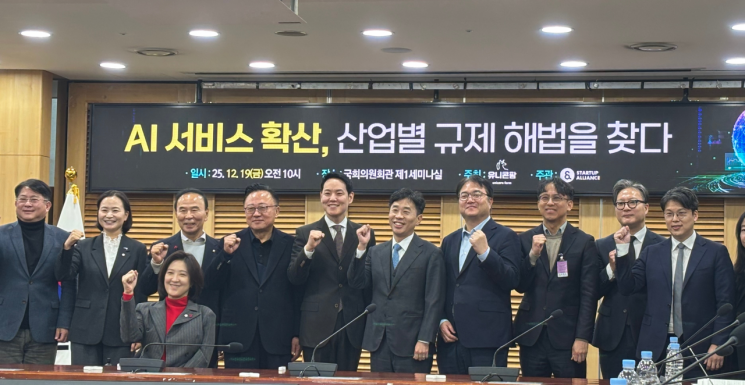 On the 19th at the National Assembly in Yeouido, participants are taking a commemorative photo at the discussion forum titled "Spreading AI Services, Finding Regulatory Solutions by Industry," hosted by the bipartisan parliamentary research group "Unicorn Farm" and organized by Startup Alliance. Photo by Hwang Seoyul chestnut@
On the 19th at the National Assembly in Yeouido, the bipartisan parliamentary research group "Unicorn Farm" held a discussion forum titled "Spreading AI Services, Finding Regulatory Solutions by Industry." The event was attended by Kim Hankyu (Co-Chair) and Park Mingyu of the Democratic Party of Korea, Ko Dongjin, Choi Boyoon, and Park Deokheum of the People Power Party, Lee Haemin of the New Reform Party, as well as Lee Gidae, Head of Startup Alliance, which organized the forum.
In his welcoming remarks, Assemblyman Kim, co-chair of Unicorn Farm, stated, "I am considering whether we can establish comprehensive principles in advance so that the time gap between market expectations and legislation does not become an issue, and whether there is a way to avoid separately regulating new industries." He added, "Since the need for new regulations will inevitably arise, now is the time to seriously explore the legislative direction."
Kim Byungpil, professor at KAIST Graduate School of Science and Technology Policy, who gave a presentation on legal AI, referred to the dispute over the legal consultation platform "LawTalk," arguing, "We need to clearly legislate the legal grounds for legal tech services to prevent wasteful disputes." He continued, "It is necessary to reach a social consensus and legislate appropriate regulatory approaches for each type of legal tech service, such as allowing them freely, implementing a notification system, requiring permits, or imposing restrictions." He also emphasized, "To encourage the development and use of legal AI, it is essential to make the full text of court rulings available for free in a machine-readable format and to set anonymization standards by law. Public disclosure of judicial AI is also necessary."
The forum also discussed regulatory challenges in the fields of autonomous driving and drones. In the area of autonomous driving, participants pointed out issues such as regulations on the use of training data and personal information, as well as the complexity of the temporary license issuance process. In the drone sector, they noted that existing aviation safety regulations were not designed with "AI autonomous flight" in mind.
© The Asia Business Daily(www.asiae.co.kr). All rights reserved.
![Clutching a Stolen Dior Bag, Saying "I Hate Being Poor but Real"... The Grotesque Con of a "Human Knockoff" [Slate]](https://cwcontent.asiae.co.kr/asiaresize/183/2026021902243444107_1771435474.jpg)















