Cash Receipts Mandatory for Cash Transactions of 100,000 Won or More
20% Penalty for Failure to Issue Receipts
Starting next year, four industries with high volumes of cash transactions, such as souvenir shops and fishing grounds, will be required to issue cash receipts for any cash transaction of 100,000 won or more.
The National Tax Service announced on December 19 that, beginning in 2026, four industries-retail of souvenirs, tourism folk crafts and decorative goods, fishing ground operations, photo processing, and other water recreation services-will be newly designated as industries required to issue cash receipts.
The cash receipt system, introduced in 2005, has gradually expanded the list of industries subject to mandatory issuance. The number of designated industries will increase from 125 in 2024 to 138 in 2025, and to 142 in 2026.
The National Tax Service has sent out notifications regarding the mandatory issuance requirement to ensure that newly added businesses are aware of the changes and do not incur penalties due to lack of information. The agency is also providing guidance on the mandatory issuance system through the publication and distribution of cash receipt guidebooks and leaflets.
To issue cash receipts, businesses operating in the designated industries must first register as cash receipt merchants via Hometax, Sontax, the National Tax Consultation Center, or a credit card terminal.
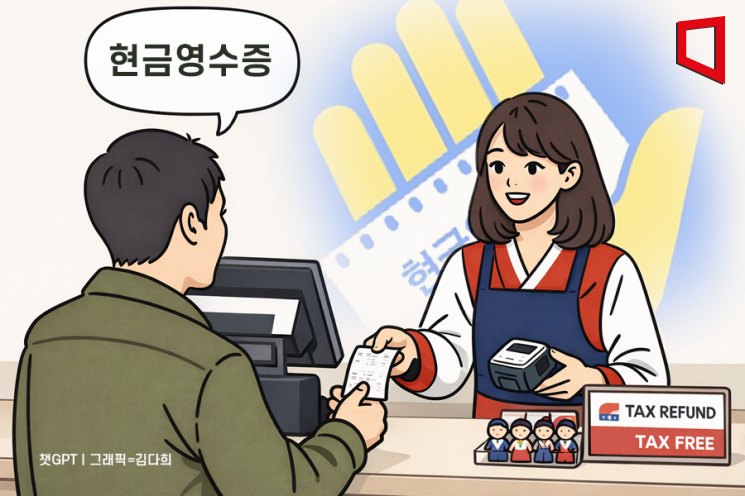
Regardless of the amount of annual revenue, businesses must issue a cash receipt for every transaction of 100,000 won or more, even if the customer does not request one. If the business does not know the personal information of the transaction counterpart, it must issue an anonymous receipt using a designated number from the National Tax Service within five days of the transaction. Businesses must not charge additional fees to consumers for issuing cash receipts or issue false cash receipts.
When issuing cash receipts, businesses can receive a value-added tax deduction. Upon receipt, the cash receipt can be used as a regular tax invoice and for input VAT deductions. If a business fails to register as a cash receipt merchant or registers after the deadline, a penalty of 1% of the revenue during the unregistered period will be imposed. If a business fails to issue a cash receipt, a penalty of 20% of the unissued amount will be charged.
Consumers who receive cash receipts can check their usage amount through Hometax or Sontax. Employees can receive income tax deductions during year-end tax settlements. In addition, if a consumer makes a cash transaction of 100,000 won or more (including VAT) with a business in a designated industry but does not receive a cash receipt, they can report the unissued receipt via Hometax within five years of the transaction date. If the report is confirmed, the informant can receive a reward of 20% of the unissued amount, up to 250,000 won per case and a maximum of 1 million won per person annually.
An official from the National Tax Service stated, "The National Tax Service will continue to promote the mandatory issuance system and the reward system for reporting violations to consumers, and will intensively monitor businesses that violate the issuance obligation, including those offering cash discounts." The official added, "Cash receipts are the first step toward creating a fair and rational tax administration, and we urge businesses to issue them faithfully."
© The Asia Business Daily(www.asiae.co.kr). All rights reserved.
![Clutching a Stolen Dior Bag, Saying "I Hate Being Poor but Real"... The Grotesque Con of a "Human Knockoff" [Slate]](https://cwcontent.asiae.co.kr/asiaresize/183/2026021902243444107_1771435474.jpg)
















