Can Cause Paralysis and Respiratory Distress, Posing a Life-Threatening Risk
Experts Warn: "Do Not Touch Wild Marine Animals"
The fact that a cute and seemingly non-threatening appearance can actually pose a serious threat to life has been reaffirmed. A recent case from a tranquil beach at an overseas resort, where a careless gesture nearly led to a fatal outcome, is raising public awareness. On December 16 (local time), Indian media outlet NDTV reported on the harrowing experience of British tourist Andy McConnell, who was enjoying the waters off the coast of the Philippines.
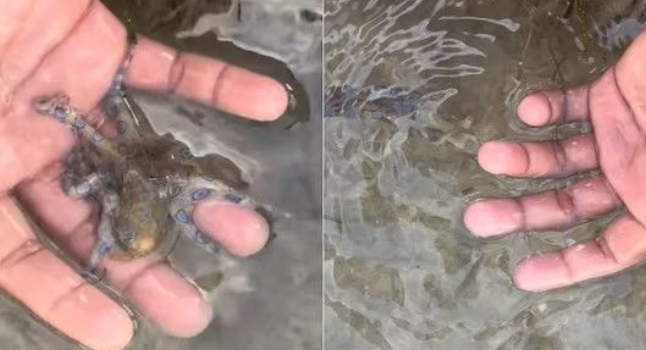 A British tourist shared a dangerous photo on social media of herself holding a highly venomous octopus found on a Philippine beach, but thanks to help from netizens, she escaped a life-threatening situation. People.com
While wading in shallow water, he discovered a small octopus. Because it was tiny and did not appear particularly dangerous, he picked it up without hesitation and filmed the moment, sharing it on his social media account. However, what seemed like an ordinary video quickly drew widespread attention online. Viewers recognized that the creature was a blue-ringed octopus, known for its deadly venom, and issued a series of warnings in response.
The blue-ringed octopus, though small, is considered one of the most venomous marine animals on Earth. According to the BBC, this octopus mainly inhabits the waters between Australia and Japan. When threatened, its body turns yellow and its blue and black rings become vivid. This dramatic color change serves as a warning signal, but in many cases, contact occurs before people notice the danger.
The octopus's venom contains tetrodotoxin (TTX), a powerful neurotoxin. It is known to be hundreds to thousands of times more toxic than cyanide, and if bitten while handling it with bare hands, it can cause symptoms ranging from paralysis and vomiting to respiratory distress and, in severe cases, cardiac arrest. Its mucus and ink also contain toxic substances, making any direct contact extremely dangerous. Particularly concerning is that a bite often causes little or no pain, so victims may not realize the severity of the situation and delay seeking help-this is considered the greatest risk factor.
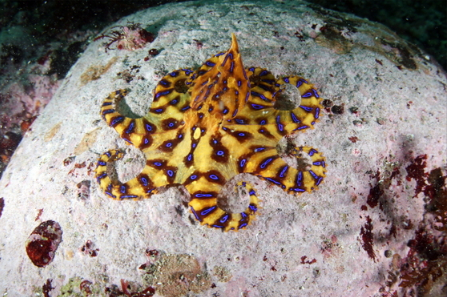 The blue-ringed octopus originally inhabited subtropical waters of the South Pacific, mainly around Australia, Indonesia, the Philippines, and Sri Lanka. However, since it was first discovered domestically in 2012, it has also been spotted along the southern coast and southern East Sea waters, including Jeju, Yeosu, Geoje, Gijang, Busan, and Ulsan. National Institute of Fisheries Science
Experts unanimously warn that handling wild marine animals simply because they appear small or harmless is extremely dangerous. Especially at resorts, shallow waters, rocky shores, and beaches may harbor creatures with unexpected toxicity, so it is essential to avoid touching or picking up any wildlife encountered in these areas.
Despite its small size, the blue-ringed octopus carries a deadly threat. The problem is that such creatures are no longer just a foreign concern. The blue-ringed octopus originally inhabited subtropical waters of the South Pacific, mainly around Australia, Indonesia, the Philippines, and Sri Lanka. However, since it was first discovered domestically in 2012, it has also been spotted along the southern coast and southern East Sea waters, including Jeju, Yeosu, Geoje, Gijang, Busan, and Ulsan. The appearance of subtropical marine life such as the blue-ringed octopus in Korean waters is a consequence of rising sea temperatures caused by global warming.
© The Asia Business Daily(www.asiae.co.kr). All rights reserved.
![Clutching a Stolen Dior Bag, Saying "I Hate Being Poor but Real"... The Grotesque Con of a "Human Knockoff" [Slate]](https://cwcontent.asiae.co.kr/asiaresize/183/2026021902243444107_1771435474.jpg)















