Business Sector Responds to Exchange Rate Fluctuations
Korean Air Estimates 48 Billion Won FX Valuation Loss
for Every 10-Won Rise in Exchange Rate
Reducing Exchange Rate Burden Through Currency Diversification
Electronics Industry Adjusts Procurement Structure and Timing
Considering Expansion of FX Hedging Ratios
As the won-dollar exchange rate surpassed 1,480 won, companies have begun reassessing their overall foreign currency revenue management, financing, and investment strategies, taking steps to manage foreign exchange risk. The airline industry, which has a high proportion of dollar-denominated payments, is strengthening its currency diversification and hedging strategies due to concerns over increased foreign exchange losses. Similarly, electronics companies are responding by adjusting their component procurement structures and the timing of facility investments. While the government has requested cooperation to stabilize the foreign exchange market, companies continue to deliberate on how to manage their foreign currency holdings and exchange rate volatility.
According to Korean Air's third-quarter report released on December 19, a 10-won increase in the won-dollar exchange rate is estimated to result in a foreign exchange valuation loss of 48 billion won. As a result, it is being suggested that this year's foreign exchange losses could expand to over 500 billion won on the books. Since most major costs, such as fuel and aircraft lease fees, are paid in dollars, the rising exchange rate is said to be putting direct pressure on profits and losses.
To reduce this exchange rate burden, airlines are actively pursuing currency diversification strategies. In January this year, Korean Air issued yen-denominated bonds worth 33 billion yen, followed by euro-denominated bonds worth 300 million dollars in September. Last month, for the first time in its history, the company issued Swiss franc bonds, raising 180 billion won, and plans to use the funds locally without converting them into dollars.
Airlines are also continuing to enter into forward contracts to reduce foreign exchange losses when paying major operating expenses such as fuel and maintenance costs in dollars. A forward contract is an agreement to purchase foreign currency at a predetermined exchange rate on the maturity date. As of the end of the third quarter this year, the outstanding balance of dollar-denominated forward contracts was 20 million dollars, which is approximately 3 billion won when converted to won.
A Korean Air official stated, "Five employees in the risk management team under the finance planning department are dedicated to this work," and added, "We will continue to pursue fixed-rate borrowings in won, as well as fixed-rate borrowings in low-interest currencies such as yen and euros."
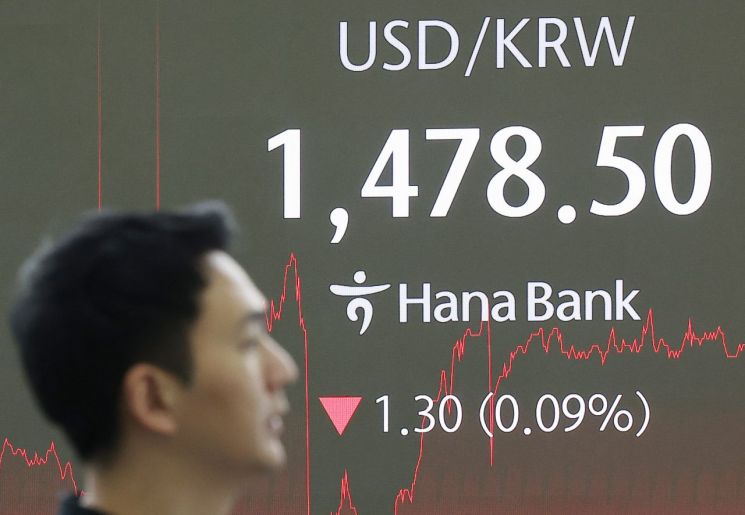 On the afternoon of the 18th, the exchange rate between the Korean won and the US dollar was displayed on the status board in the dealing room at the headquarters of Hana Bank in Jung-gu, Seoul. Photo by Yonhap News
The electronics industry is also managing exchange rate risk by adjusting procurement structures and investment timing. An industry insider said, "What companies can realistically do is to ease their reliance on dollar transactions and diversify component suppliers by considering the currency conditions of each country. While it is difficult to substitute key components that must be immediately used in production, we are slowing down the introduction of large equipment and investments where possible."
Companies are strengthening their ongoing monitoring of exchange rate fluctuations and raising their level of response. While a rising exchange rate can be somewhat positive for foreign currency sales in export businesses, it simultaneously increases manufacturing and logistics costs, putting pressure on overall financial structures. In particular, with mid- to long-term business plans such as overseas investments coming up next year, the growing volatility of the exchange rate is rapidly increasing uncertainty. An industry representative said, "If the won-dollar exchange rate continues to rise or fluctuate at a time when large-scale overseas investments need to be executed, it becomes difficult to estimate the scale of losses. We are urgently reviewing measures to minimize exchange rate risk."
To cope with the high exchange rate, companies are specifically considering increasing their foreign exchange hedging ratios. This involves matching the currency of wages and expenditures with the currency of export and import transactions to suppress the occurrence of foreign exchange positions. In addition, by matching foreign currency assets and liabilities, companies are offsetting gains and losses to minimize the impact of exchange rate fluctuations. A company official explained, "When a company sells forward contracts, the bank that buys them will sell spot dollars, so when the won-dollar exchange rate is high, there can be a short-term stabilizing effect on the market. The government has also requested that the hedging ratio be increased."
Meanwhile, on the previous day, Kim Yongbeom, Chief Policy Officer at the Presidential Office, called together seven major export companies to request cooperation in stabilizing the foreign exchange market, and companies are now considering ways to utilize their overseas retained earnings. According to the Bank of Korea, as of the cumulative total in September, companies' overseas retained earnings reached 114.4 billion dollars (approximately 169 trillion won), the largest amount ever. A representative of an export company said, "Our company has a high proportion of overseas sales, but since we need to pay wages and make investments at local subsidiaries, there is little incentive to remit funds to Korea. However, since there was a government request, we are considering various options."
© The Asia Business Daily(www.asiae.co.kr). All rights reserved.
![Clutching a Stolen Dior Bag, Saying "I Hate Being Poor but Real"... The Grotesque Con of a "Human Knockoff" [Slate]](https://cwcontent.asiae.co.kr/asiaresize/183/2026021902243444107_1771435474.jpg)
















