Gyeonggi Province has operated 18 "Resource Circulation Villages," successfully separating and recycling 30.6 tons of waste.
Looking at some key village examples: The Babi Sarangbang in Janggi-dong, Gimpo, promoted the use of resource-circulating products while providing environmental education through the operation of "Babibachae" (which means "Empty Properly, Fill Properly").
The Damda Village Cultural Education Community in Janggok-dong, Siheung, conducted resource circulation education for daycare centers and parents, and operated a booth at a local festival to encourage waste separation.
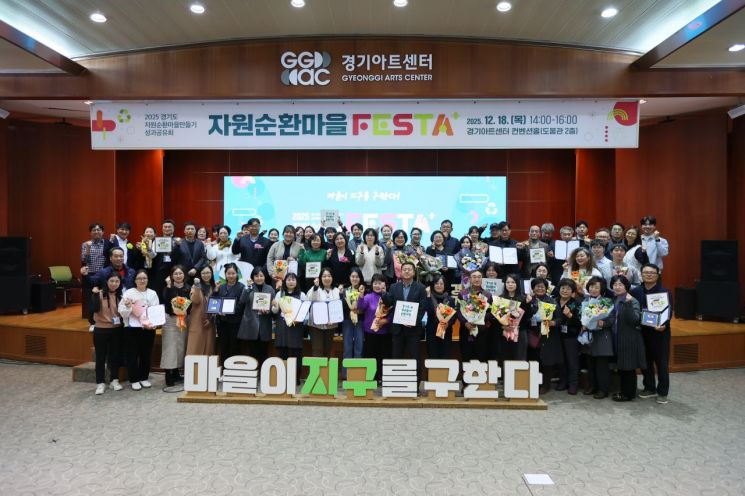 Participants of the Resource Circulation Village Festa are taking a commemorative photo. Provided by Gyeonggi Province
The Yeonpung Merchants Association in Yeonpung-ri, Paju, provided education on resource circulation and upcycling (the process of transforming recycled materials into products of higher value through design or enhanced utility) for residents, and installed waste separation bins.
As a result, as of December this year, a total of 30,620 kilograms of waste was separated and recycled. This equates to a carbon reduction of 127,962 kilograms.
At the event, Gyeonggi Province selected four outstanding villages: Babi Sarangbang in Janggi-dong, Gimpo; Damda Village Cultural Education Community in Janggok-dong, Siheung; Yeonpung Merchants Association in Yeonpung-ri, Paju; and the Daea Elementary School Ecological Environment Committee in Jeungdong 1-ri, Yangpyeong.
Cha Seongsu, Director of Climate, Environment, and Energy at Gyeonggi Province, stated, "The Resource Circulation Village initiative is significant in that it empowers residents to create a culture of recycling in their daily lives. We will continue to expand resource circulation policies in collaboration with residents of the province."
© The Asia Business Daily(www.asiae.co.kr). All rights reserved.
![Clutching a Stolen Dior Bag, Saying "I Hate Being Poor but Real"... The Grotesque Con of a "Human Knockoff" [Slate]](https://cwcontent.asiae.co.kr/asiaresize/183/2026021902243444107_1771435474.jpg)















