Sanofi Signs 1.5 Trillion Won Tech Transfer for 'Y01'
Targeting Tau in the Alzheimer's Market
Tau Antibody Sector Projected to Reach 30 Trillion Won by 2037
Oscotec and Adel, both new drug development companies, have projected that their Alzheimer's treatment candidate 'ADEL-Y01', which was licensed out to Sanofi, could secure a significant share in the tau antibody market, which is estimated to reach 30 trillion KRW by 2037.
Yoon Taeyoung, CEO of Oscotec, stated at a technology transfer briefing held on the 18th at the Korea Financial Investment Education Institute in Yeouido, Seoul, "The tau antibody market does not exist yet, but by 2037, it is expected to form a market worth between 5.5 billion and 28 billion USD (approximately 8 trillion to 41.3 trillion KRW), with a baseline of around 30 trillion KRW." He added, "If ADEL-Y01 becomes both 'first-in-class' and 'best-in-class', we expect it to capture a substantial portion of the market."
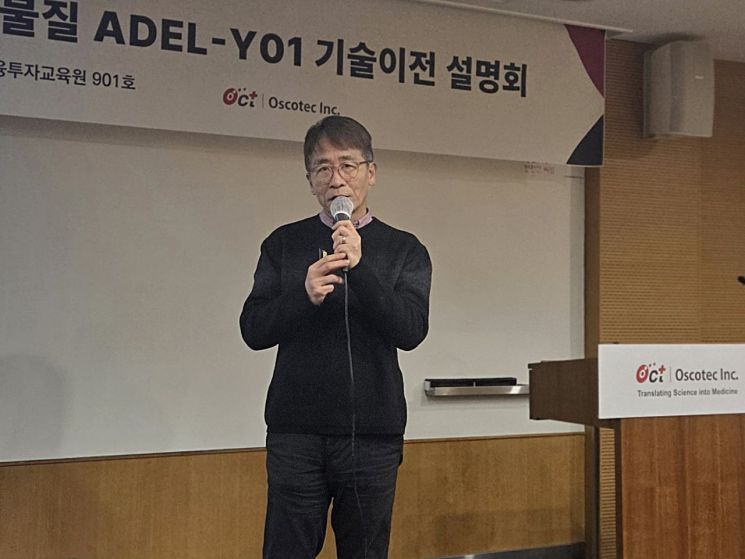 Yoon Taeyoung, CEO of Oscotec, is speaking at the technology transfer briefing held on the 18th at the Korea Financial Investment Education Institute in Yeouido, Seoul. Photo by Jeong Donghoon
On December 16, Oscotec signed a technology transfer agreement with Adel to license out ADEL-Y01, which they co-developed, to Sanofi for up to 1.04 billion USD (about 1.53 trillion KRW). The deal includes an upfront payment of 80 million USD (about 118.1 billion KRW) and milestone payments totaling 960 million USD (about 1.4178 trillion KRW). Additional payments will be made in stages depending on future development and commercialization milestones. The contract was signed between Sanofi and Adel, and under the joint development agreement, Oscotec will receive 47% of the economic benefits Adel receives.
ADEL-Y01 selectively targets 'acetyl-tau', a core pathological factor in Alzheimer's disease among tau proteins. CEO Yoon explained, "The concept is to use antibodies to capture the 'seed' that is released outside the cell as tau aggregates spread along neural networks in Alzheimer's, thereby blocking its transmission to the next neuron." He emphasized, "Experimental data showing that we targeted a 'sweet spot' closer to the core of tau aggregation compared to competing drugs and demonstrated superior inhibitory potency was a key factor that convinced Sanofi."
This deal will also prompt Oscotec to reorganize its mid- to long-term pipeline strategy. CEO Yoon said, "The out-licensing of ADEL-Y01 is a turning point for Oscotec. We have already halted direct development of our two legacy pipelines, and plan to license both out in some form by next summer." He continued, "Our goal is to secure candidate substances for at least two new targets within two to three years, and to achieve more than three global technology transfers and clinical entry for at least two new projects before 2030."
Issues surrounding the subsidiary Genosco were also addressed during the Q&A session. CEO Yoon stated, "We are still pushing for 100% acquisition of the subsidiary. We are intensely discussing how to leverage each other's strengths and what kind of synergy we can create, and we will introduce a grand plan early next year." He agreed that, "If the deal had been completed around this time last year, it would have been advantageous in discussions about Genosco's listing earlier this year," but made it clear that the plan to incorporate the subsidiary remains unchanged.
Oscotec intends to prioritize reinvestment in research and development with the upfront payment from this deal. CEO Yoon said, "Our current research lab is relatively small compared to our achievements. By strengthening our R&D capabilities, we will be able to increase both the speed and frequency of subsequent successes."
© The Asia Business Daily(www.asiae.co.kr). All rights reserved.

















