Seeking Differentiated Strategies for "Basic Science-Research-Demonstration"
Pohang, a City with World-Class Basic Science Infrastructure
Pohang City has launched a full-scale initiative to attract the "Asia-Pacific AI Center," in line with the adoption of the APEC AI Initiative.
On December 18, the city held a meeting of the Asia-Pacific AI Center Attraction Promotion Committee in the main conference room of City Hall. The event was attended by Pohang Mayor Lee Kangdeok, Handong Global University President Choi Doseong, POSTECH Research Director Park Sujin, Asia Pacific Center for Theoretical Physics Secretary-General Jeon Jaehyung, Max Planck Research Institute Director Park Jaehun, as well as representatives from academia, research, and industry. Also present were Lee Wonmi, Group Leader at Samsung SDS, Lee Yeongeun, Director at Amazon, and Yoon Seonguk, Executive Vice President at KT, along with other domestic and international ICT and cloud industry leaders.
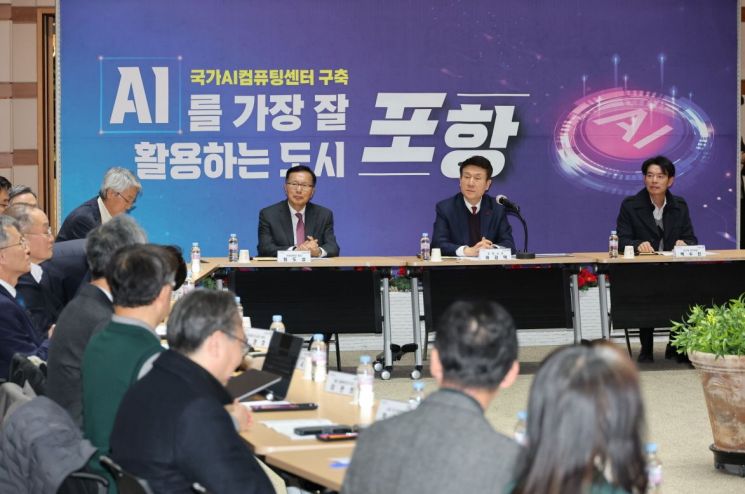
This meeting was organized to develop strategies for bringing the center to Pohang, following the recent adoption of the "AI Initiative" for digital transformation at the APEC Summit, with the aim of establishing a joint AI hub among member countries.
Pohang City presented the rationale for attracting the Asia-Pacific AI Center and highlighted the city’s unique strengths, based on a pre-established operational model. In particular, the city emphasized its status as the optimal location by unveiling concrete attraction strategies that leverage the region’s abundant research and industrial infrastructure.
The presentation focused on Pohang’s unique advantages, including world-class basic science infrastructure and research talent represented by the Asia Pacific Center for Theoretical Physics, the Max Planck Korea/POSTECH Research Institute, POSTECH, and Handong Global University; industrial and data infrastructure based on steel, secondary batteries, hydrogen, and bio industries; the nation’s highest level of energy self-sufficiency; and a stable power supply and next-generation technology verification environment supported by its location on the East Coast.
Participants agreed on the need for a "comprehensive hub" that encompasses data and computing infrastructure, basic science and AI research, policy and standards, and talent development, in response to the proliferation of large-scale and generative AI.
They also shared the view that by linking Pohang’s international research network, industrial data, and strengths in power and location, the city could propose a virtuous cycle model-where basic science, AI research, demonstration, and international cooperation are realized in a single city-providing a compelling and differentiated case for selection over other cities.
In addition, there was consensus that the Asia-Pacific AI Center should become an "action-oriented AI collaboration hub" that goes beyond research to address APEC’s shared challenges in industry, energy, and climate.
Based on the feedback gathered at the meeting, Pohang City plans to further develop a detailed roadmap and implementation plan for attracting the Asia-Pacific AI Center.
Mayor Lee Kangdeok emphasized, "Pohang is Korea’s leading basic science city, having grown on the foundation of world-class research and educational infrastructure," adding, "Our city is fully prepared to enable the Asia-Pacific AI Center to deliver rapid results and become a trusted international organization."
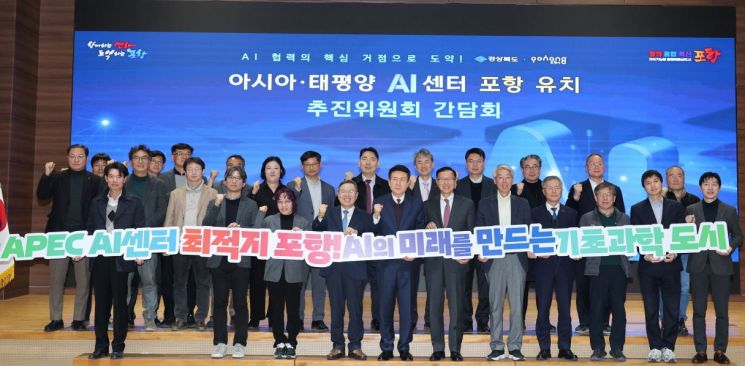 "Pohang is the Optimal Location for the APEC AI Hub"... Combining World-Class Research Infrastructure and Industrial Data. Photo by Pohang City
© The Asia Business Daily(www.asiae.co.kr). All rights reserved.
![Clutching a Stolen Dior Bag, Saying "I Hate Being Poor but Real"... The Grotesque Con of a "Human Knockoff" [Slate]](https://cwcontent.asiae.co.kr/asiaresize/183/2026021902243444107_1771435474.jpg)
















