Changwon Seongmin Girls' High School in South Gyeongsang Province is actively advancing student-led ecological and agricultural education, successfully carrying out a school garden project in collaboration with the local community in response to the climate crisis era.
The open field behind the school, measuring about 189 square meters, had been largely overlooked by students and staff until 2024. However, thanks to the foresight of Principal Kim Yongjun, its educational potential was rediscovered. The initiative began when members of the horticulture club voluntarily started cultivating the land, which soon sparked a school-wide expansion of ecological education. Building on this momentum, the school established an ecological garden in February of this year, with support from the Gyeongsangnam-do Office of Education’s Climate Environment Promotion Team and the Urban Agriculture Department of the Changwon Special City Agricultural Technology Center, enabling all 16 classes to participate jointly.
Starting in March, every class engaged in unique garden activities, directly cultivating over 30 types of crops, including chili peppers, tomatoes, and potatoes. Students and staff with little farming experience received guidance from more experienced faculty and administrative staff, gradually learning basic agricultural techniques such as plowing, composting, and pest management. Through these activities, the garden became more than just a cultivation space-it evolved into a living classroom that fostered students’ ecological sensitivity and collaborative skills.
Some of the harvested crops were shared among all students at the self-service cafeteria, putting the concept of local food consumption into practice. Others were donated to local nursing homes, extending the project into ecological citizenship education. This serves as a meaningful example of how schools can provide small-scale food self-sufficiency experiences and sustainability education in the face of climate-related food challenges.
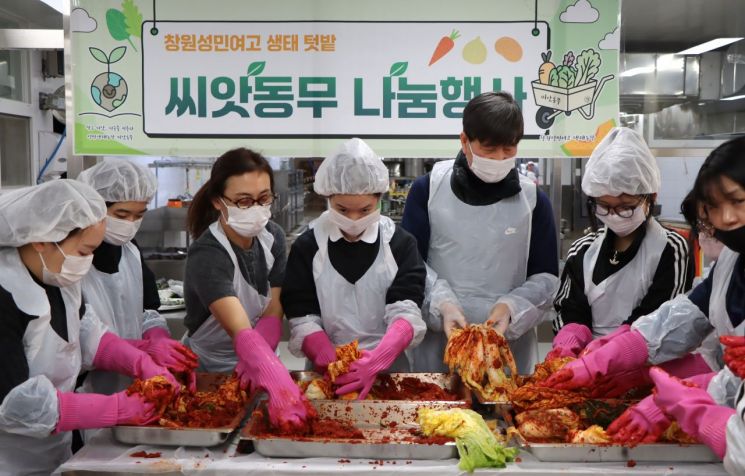
In the second semester, all classes cultivated cabbages and radishes for kimchi-making, completing the harvest in early December. To help students with little experience in making kimchi, parents and cafeteria cooks joined in, launching a full-scale school kimchi-making project.
Notably, the necessary ingredients for kimchi are to be purchased with proceeds from a school bazaar organized by the student council, a tradition since the school’s founding. The bazaar, started by students’ goodwill, has positively impacted the community in various ways, such as purchasing mirrors for the school and supporting charitable activities. This year, the proceeds will be combined with the kimchi-sharing initiative, promising even greater synergy. The fact that kimchi will be made from radishes and cabbages lovingly grown in the garden, together with charitable funds raised voluntarily by students, holds special significance for everyone involved.
Although the winter season, with its falling snow, tends to make hearts feel colder, the school hopes that the kimchi prepared together by parents, students, and staff will bring warmth to dinner tables throughout the community.
Over the past year, the garden project faced challenges such as growth disorders caused by abnormal weather and intense sunlight. However, students gained valuable firsthand experience, learning about the value and labor involved in bringing crops to the table, and developing a sense of ecological responsibility.
Changwon Seongmin Girls' High School is building a new educational ecosystem through its garden activities, connecting students, staff, parents, and the local community.
Principal Kim Yongjun stated, "The garden is a place where students collaborate, learn from nature, and grow as ecological citizens," adding, "We will continue to expand sustainable ecological education and move forward as an ecological community school together with the local community."
© The Asia Business Daily(www.asiae.co.kr). All rights reserved.
![Clutching a Stolen Dior Bag, Saying "I Hate Being Poor but Real"... The Grotesque Con of a "Human Knockoff" [Slate]](https://cwcontent.asiae.co.kr/asiaresize/183/2026021902243444107_1771435474.jpg)
















