Normal Operation of Satellite Launched on Nuri Rocket's Fourth Mission Confirmed
Space Demonstration of Ten Types of Korean Semiconductors and Components from Samsung Electronics, KAIST, and SMEs
A dedicated satellite for verifying the performance of domestically produced devices and components in space has been confirmed to be operating normally and has officially begun its mission. This marks the implementation phase for establishing a space usage heritage for Korean semiconductors and electronic components.
The Korea Aerospace Administration and the Korea Aerospace Research Institute announced on December 18 that the first satellite of the "Domestic Device and Component Space Verification Support Project," known as E3T-1, has been confirmed to be operating normally and will commence its payload verification mission.
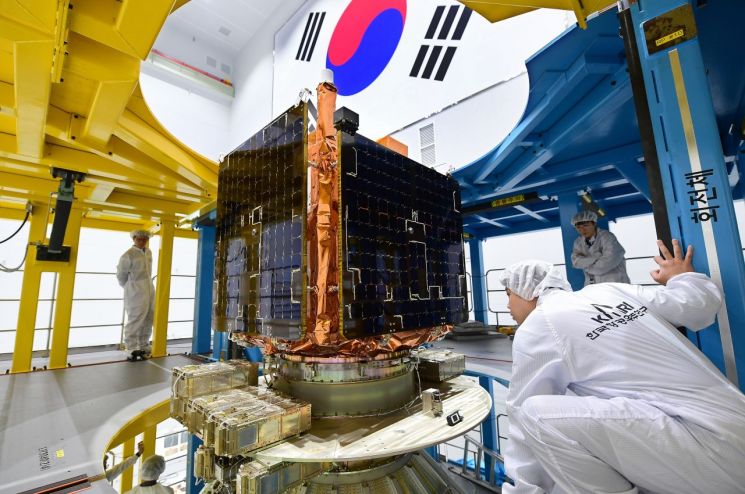 A researcher at the Korea Aerospace Research Institute is conducting the final inspection of the next-generation medium satellite 3 and the CubeSat deployment tube installed on the third stage of the Nuri rocket before the fourth launch of Nuri. Provided by Korea Aerospace Research Institute
E3T-1 was launched aboard the fourth Nuri rocket on November 27 and succeeded in establishing two-way communication on December 4. After checking the satellite's status and conducting initial operation tests of the payloads, analysis of the test data on December 17 confirmed that there were no anomalies. The satellite is scheduled to carry out its space verification mission in a 600-kilometer orbit for the next six to twelve months.
E3T is a dedicated verification satellite designed to confirm the normal operation of domestic research and development products in the space environment and to collect demonstration data. It is a 12U-class ultra-small satellite, with the main body (4U) jointly developed by the Korea Aerospace Research Institute and Nara Space Technology.
The payload (8U) carries a total of ten types of domestically produced devices, components, and semiconductors. These include dynamic random-access memory (DRAM) and NAND flash memory developed by Samsung Electronics; application-specific integrated circuits (ADC and DAC ASIC) for analog-to-digital and digital-to-analog conversion developed by the Mixed Signal Integrated Circuit Laboratory at the Korea Advanced Institute of Science and Technology (KAIST); static random-access memory (SRAM) from MID Co., Ltd.; as well as connectors, capacitors, thermistors, heaters, magnetics, resistors, and Schottky diodes developed by Korean small and medium-sized enterprises. These components were developed with support from the "Space Development Infrastructure Establishment and Performance Dissemination Project."
In the space industry, not only technical performance but also a proven track record of operation in the actual space environment is considered a key requirement for market entry. The E3T-1 mission is significant in that it has laid the groundwork for domestic companies and research institutions to overcome this barrier.
Han Changheon, Director of the Aerospace Industry Bureau at the Korea Aerospace Administration, stated, "With the launch of the E3T-1 mission, it has become possible to establish a space usage heritage for domestically produced devices and components. We will continue to provide opportunities for space verification of Korean devices and components to strengthen the competitiveness of K-Space."
© The Asia Business Daily(www.asiae.co.kr). All rights reserved.

















