MIT Maritime Consortium's First Year: Research Results Unveiled
Autonomous Navigation and SMR-Powered Ships Enter Technology Verification Phase
Over 180 Global Experts Gather to Discuss Roadmap
HD Korea Shipbuilding & Offshore Engineering shared its research achievements on future shipbuilding technologies with global shipbuilding and maritime experts.
HD Korea Shipbuilding & Offshore Engineering, the intermediate holding company for the shipbuilding division of HD Hyundai, held a workshop on December 17 and 18 at the HD Hyundai Global Research and Development (R&D) Center in Seongnam, Gyeonggi Province, to present the first-year research results of the 'MIT Maritime Consortium.' The consortium, launched in March and led by the Massachusetts Institute of Technology (MIT), includes participants such as the Greek shipping company Capital and the American Bureau of Shipping (ABS). The consortium has set technological innovation and decarbonization in the maritime and shipbuilding sectors as joint objectives.
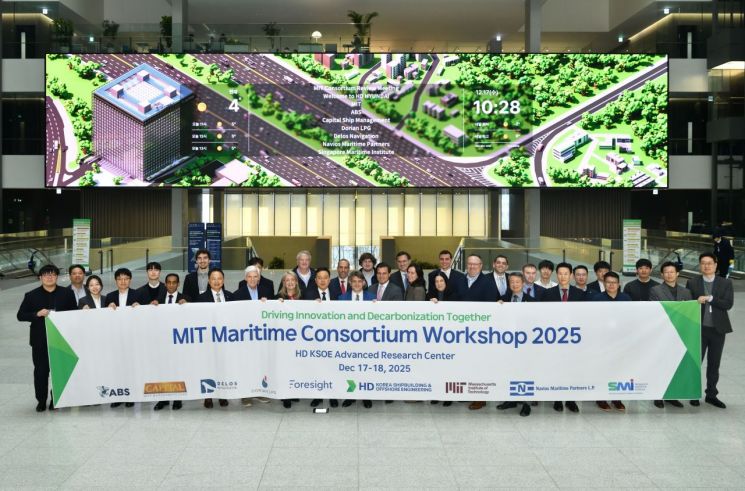 On the 17th, the first day of the 'MIT Maritime Consortium' workshop held at HD Hyundai Global Research and Development (R&D) Center in Seongnam, Gyeonggi Province, officials are taking a commemorative photo. HD Hyundai
Approximately 180 experts attended the workshop, including representatives from MIT, Capital, ABS, the Greek shipping company Dorian, the Singapore Maritime Institute, and the UK-based renewable energy investment firm Foresight Group.
The consortium unveiled its first-year research outcomes, which included: ▲ artificial intelligence-based autonomous navigation technology ▲ cybersecurity response technology ▲ advancement of small modular reactor (SMR)-powered ship technology ▲ manufacturing technology based on 3D printing.
In the field of autonomous navigation, the consortium plans to select a demonstration vessel to apply the integrated control solution from Avikus, HD Hyundai’s autonomous navigation subsidiary, and verify its fuel-saving effects. In the cybersecurity sector, the initial development of an artificial intelligence model to detect cyber threats targeting ships has been completed. In addition, the consortium participated in the creation of the 'SMR-Powered Ship Safety Guidelines,' published by MIT in October, to help establish safety standards for maritime nuclear technology.
The consortium also discussed its three-year research roadmap and the key technological directions for the shipbuilding and maritime industries beyond 2030. Major agenda items included responding to decarbonization regulations, standardizing fuel efficiency improvements, digital transformation, and strategies to address cyber threats.
Themis Sapsis, Director of MIT’s Center for Ocean Engineering, stated, “The structural changes in the shipbuilding and maritime industries are challenges that cannot be solved by a single company or institution. Collaboration across engineering, artificial intelligence, and increasingly stringent regulations is essential.” Kwangpil Jang, Head of Future Technology Research at HD Korea Shipbuilding & Offshore Engineering, said, “We will focus on establishing standards to verify the fuel-saving effects of autonomous navigation technology and contribute to technological development and decarbonization through global cooperation.”
Meanwhile, HD Hyundai is expanding its educational and research collaborations with overseas universities beyond MIT. Last year, the company signed agreements with the University of Michigan in the United States and Seoul National University to foster talent in the shipbuilding industry, and in June, it hosted the Korea-US Shipbuilding Cooperation Expert Forum.
© The Asia Business Daily(www.asiae.co.kr). All rights reserved.
![Clutching a Stolen Dior Bag, Saying "I Hate Being Poor but Real"... The Grotesque Con of a "Human Knockoff" [Slate]](https://cwcontent.asiae.co.kr/asiaresize/183/2026021902243444107_1771435474.jpg)















