Pits and lava tubes on the Moon are attracting attention as natural shelters that can protect explorers from extreme temperature fluctuations and cosmic radiation during lunar exploration. However, due to the harsh terrain characterized by steep slopes, rocky surfaces, and the risk of falls, no country has yet succeeded in accessing these areas. A Korean research team is drawing attention for overcoming these challenges using only an 'origami structure,' without relying on complex machinery.
KAIST announced on December 18 that the research team led by Professor Daeyoung Lee of the Department of Aerospace Engineering, in collaboration with Unmanned Exploration Research Institute, Korea Astronomy and Space Science Institute, Korea Aerospace Research Institute, and Hanyang University, has developed the world's first deployable airless wheel capable of entering lunar pits and lava tubes.
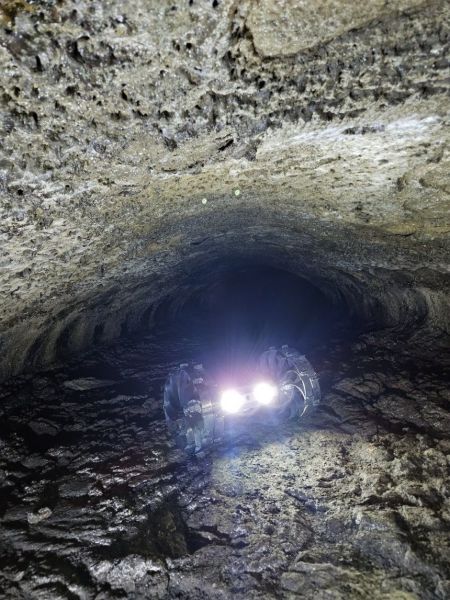 A lunar exploration rover equipped with deployable airless wheels is conducting a test exploration in the lava caves of Jeju Island. Provided by KAIST
A lunar exploration rover with deployable wheels exploring the lava caves of Jeju Island. [Photo by KAIST]
Lunar pits are regarded as promising candidates for long-term lunar habitats and are also considered important sites for preserving records of the early geological history of the solar system.
Until now, leading organizations such as NASA and the European Space Agency (ESA) have proposed exploration methods that involve deploying small rovers from larger ones.
However, due to the structural limitations of small rovers, they have not been able to secure sufficient mobility. Previously proposed variable wheels have also faced challenges in practical application, due to issues such as cold welding, uneven thermal expansion, and the highly abrasive lunar dust present in the harsh lunar environment.
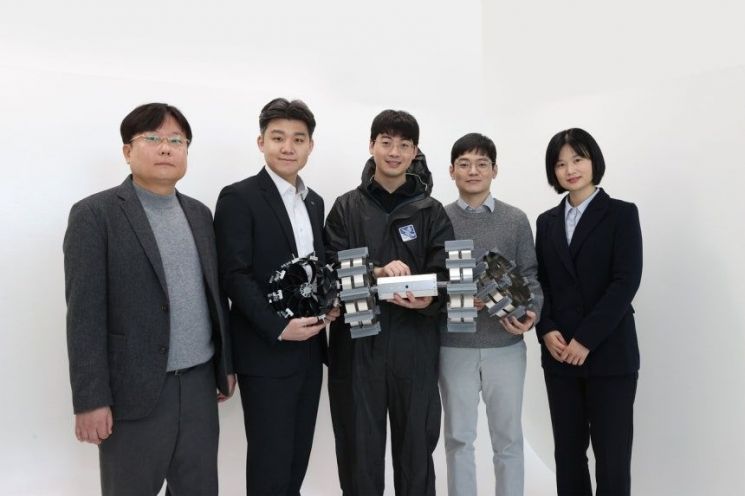 (From left) Jongtae Jang, Principal Researcher at Korea Aerospace Research Institute; Namseok Cho, CEO of Unmanned Exploration Research Institute; Seongbin Lee, PhD Candidate at KAIST; Daeyoung Lee, Professor at KAIST; Chaekyung Shim, Center Director at Korea Astronomy and Space Science Institute. Provided by KAIST
To address these problems, the research team proposed a new deployable wheel that combines an origami structure with soft robotics technology, instead of relying on complex mechanical systems. By applying the interlocking structure of the 'Da Vinci Bridge' and folding high-elasticity metal plates in an origami fashion to form a wheel, the design can withstand the harsh conditions of space.
The developed deployable airless wheel can be folded down to a diameter of 23 cm and expanded up to 50 cm, even without components such as hinges, just like a conventional wheel. This allows small rovers for exploration to secure the mobility needed to overcome large obstacles.
This wheel also demonstrated outstanding performance in test environments. It showed excellent driving capabilities on artificial lunar soil and proved its exceptional shock resistance by maintaining its shape and function even after being dropped from a height of 100 meters under lunar gravity conditions.
Professor Lee stated, "The deployable airless wheel is the world's first technology to solve the problem of entering lunar pits and lava tubes, which no one has previously overcome. This will serve as a turning point for Korea to usher in an era of independent lunar exploration."
He added, "Although there are still remaining challenges such as communication, navigation, and power, if we use this technology as a breakthrough and address each issue step by step, Korea's lunar exploration will move beyond being a dream and enter the implementation stage."
This research is recognized as a significant achievement in presenting next-generation mobility technology to overcome extreme space environments. The results of this study, co-authored by Seongbin Lee, PhD candidate at KAIST, and Namseok Cho, CEO of Unmanned Exploration Research Institute, as joint first authors, were published in the December issue of the international robotics journal Science Robotics.
© The Asia Business Daily(www.asiae.co.kr). All rights reserved.
![Clutching a Stolen Dior Bag, Saying "I Hate Being Poor but Real"... The Grotesque Con of a "Human Knockoff" [Slate]](https://cwcontent.asiae.co.kr/asiaresize/183/2026021902243444107_1771435474.jpg)
















