Accelerating Reforms After the Launch of the Popular Sovereignty Government
Comprehensive Review of Reform Initiatives
The Presidential Security Service, marking its 62nd anniversary, conducted a comprehensive review of its reform initiatives undertaken since the launch of the government based on popular sovereignty and reaffirmed its commitment to becoming a trusted and professional security agency suited to the new "Cheong Wa Dae era."
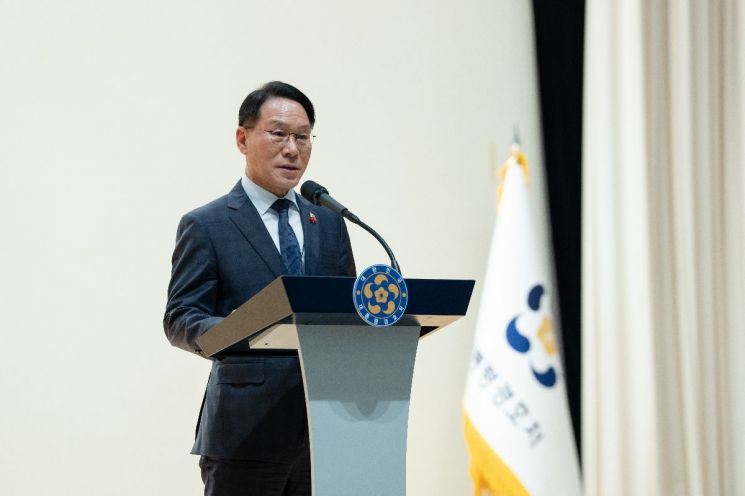
At the founding anniversary ceremony held at the main auditorium of the Presidential Office on the 15th, Hwang Inkwon, Chief of the Presidential Security Service, stated, "This year has been a meaningful one in which, following the inauguration of the new administration, we engaged in self-reflection, apologized to the public for past mistakes, and took the first steps toward change." He added, "As core tasks, we have pursued personnel and organizational renewal, as well as improvements to our organizational culture." He further emphasized, "Next year must be the year when these changes take root as a new standard, not just as temporary measures."
Since the launch of the new administration in June, the Presidential Security Service has carried out fundamental reforms in four key areas-personnel, organization, culture, and the security work system-with the goal of swiftly normalizing security operations and establishing a public security function aligned with constitutional values. In connection with the '12·3 Rebellion,' the agency conducted a detailed analysis of the types of illegal acts and cooperation by staff, clarifying accountability based on the seriousness and directness of the acts and whether there was command responsibility, strictly adhering to a zero-tolerance policy. To prevent excessive concentration of key powers and to respond to the increasingly complex and diverse security environment, the agency streamlined its administrative structure by consolidating similar functions and reassigning departments, while strengthening organizational functions with a focus on the security field.
Efforts to establish a horizontal and collaborative organizational culture were also pursued in parallel. During his first six months in office, Chief Hwang held communication sessions with all staff ("Talk Talk with the Chief") to directly gather feedback from the field, identifying a total of over 50 key tasks across five areas: systems and policies, organizational culture, work improvement, education and capacity building, and improvement of working conditions and welfare.
The Presidential Security Service stated, "We will treat this reform as the starting point for sustainable change and will continue to firmly uphold the principles of 'open security and low-profile security' based on the Constitution and the law. We will place the utmost priority on the safety of our protectees and the public, establish a transparent and accountable security system, and strive to become a trusted and professional security agency."
© The Asia Business Daily(www.asiae.co.kr). All rights reserved.
![Clutching a Stolen Dior Bag, Saying "I Hate Being Poor but Real"... The Grotesque Con of a "Human Knockoff" [Slate]](https://cwcontent.asiae.co.kr/asiaresize/183/2026021902243444107_1771435474.jpg)















