Shortfall in Dividend Income Tax Offset by Individual Consumption Tax
Annual Average of 257.7 Billion Won in Taxes to Be Imposed Starting Next Year
With the imposition of taxes on synthetic nicotine cigarettes, it is expected that nearly 1.3 trillion won will be collected as individual consumption tax over the next five years. Although tax revenues such as dividend income tax fell short of initial targets during the National Assembly's tax law review, increases in revenues from sources like individual consumption tax have allowed the government to make up for its targeted tax revenue goals.
According to the National Assembly Budget Office's report, "Results and Key Points of the 2025 Revised Tax Law Review," released on December 19, the amendment to the Tobacco Business Act will add the relevant individual consumption tax to synthetic nicotine cigarettes starting next year. Beginning with 95 billion won in 2026, a total of 1.2885 trillion won in taxes is expected to be collected over five years until 2030. This amounts to an annual average of 257.7 billion won in taxes over the next five years.
Previously, through discussions in the National Assembly, the definition of tobacco was expanded from products made from tobacco leaves to those made from both tobacco and nicotine, resulting in synthetic nicotine-based cigarettes being subject to individual consumption tax like traditional tobacco products. However, an exception has been made to reduce the initial burden on small businesses involved in the manufacturing and distribution of synthetic nicotine, allowing for a two-year reduction in the individual consumption tax.
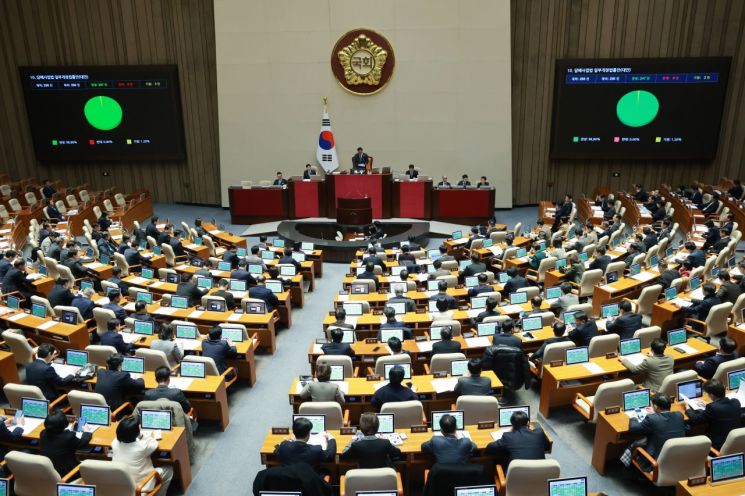 On December 2 last year, the partial amendment bill of the Tobacco Business Act was passed at the plenary session of the National Assembly. Photo by Yonhap News
Thanks to the individual consumption tax, the government has been able to maintain its original tax revenue projections. According to the National Assembly Budget Office's analysis, if the government's proposed tax law amendments had been passed as submitted to the National Assembly, tax revenues would have increased by 37.804 trillion won over the next five years. However, due to the National Assembly's review, measures such as separate taxation of dividend income for individual shareholders of high-dividend companies and the introduction of a special deduction for contributions to the Korea Development Bank's Advanced Strategic Industry Fund (corporate tax) reduced tax revenues by 903.1 billion won and 400 billion won, respectively, over five years. The decrease in tax revenue is expected to be offset by the individual consumption tax on synthetic nicotine. In addition, the increase in the penalty tax rate for the issuance and receipt of false tax invoices (570 billion won over five years, value-added tax) will help the government come close to achieving its originally targeted tax revenue goals.
Meanwhile, the National Assembly Budget Office projected that the revised tax law would increase tax revenues by 37.5104 trillion won over the next five years, which is 293.6 billion won less than the government's original proposal.
© The Asia Business Daily(www.asiae.co.kr). All rights reserved.
![Clutching a Stolen Dior Bag, Saying "I Hate Being Poor but Real"... The Grotesque Con of a "Human Knockoff" [Slate]](https://cwcontent.asiae.co.kr/asiaresize/183/2026021902243444107_1771435474.jpg)















