19.3 Hectares of Climate Response Forests Created Over Three Years
18.2 Billion KRW in National Funding Invested
Recommended Tree Species Like Korean Black Pine Planted
Fine Dust Alerts Drop by 80%
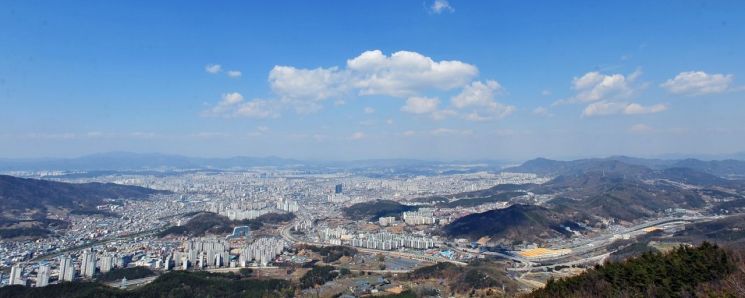
Daejeon City has significantly improved the quality of life for its citizens by investing 18.2 billion KRW in national funds over three years to create "climate response forests," establishing "Green Clean City Daejeon" where residents can enjoy the city's green breath.
From 2023 to 2025, Daejeon City created climate response forests covering 19.3 hectares-an area equivalent to about 270 soccer fields-to block and reduce fine dust. A total of 18.2 billion KRW was invested, including funds from the Korea Forest Service.
Unlike ordinary urban forests, climate response forests are designed to absorb fine dust and minimize its spread. According to research by the National Institute of Forest Science, areas with urban forests have PM10 concentrations that are 25% lower and PM2.5 concentrations that are 40% lower than surrounding city areas.
In these forests, recommended tree species with excellent fine dust reduction effects-such as Korean black pine, Korean pine, dawn redwood, and bald cypress-were planted. These trees block the movement of fine dust with their leaves and branches, and their rough leaves and bark trap dust, helping to reduce airborne fine particles. In addition, the forests weaken internal winds and increase humidity, allowing fine dust to settle more quickly.
Notably, a forest of one hectare can absorb 46 kilograms of fine dust per year, which is equivalent to the amount emitted annually by 27 diesel vehicles.
This year, climate response forests were created in major neighborhood parks within residential areas-including Panam Neighborhood Park (1 ha), Tapgol Neighborhood Park (1.5 ha), Sajeong Neighborhood Park (3 ha), and the idle land at Daecheong Dam spillway (6 ha)-so that citizens can easily enjoy clean air in their daily lives.
Thanks to these efforts, the improvement in air quality across Daejeon has been substantial. In fact, the number of fine dust and ultrafine dust alerts dropped significantly after the establishment of climate response forests, from 34 times in 2023 to 15 times in 2024, and to 7 times in 2025.
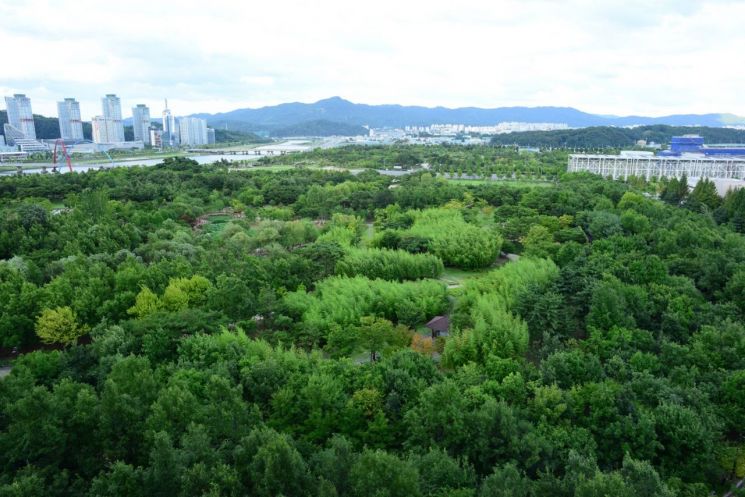
In 2026, Daejeon City plans to secure an additional 2.4 billion KRW to continue creating clean forests at four locations: Daedeok Industrial Complex (0.5 ha), Maebong Neighborhood Park (1 ha), Gapcheon Ecological Lake Park (1.5 ha), and idle land in Yongsan-dong (0.4 ha).
Additionally, the "Urban Wind Path Forest" project, which has been promoted alongside the climate response forests, was implemented over the past three years with an investment of 9.9 billion KRW across 32 routes. While this project initially aimed to mitigate the urban heat island effect and achieve carbon neutrality, it will now also serve as an "air purification corridor" by working in conjunction with climate response urban forests to help absorb and disperse fine dust.
Park Youngcheol, Director of Greenery and Agro-Bio at Daejeon City, stated, "The climate response forests and wind path forests throughout the city are working together to keep Daejeon's air clean. We will continue to create world-class forests where all citizens can find rest and happiness, and enjoy the city's green breath."
© The Asia Business Daily(www.asiae.co.kr). All rights reserved.
![Clutching a Stolen Dior Bag, Saying "I Hate Being Poor but Real"... The Grotesque Con of a "Human Knockoff" [Slate]](https://cwcontent.asiae.co.kr/asiaresize/183/2026021902243444107_1771435474.jpg)
















