“Private Investment-Linked TIPS R&D Expansion Plan”
Presented at the 2nd Meeting of Ministers Related to Science and Technology
The Ministry of SMEs and Startups is restructuring the TIPS (Tech Incubator Program for Startup) R&D support system to expand the outcomes of TIPS R&D into various technologies and industries, and to serve as a catalyst for regional innovation.
On December 18, the Ministry of SMEs and Startups announced its “Plan for Expanding Private Investment-Linked TIPS R&D” at the 2nd Science and Technology Ministers' Meeting. TIPS is a private sector-led technology innovation program in which private investors identify and invest in R&D projects of innovative companies first, and then the government provides matching R&D funding. From 2013 to this year, the program has attracted 21.3 trillion won in private investment-nearly ten times the government’s R&D contribution of 2.2 trillion won-to more than 5,000 innovative companies. Based on this robust private investment, 48 companies have successfully gone public through IPOs, and there have been 96 cases of mergers and acquisitions (M&A).
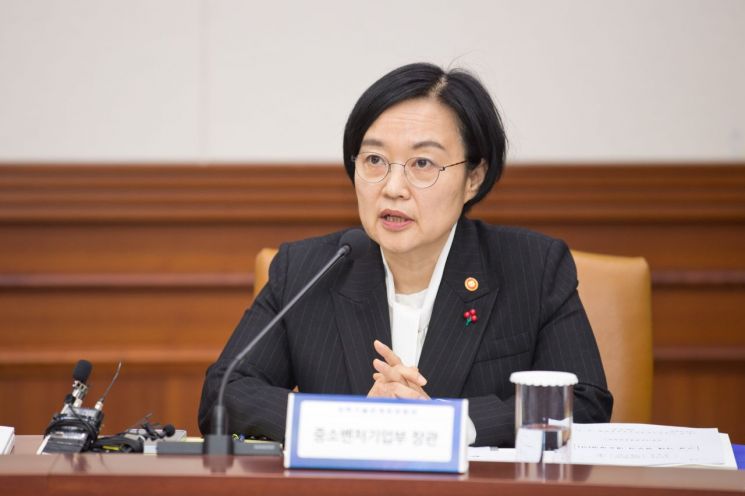 Hansung Sook, Minister of SMEs and Startups, is speaking at the 2nd Science and Technology Ministers' Meeting held at the Government Seoul Office in Jongno-gu, Seoul on the 18th. Ministry of SMEs and Startups
The Ministry will first simplify the startup-phase TIPS, which had previously been divided into multiple complex tracks, by integrating them. The global track will be abolished, and the deep tech track will be changed to provide follow-up support for companies that have achieved results in basic R&D. The number of scale-up TIPS R&D projects for the growth phase will be expanded to 300, and a new global TIPS R&D program will be established to promote overseas expansion. This will restructure the support system into a full-cycle model covering startup, growth, and global expansion.
Support amounts will also be increased to match company value at each growth stage. TIPS R&D funding will be raised to 800 million won, while scale-up TIPS R&D will be increased to a maximum of 3 billion won. For global TIPS R&D, which requires prior overseas investment, up to 6 billion won will be provided. At the same time, the “Deep Tech Challenge Project,” which tackles difficult technological challenges, will be expanded to up to 5 billion won per project. The “Ecosystem Innovation-Type” project, a large-scale collaborative project involving multiple SMEs to be piloted in 2026, will offer up to 20 billion won per project.
To ensure that each stage is linked through private investment, the Ministry will expand “commercialization matching investment”-where the government co-invests alongside private follow-on investors-to all stages of TIPS. This aims to further encourage active private investment by strengthening connections with investment firms.
In line with the expanded support system, the number of operating entities responsible for identifying post-scale-up TIPS candidates will be significantly increased to more than 80. Over 50 “general operators” will be selected at the investment firm level, while up to 30 “specialized operators”-consortia consisting of investment firms and R&D partners-will be designated for projects requiring strategic support, enabling tailored assistance. In addition, participation by specialized agencies in each field will be expanded to enhance expertise in project selection, evaluation, and R&D support. The “moving target support system” will be introduced to strengthen autonomy and accountability in R&D execution, allowing for flexible responses to technological and market changes.
Inter-ministerial cooperation will also be expanded to discover and nurture promising companies in strategic technology sectors. When each ministry identifies and recommends companies based on policy demand, the Ministry of SMEs and Startups will connect them with private investment and support TIPS R&D. If projects are recommended, their market potential will be supplemented and linked to the Deep Tech Challenge Project. To this end, a “TIPS R&D Coordination Committee” will be established to coordinate policies and plans, and a “TIPS R&D Task Force” composed mainly of private experts will be formed to handle R&D support operations.
From next year, regional preferences in TIPS R&D will be greatly strengthened. More than 50% of standard and scale-up TIPS will be allocated to regional companies, and private investment requirements for regional companies will be relaxed to reflect local investment conditions. At the same time, investment firms based in the regions will be prioritized to encourage investment in local companies.
To ensure sustainable regional investment, the foundation for regional venture investment will be established. Regional investment-dedicated funds, combining the mother fund (such as the Regional Growth Fund) and local innovation capital, will be gradually expanded through 2030. Legal and institutional improvements, such as abolishing restrictions on local governments’ venture fund investments, will also be implemented.
Minister Hansung Sook stated, “It is necessary to expand TIPS R&D, which has led the startup and venture ecosystem, into an inter-ministerial policy platform to drive innovation across various technologies and industries.”
© The Asia Business Daily(www.asiae.co.kr). All rights reserved.
![Clutching a Stolen Dior Bag, Saying "I Hate Being Poor but Real"... The Grotesque Con of a "Human Knockoff" [Slate]](https://cwcontent.asiae.co.kr/asiaresize/183/2026021902243444107_1771435474.jpg)















