Government Presents 'NEXT K' as a Turning Point
Redesigning Industry Structure with 'AI Reset' and 'IP League'
Shifting Policy Focus from Short-Term Hits to Building Industry Resilience
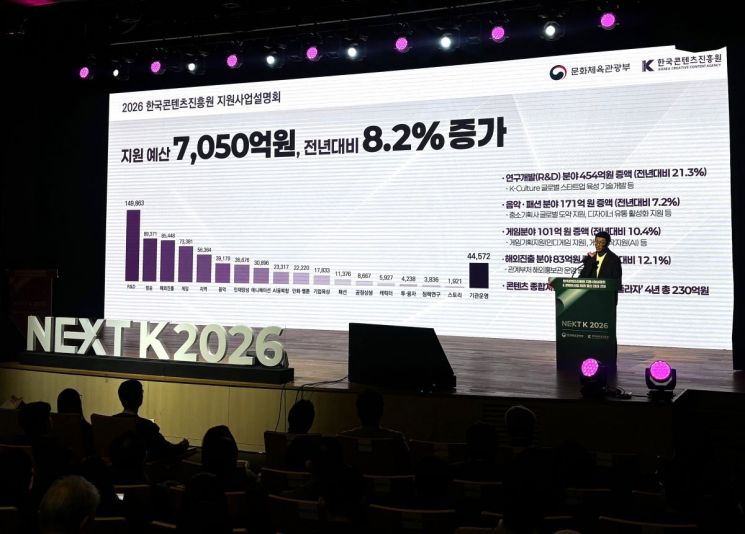
The government has defined 2026 as a turning point that will determine not the growth, but the direction of K-content.
The Ministry of Culture, Sports and Tourism and the Korea Creative Content Agency (KOCCA) predicted at the "NEXT K 2026" event held at COEX in Seoul on the 17th that next year will be the "golden time" to decide the next stage of K-content. They believe it is a moment when the industry must choose between short-term results and the sustainability and structural transformation of the sector.
Yoo Hyunseok, Acting President of KOCCA, stated, "2026 will be a crucial period to determine whether K-content can move beyond crisis and advance toward a sustainable NEXT-K." Song Jin, Director of KOCCA's Content Industry Policy Research Center, also said, "It is a time to decide on the sustainable growth of K-content and its leap to the 'Next K.'"
This outlook is less about predicting new trends or genres and more about indicating which choices to make amid already established changes. The background for this is the accumulation of changes over the past several years. The use of generative AI has spread across production sites, and intellectual property (IP) has shifted from one-off hits to a model of repetition and expansion. The global market has also moved away from a single-region focus to a phase that emphasizes local sentiment and cultural connection.
KOCCA noted that these changes are not isolated phenomena but have simultaneously entered a stage of maturity. Accordingly, they presented several key keywords as the directions that the K-content industry must choose from 2026 onward.
The first is the "AI Reset." Director Song explained, "The capabilities and roles of creators are changing," and "new roles such as AI content strategists and AI content engineers are emerging." He argued that the industry has entered a stage where competitiveness is determined not by whether AI is used, but by where and how it is applied.
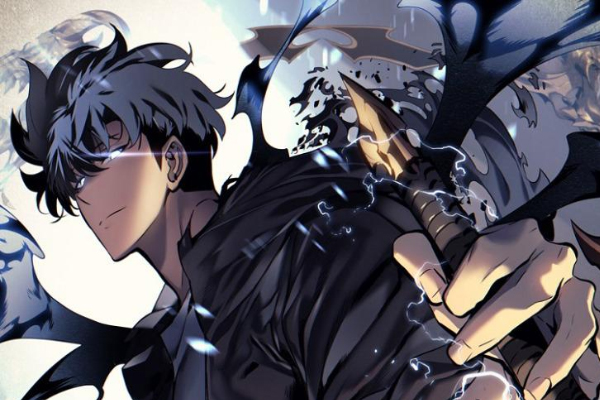 Starting from a web novel and expanding into webtoons, animations, games, and dramas, "Solo Leveling" has sparked a global phenomenon.
In support of this, policy support is being expanded. Koo Kyungbon, Head of KOCCA's Management Strategy Division, said, "The 2026 budget is 705 billion won, an 8.2% increase from the previous year," and added, "Support for content production using AI has been greatly expanded to 18.8 billion won, covering 50 projects." He continued, "We plan to establish an AI-specialized content academy with a budget of 19.1 billion won to foster creative talent tailored to AI."
KOCCA also highlighted the need to address copyright and data governance, fair use, and the restructuring of revenue-sharing models as AI becomes more widespread. Director Song stated, "While simple tasks in content production are being largely replaced by AI, roles involving narrative design, direction, and aesthetic judgment are becoming even more important." Along with the restructuring of repetitive and standardized work, the reorganization of job structures centered on AI utilization skills, and the redesign of production systems that combine human creativity with AI productivity, have emerged as key tasks. Going forward, the issue will move beyond whether to adopt technology and will focus on redesigning the very operational structure of the content industry.
The second pillar is the "Content IP League." Director Song explained, "IPs with unique universes and a stable user base are evolving into a model similar to sports clubs, growing based on fandom." As a representative example, he cited "Solo Leveling," which started as a web novel and expanded into webtoons, animation, games, and drama, creating a global phenomenon.
KOCCA defines IP not as the proprietary asset of individual companies, but as a cyclical structure that expands across the entire industry. They believe that with IPs possessing unique universes and fandoms at the center, collaboration with other industries, multi-format development, and related industry expansion can be repeated.
In such a structure, strategies that accumulate IP value by broadening overall market interest and user experience, rather than limiting success to a single company, become increasingly important. This can help mitigate the volatility of the content industry and provide a foundation for long-term growth.
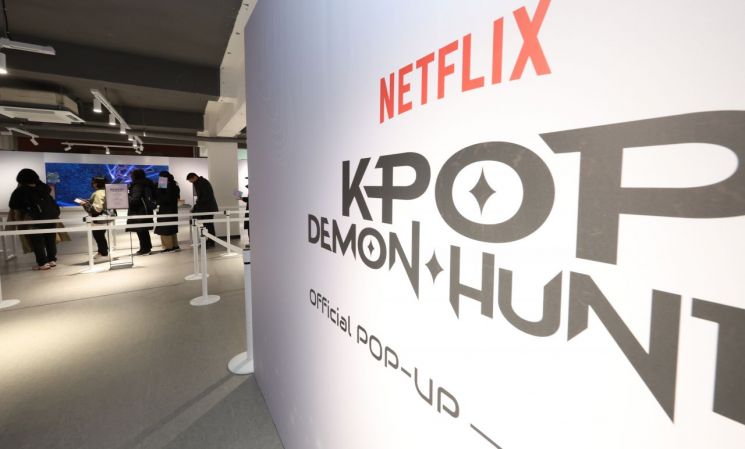
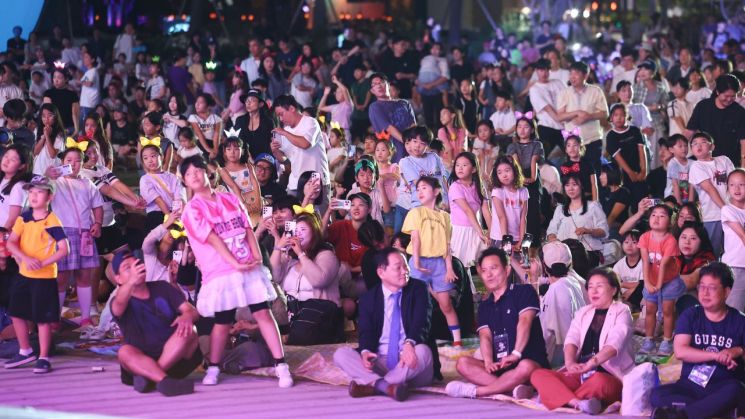 On September 14, at Seoul Plaza in Jung-gu, Seoul, citizens and tourists were dancing along to the point choreography of "Sodapop," a song featured in the Netflix animation "K-Pop Demon Hunters," during the 2025 Seoul Hunters Festival. Photo by Yonhap News Agency
The core of the global strategy is "HIP 2.0." This concept combines hyper-localization, inbound hubs, and partnerships, aiming to strengthen cultural and emotional connections with local audiences, moving beyond simple translation or expanded distribution.
Director Song explained, "Translation, editing, and production methods are becoming more sophisticated so that overseas users can naturally accept the unique emotions embedded in K-content." There is a growing recognition that strategies connecting global viewers and content emotionally, through multi-language production, localized versions tailored to each country's sensibilities, and collaboration with local partners, are becoming increasingly important.
Acting President Yoo stated, "We will strengthen the World Content Marketplace (a digital export platform connecting Korean content companies with overseas buyers online) centered on the network of 30 overseas business centers, so that content companies can more easily meet global buyers from within Korea."
The key foundations supporting the content industry in 2026 will be "attachment capital" and "fan relationships." Director Song noted, "Fans' affection does not remain at the level of emotion, but moves the market and leads to actual revenue," and described, "Love and betrayal are separated by a thin line." He believes that the process of accumulating trust through fan-participatory platform operations, transparent communication, and consistent content identity can lead to long-term competitiveness.
It was also pointed out that if the industry becomes too focused on short-term results, fans' expectations may collapse, and the resulting aftermath could quickly turn into risk. This means that relationship management is emerging as a key factor determining the sustainability of the industry, even before revenue models are considered.
With this awareness, KOCCA has shifted its policy focus from supporting short-term box office success to strengthening the industry's overall resilience. Koo Kyungbon, Head of KOCCA's Management Strategy Division, explained, "We have concentrated support on future growth areas centered on AI and research and development, allocating 45.4 billion won to R&D and 10.1 billion won to the gaming sector." Along with the introduction of technologies to improve production efficiency, the aim is to establish a foundation for continuously accumulating creative capabilities.
Acting President Yoo stated, "The content industry is at a turning point where the technological environment and the order of the global market are rapidly changing," adding, "We will focus on mid- to long-term policy support and strengthening the industrial base to ensure that K-content does not miss its golden time for a leap forward."
© The Asia Business Daily(www.asiae.co.kr). All rights reserved.
![Clutching a Stolen Dior Bag, Saying "I Hate Being Poor but Real"... The Grotesque Con of a "Human Knockoff" [Slate]](https://cwcontent.asiae.co.kr/asiaresize/183/2026021902243444107_1771435474.jpg)


















