After the Gyeongnam Provincial Council approved next year's budget for the Gyeongnam Office of Education, which included a complete cut of the Future Education District budget the previous day, the "Gyeongnam Village Education Community Activation Residents' Meeting" strongly condemned the decision.
On December 17, the residents' group held a press conference in the Provincial Council's briefing room and announced that they would take the lead in enacting the "Gyeongnam Village Education Community Activation Support Ordinance," which provides the basis for operating the Future Education District, through the resident ordinance proposal system.
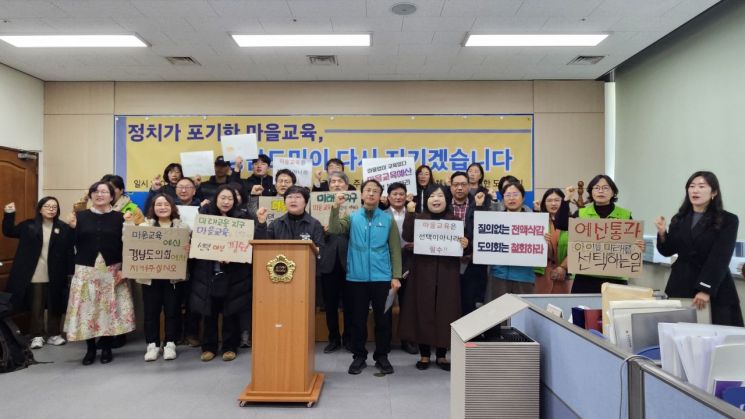 The 'Gyeongnam Village Education Community Activation Residents' Meeting' is condemning the complete budget cut of the Gyeongnam Office of Education's Future Education District. Photo by Se-ryeong Lee
The group stated, "We feel deep anger and devastation that the Provincial Council completely cut the Future Education District budget during the review of the 2026 main budget for the Gyeongnam Office of Education."
They further criticized, "This is not a simple budget adjustment but a decision to abandon the future of education in Gyeongnam, and a reckless act that disregards the lives and growth of children."
The residents' group argued, "The Future Education District project was a core policy of Gyeongnam-style educational innovation that helped children learn and grow beyond the classroom, within their communities. Cutting the budget for such a project is a unilateral decision that ignores voices from the field and the demands of residents, and is an irresponsible action that leaves children neglected in the face of the crisis of regional extinction."
They stated, "The clock of Gyeongnam education is turning backward," and defined the situation as "an absurd catastrophe."
They emphasized, "If the Provincial Council has halted the policy by abolishing the ordinance and then cutting the budget, we will establish an institutional foundation to ensure the village education community continues without disruption by directly proposing the ordinance as residents."
They added, "This ordinance will not be a mere declaration, but a new promise for Gyeongnam education that explicitly defines children's right to grow and the region's educational responsibility."
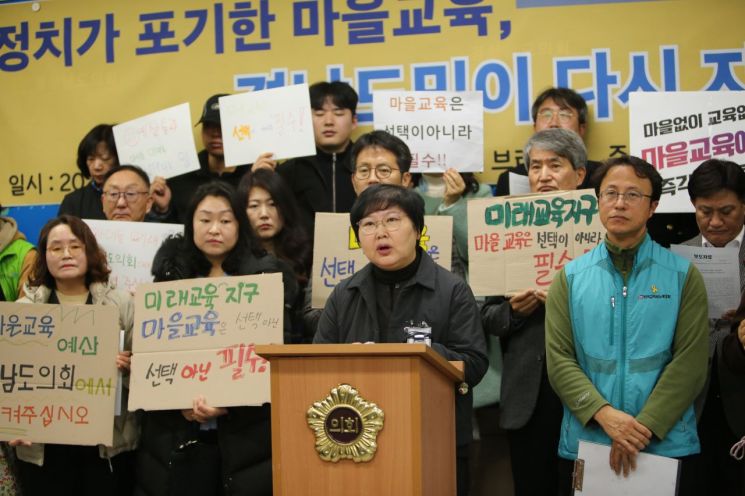 Hwang Eunyoung, representative of the Gyeongnam Village Education Community Residents' Meeting for Revitalization, is speaking about the complete budget cut of the Future Education District project. Photo by Lee Seryung
Hwang Eunyoung, the representative, said, "Given the situation so far, we can no longer rely on the Office of Education or the council, so we intend to propose the ordinance through the power of the residents. Based on the residents' group, we plan to collect and submit the opinions of more than 14,000 residents over the next six months."
She also stated, "The only way to deliver the power of the residents to the council members is through the resident ordinance proposal system," and added, "We also plan to work together with prospective candidates for superintendent during the process of collecting residents' opinions."
The resident ordinance proposal system allows residents to directly request the enactment, revision, or abolition of ordinances from the local council by gathering a certain number of signatures as stipulated by law.
In Gyeongnam, if more than 14,000 residents aged 18 or older sign in solidarity, an ordinance proposal can be submitted.
If the ordinance proposal process is lawful, the local council must review and decide on it within one year after the chairperson accepts it.
The Future Education District project was implemented in 18 cities and counties in the province, based on the "Gyeongsangnam-do Village Education Community Activation Support Ordinance" enacted in July 2021.
However, due to concerns over undermining educational neutrality, the implementation of ideological and value-based education, and inadequate standards for hiring and managing instructors, the ordinance was abolished by the Provincial Council in 2024. Subsequently, the Future Education District budget was completely cut, and the project was effectively halted.
In response, the provincial Office of Education restructured the project into the "Future Education District for Population Decline Crisis Response," targeting 14 cities and counties in the province (excluding Changwon, Jinju, Yangsan, and Geoje) that are experiencing population decline and at risk of regional extinction, and included it in the 2026 budget proposal. However, the budget was once again completely cut, and the project could not move forward.
© The Asia Business Daily(www.asiae.co.kr). All rights reserved.


















