Work Briefing Presided Over by President on the 17th
Launch of Renewable Energy Meteorological Services
Advancement of AI-Based Weather and Climate Prediction Systems
The Korea Meteorological Administration announced plans to improve its special warning system, strengthen monitoring and forecasting capabilities, and enhance the earthquake early warning system to protect public safety from climate disasters.
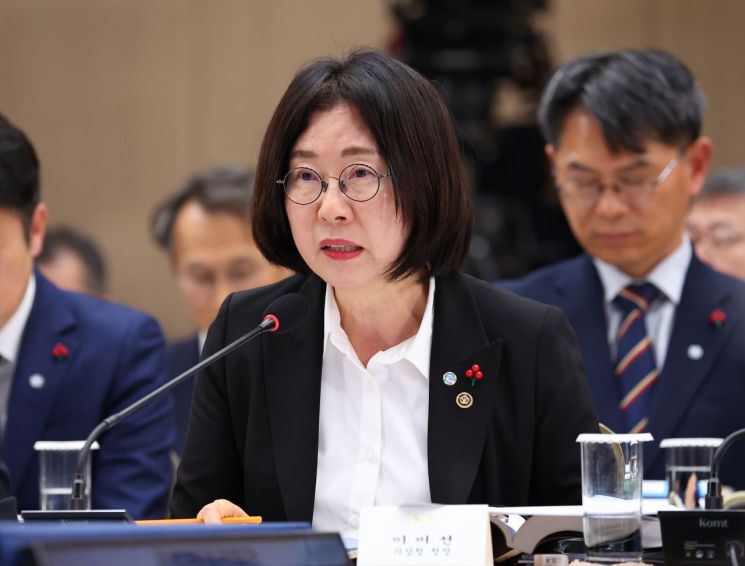 Im Sun, Director of the Korea Meteorological Administration, is reporting to President Lee Jae-myung at the Government Sejong Convention Center on the 17th. Photo by Yonhap News Agency
During a work briefing presided over by President Lee Jaemyung at the Government Sejong Convention Center on the 17th, the Korea Meteorological Administration stated that it will introduce a new Severe Heatwave Warning and Tropical Night Advisory starting in June next year.
The current heatwave warning is issued when the maximum daily apparent temperature is expected to reach 35 degrees Celsius or higher for at least two consecutive days. The newly introduced Severe Heatwave Warning will be issued when the warning criteria are met and the maximum apparent temperature is forecast to reach 38 degrees Celsius or higher for two (or one) days. The Tropical Night Advisory will be issued when the minimum nighttime temperature is expected to remain at 25 degrees Celsius or higher for at least two consecutive days.
Given that there were 16 instances of heavy rainfall exceeding 100mm per hour last year and 15 this year, the Korea Meteorological Administration will expand the issuance of higher-level emergency disaster text messages starting in May next year. The criteria for sending these messages will be either "80mm of rainfall in one hour and 20mm in 15 minutes" or "100mm or more of rainfall in one hour."
The Korea Meteorological Administration will integrate radar operations with the Ministry of Climate, Energy and Environment to ensure connectivity in monitoring heavy rain and snow, and to strengthen support for flood response. In addition, earthquake on-site alerts, which were previously sent only to critical national infrastructure such as nuclear power plants and dams, will be incorporated into the early warning system to establish a two-stage alert system. The notification time for earthquake early warnings will be significantly reduced to 3-5 seconds after the initial observation.
With the confirmation of the 2035 Nationally Determined Contribution (NDC) target for greenhouse gas reduction and the acceleration of renewable energy adoption, the Korea Meteorological Administration will begin providing customized meteorological services for renewable energy, based on observation and forecasting, to support solar and wind power generation.
The Korea Meteorological Administration will develop a reanalysis wind field and a renewable energy resource map by December next year by integrating artificial intelligence (AI), numerical models, and observational data to support site selection for wind power generation. It will also produce solar radiation and wind meteorological forecast data for solar and wind power generation and demand forecasting, and provide this information through an integrated renewable energy meteorological information platform.
Im Sun, Director of the Korea Meteorological Administration, stated, "We will make every effort to utilize advanced technologies such as AI to ensure that climate response is based on science, in order to protect public safety from climate disasters."
© The Asia Business Daily(www.asiae.co.kr). All rights reserved.

















