Six-Party Consultative Group Led by Government Reaches Conclusion...
Muan Integrated Relocation Moves Forward
1 Trillion Won in Support, Industrial Development,
and Consideration of "Kim Daejung Airport" Name Included
Welcomed by Many, but Civil Society Raises Concerns Over "Imbalance of Responsibility"
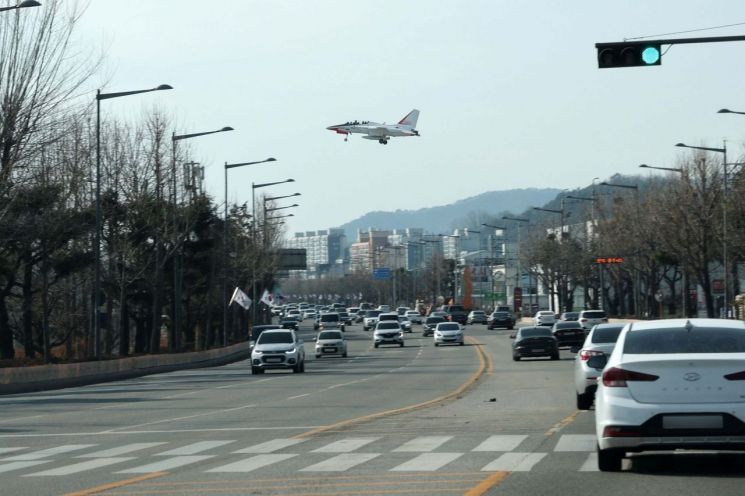
Negotiations between the central government and local governments regarding the integrated relocation of Gwangju's military and civilian airports have reached a conclusion after decades of discussion. On December 17, the government, Gwangju City, South Jeolla Province, Muan County, the Ministry of Economy and Finance, the Ministry of National Defense, and the Ministry of Land, Infrastructure and Transport jointly announced at a six-party consultative meeting held in Gwangju that they had agreed to relocate the Gwangju Military Airport to Muan.
At the six-party task force (TF) meeting on the relocation of Gwangju Military Airport, held that morning at Gwangju Urban Corporation, an agreement was adopted outlining the principles of relocation and government support measures. The government designated this agreement as a key task for balanced national development and pledged to provide full support to ensure its smooth implementation.
1 Trillion Won in Support and Industrial Development... Key Points of the Muan Relocation Agreement
According to the agreement, Gwangju City will allow Muan County to secure development profits generated from the military airport relocation project as a priority, so that these can be used for local resident support initiatives. To this end, a total fund of 1 trillion won will be raised, including Gwangju City's own resources and government policy support and subsidies, with specific funding plans to be presented promptly.
South Jeolla Province and the central government agreed to establish a foundation for advanced industries in Muan County, including the creation of a national agricultural AX platform, new energy industries, and an aviation MRO (Maintenance, Repair, and Overhaul) center, as well as to attract businesses. The agreement also includes the prompt designation of the Muan National Industrial Complex and the inclusion of additional support projects.
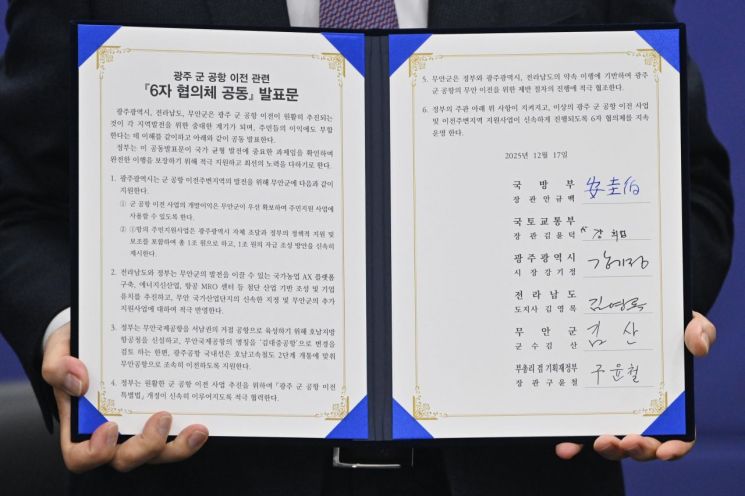 On the morning of the 17th, guests attending the first meeting of the "Gwangju Military Airport Relocation Six-Party Consultative Group" held at Gwangju Urban Corporation in Seo-gu, Gwangju, unveiled the "Joint Statement." Photo by Yonhap News
The government will push for the establishment of the Honam Regional Aviation Administration to foster Muan International Airport as a key hub for the southwest region, and is also considering renaming Muan International Airport to "Kim Daejung Airport." Domestic flights at Gwangju Airport will be transferred to Muan Airport in line with the opening of the second phase of the Honam High-Speed Rail.
To facilitate the relocation of the military airport, the parties also agreed to cooperate on amending the "Special Act on the Relocation of Gwangju Military Airport." Muan County will cooperate with the administrative procedures for the relocation, provided that the government, Gwangju City, and South Jeolla Province fulfill the agreed items. The government plans to continue operating the six-party consultative group under its leadership to monitor the implementation of the agreement and manage both the relocation project and support initiatives for surrounding areas.
Turning Point in 2027... Military Airport Relocation Procedures Begin
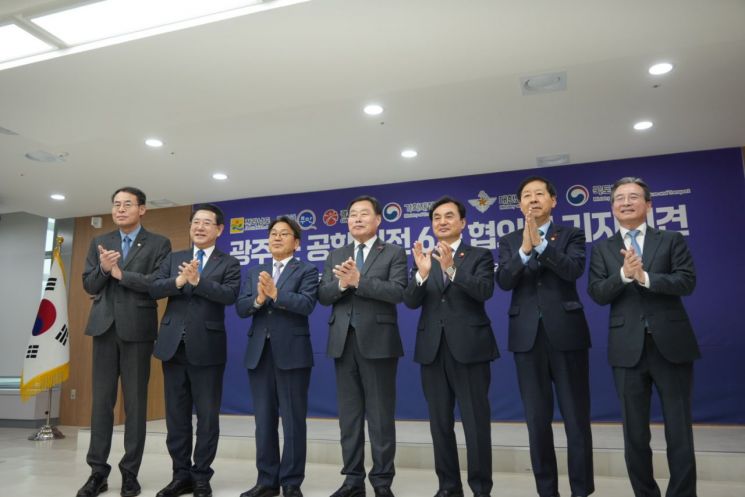 On the 17th, after the joint announcement of the six-party consultative body related to the relocation of Gwangju Military Airport at Gwangju Urban Corporation, a commemorative photo was taken. On that day, Kim Yongbeom, Chief of Policy Office at the Presidential Office, evaluated the agreement, saying, "It is meaningful in that it created an opportunity for resolution through dialogue and consultation on regional conflicts that have continued for decades." Photo by Song Bohyun
This agreement has drawn attention to the timeline for the next steps. The government and relevant authorities plan to finalize the relocation site in Muan by 2027, which coincides with the scheduled transfer of the civilian airport and the opening of the second phase of the Honam High-Speed Rail. The military airport relocation process will proceed through the following steps: proposal for relocation, feasibility study, selection of preliminary relocation candidates, selection of the relocation site, review of support plans for surrounding areas, resident voting and invitation application, and final selection of the relocation site.
With the official agreement on relocation to Muan reached at the six-party consultative group, the procedures based on the premise of relocating to Muan have now begun. Once the Minister of National Defense announces the preliminary relocation candidates, the site selection process will accelerate, followed by the establishment and review of support plans for surrounding areas, and a resident vote to determine the final relocation site. The vote will be considered valid if more than one-third of eligible voters participate and a majority of valid votes are in favor.
Once the relocation site in Muan is finalized, Gwangju City will construct the new military airport and donate it to the Ministry of National Defense, which will in turn transfer the existing military airport site and facilities to Gwangju City. The entire Gwangju Military Airport relocation project will require a total investment of 5.7 trillion won and will include new airport construction, support for the relocation area, and development of the former site. The project is expected to take at least 10 years to complete.
Mixed Reactions: Welcome and Concern, and Ongoing Disputes Over Responsibility
The announcement of the agreement was met with a series of welcoming statements from the political sphere. Kang Gijung, Mayor of Gwangju, stated on Facebook, "The Muan integrated relocation roadmap is not just about moving an airport, but about designing a new future," adding, "An airport city will be created in Muan, and a 'Gwangju-style Silicon Valley' will emerge in Gwangju."
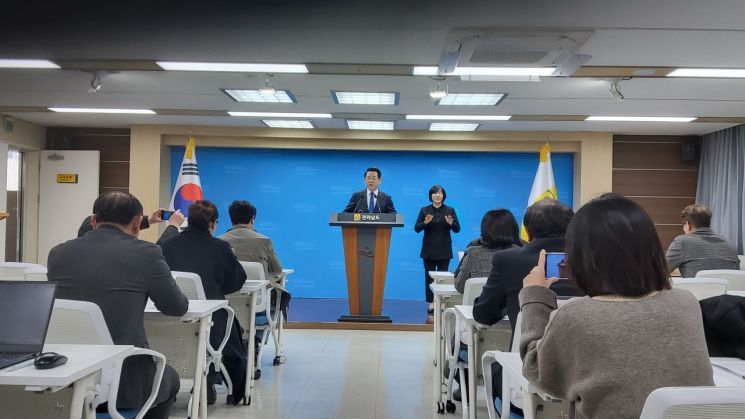 Jeonnam Governor Kim Youngrok held a press conference on the 17th at the Jeonnam Provincial Government briefing room to explain the 'Launch and Operational Direction of the Six-Party Consultative Body for the Relocation of Gwangju Military Airport.' Photo by Shim Jinseok
Kim Youngrok, Governor of South Jeolla Province, held a press conference at the provincial government on the same day, saying, "This joint announcement by the six-party consultative group is significant in that the government and local governments have formalized their commitment to resolving the preconditions demanded by Muan County," and declared that "the military airport relocation is now on track." Governor Kim explained that the agreement included: ▲Gwangju City's creation of a 1 trillion won support fund for Muan County, ▲the establishment of advanced industry infrastructure and business attraction by South Jeolla Province and the government, and ▲the prompt designation of the Muan National Industrial Complex. He also stated, "The civilian airport relocation is expected to coincide with the opening of the second phase of the Honam High-Speed Rail."
The Gwangju City branch of the Democratic Party of Korea evaluated the agreement as "an important turning point in which the central government and local governments have clarified their respective roles and responsibilities and reached a joint conclusion." Assemblyman Jung Junho (Buk-gu Gap, Gwangju) welcomed the decision to review the establishment of the Honam Regional Aviation Administration, saying, "It will help develop Muan Airport into a key hub for the southwest region and transform the former airport site into a new growth engine for Gwangju." Assemblywoman Jeon Jinsook (Buk-gu Eul, Gwangju) also commented, "It is a meaningful step forward in which the state has taken responsible action."
Gwangsan-gu, Gwangju, also welcomed the agreement, stating, "It is significant that the long-stalled issue of airport relocation has begun to be resolved under the responsibility of the state," and emphasized that "President Lee Jaemyung's decision at the town hall meeting on June 25, which made it clear that the relocation of the military and civilian airports should be a national responsibility, was the driving force behind the agreement." The district also expressed hope that the integrated airport would become a gateway for balanced and shared growth between Gwangju and South Jeolla Province, and commented that the decision to name the airport "Kim Daejung Airport" holds symbolic significance in spreading the spirit of Kim Daejung worldwide.
The business community also welcomed the agreement. The Gwangju Chamber of Commerce and Industry stated, "A concrete solution has been found for a problem that has been adrift for 18 years," stressing that "since the military airport is a national security facility, the relocation should be carried out under the responsibility of the state, and a clear basis for national financial support must be established through the amendment of the special law." The chamber also added that the former airport site should be utilized as a strategic base for youth job creation and the concentration of high-tech industries.
On the other hand, the Gwangju Citizens' Coalition raised concerns about the fairness and effectiveness of the agreement.
The coalition argued, "This six-party agreement specifies only Gwangju City's obligations in detail, while the responsibilities of the government and Muan County remain abstract and ambiguous," calling for the agreement to be scrapped and renegotiated. They claimed that only Gwangju City's duties, such as the prior relocation of the civilian airport and the provision of 1 trillion won in support, are clearly defined, while the government's financial responsibilities for the military airport relocation and Muan County's specific implementation obligations are not included. The coalition also insisted that the existing "donation for transfer" method makes the military airport relocation difficult and emphasized that the agreement should specify a government-led amendment to the special law and substantial national responsibility.
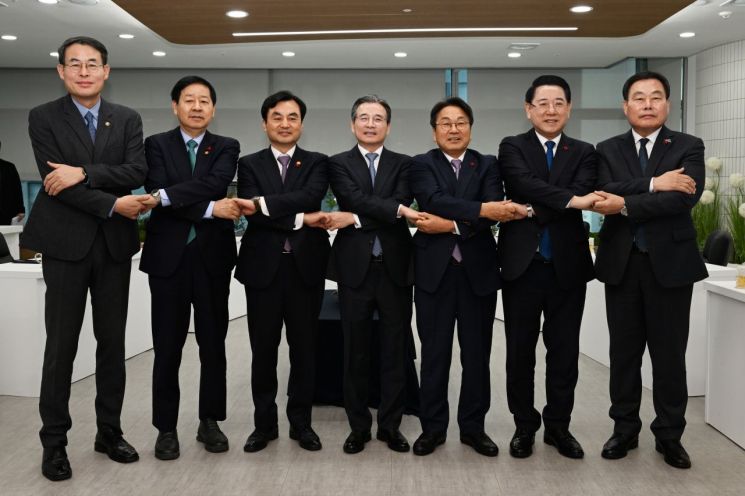 On the morning of the 17th, at Gwangju Urban Corporation in Seo-gu, Gwangju, attendees of the first meeting of the "Gwangju Military Airport Relocation Six-Party Consultative Body" are holding hands after signing the joint statement.
© The Asia Business Daily(www.asiae.co.kr). All rights reserved.



















