On December 17, as Chung Cheongrae, leader of the Democratic Party, joined the inter-ministerial conflict sparked by the Korea-U.S. consultation led by the Ministry of Foreign Affairs on December 16, the Ministry of Foreign Affairs responded by stating, "This is completely different in intent and nature from the previous Korea-U.S. Working Group," in a belated attempt to contain the situation.
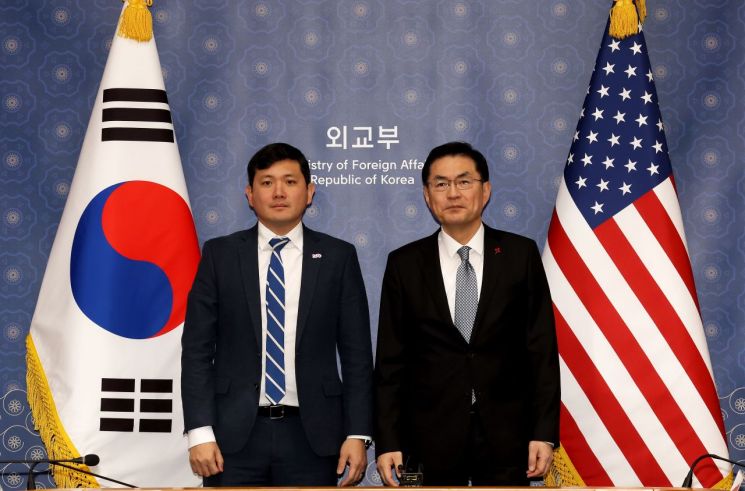 On December 16, 2025, Jung Yeondu, Director of the Office of Foreign Policy Strategy and Information (right), and Kevin Kim, Deputy Chief of Mission at the U.S. Embassy in Korea, posed for a photo after attending the follow-up consultation on the Joint Fact Sheet of the South Korea-U.S. Summit held at the Ministry of Foreign Affairs building in Jongno-gu, Seoul. [Joint Coverage] Yonhap News Agency Photo by Yonhap News Agency
A key official from the Ministry of Foreign Affairs told reporters at the Seoul Government Complex that day, "Both Korea and the United States shared the same understanding on this matter, and that remains unchanged." He added, "Seven years ago, the working group was created under very exceptional circumstances to discuss a specific issue. This time, we are simply starting director-level consultations to follow up on the agreements reached between the leaders-nothing more, nothing less."
The previous day, at the Ministry of Foreign Affairs building, Jung Yeondu, Director of the Office of Foreign Policy and Strategic Information, and Kevin Kim, Deputy Chief of Mission at the U.S. Embassy in Korea, led the three-hour "Korea-U.S. Summit Joint Fact Sheet (JFS) Follow-up Consultation" as chief representatives for each side. During the coordination process before the meeting, the Ministry of Unification criticized the consultation, warning it could become a "second Korea-U.S. Working Group," which had previously been seen as an obstacle to inter-Korean exchanges during the Moon Jae-in administration. In response, the Ministry of Foreign Affairs even changed the name from "Korea-U.S. Policy Coordination on North Korea" but the Ministry of Unification ultimately declared it would not participate. This has led to interpretations of a clash between so-called "sovereigntists" and "alliance advocates," and with Democratic Party leader Chung publicly announcing in the morning that he would "enhance autonomy in Korea-U.S. relations" and "support the Ministry of Unification's position," the dispute appears to be escalating.
The Ministry of Unification's concerns stem from the possibility that the latest Korea-U.S. consultation could provoke North Korea by discussing future sanctions and potentially deprive South and North Korea of opportunities for exchange and cooperation. Addressing these concerns, a key official from the Ministry of Foreign Affairs said, "The focus of this consultation is not on strengthening or implementing sanctions mechanisms, but rather on assessing the current situation and exploring what tasks our governments can undertake to implement the agreements reached between the leaders." It was also reported that no mention of sanctions was made during the closed-door consultation the previous day. The official further explained, "The Ministry of Unification is a partner in cooperation and a ministry with which we maintain close communication; it has never been excluded or kept in the dark in these consultations."
The Ministry of Unification, for its part, has effectively declared an "independent channel," stating, "The Ministry of Foreign Affairs will handle diplomatic policy, while the Ministry of Unification will separately consult with the U.S. side on issues related to inter-Korean dialogue and cooperation and other North Korea policy matters." However, there are concerns that this kind of "two-track" strategy on Korean Peninsula issues could lead to confusion between ministries. A Ministry of Foreign Affairs official emphasized, "We believe the Ministry of Unification can provide any necessary explanations to the United States," but also stressed, "The Ministry of Foreign Affairs will continue to conduct diplomatic negotiations as it always has." He pointed out, "The conduct of these meetings is not decided solely among ministries, but is reported to and coordinated with higher government authorities."
© The Asia Business Daily(www.asiae.co.kr). All rights reserved.
![Clutching a Stolen Dior Bag, Saying "I Hate Being Poor but Real"... The Grotesque Con of a "Human Knockoff" [Slate]](https://cwcontent.asiae.co.kr/asiaresize/183/2026021902243444107_1771435474.jpg)















