"Pax Silica is not aimed at excluding China"
"Diversification of key minerals such as rare earth elements is necessary"
"We will wisely address sensitive issues regarding CPTPP membership"
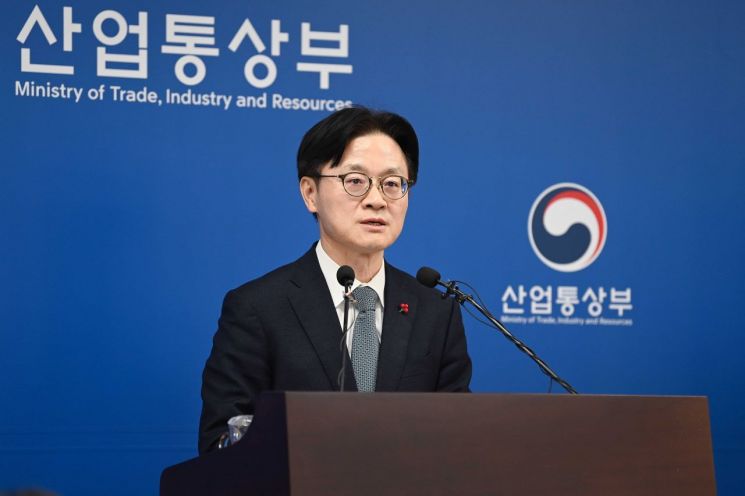
Minister of Trade, Industry and Energy Kim Jungkwan stated that the postponement of the Korea-US Free Trade Agreement (FTA) Joint Committee, which was expected to be held this month, was not a cancellation but rather a schedule adjustment due to the need for further discussion during the working-level coordination process.
On December 17, during a Q&A session with reporters following a presidential work briefing, Minister Kim explained, "Both sides determined that a bit more time was needed on detailed issues related to non-tariff barriers. We are constructively consulting with the United States Trade Representative (USTR) and are discussing the schedule with the aim of holding the meeting early next year."
Regarding the US-led key mineral cooperation initiative, known as 'Pax Silica,' he drew a line against interpreting it as a bloc aimed at excluding China.
Minister Kim stated, "While the media sometimes view this as a sanction against China, in sectors like key minerals where there is heavy dependence on a particular country, there is a policy need for every nation to diversify both usage and supply sources. Korea also needs to diversify its supply chain for key minerals such as rare earth elements, which is why we are participating in such cooperation."
He assessed Korea Zinc's investment in a US smelter somewhat positively. Minister Kim said, "Consensus on this investment plan was partially formed through an MOU signed in August last year. This will not only benefit Korea Zinc but also help enhance the stability of the key mineral supply chain at the national level." However, he added, "It is not at the stage where the government is directly supporting this as part of its US investment projects. We will continue to consult with the US side, taking into account necessity and circumstances."
Minister Kim also announced that the government has begun reviewing membership in the Comprehensive and Progressive Agreement for Trans-Pacific Partnership (CPTPP). He said, "We have started reviewing whether to join and developing a strategy, with the aim of making a decision next year. However, there are many factors to consider regarding the timing, scope, and method of accession." Regarding relations with Japan and the issue of importing seafood from Fukushima, he stated, "We are fully aware of the sensitive issues and will work wisely in consultation with relevant ministries."
On differences with the Ministry of Economy and Finance over the introduction of production tax credits and subsidies, he emphasized the needs on the ground. Minister Kim said, "As the ministry closest to the field, we strongly feel the need for production tax credits. While we will consider the potential for trade friction, since more countries are adopting similar systems, we will have serious discussions with the Ministry of Economy and Finance."
Regarding calls for differentiated corporate tax rates to incentivize regional investment, he said, "If companies cite tax policy as a key factor for relocating to regional areas, we will not rule out discussions with the tax authorities. Since key factors differ for each company-such as regulations, funding, and tax policy-we will take a tailored approach." However, he also stressed the need to improve residential conditions, including education, healthcare, and culture.
On the issue of nuclear power plant export governance, which is adrift due to conflicts between Korea Electric Power Corporation and Korea Hydro & Nuclear Power, he said, "This is not a simple matter. A study is currently underway to review a new structure that includes a third-party institution. Based on the results, we expect to announce the direction for reforming nuclear power plant export governance early next year."
Regarding organizational culture innovation, he identified reducing 'fake work' as a core task. Minister Kim said, "We will boldly cut down on work that does not provide real benefits to the public and industry, such as excessive report writing and formal events. We will streamline unnecessary work through anonymous feedback, and if necessary, consider penalties."
© The Asia Business Daily(www.asiae.co.kr). All rights reserved.
![Clutching a Stolen Dior Bag, Saying "I Hate Being Poor but Real"... The Grotesque Con of a "Human Knockoff" [Slate]](https://cwcontent.asiae.co.kr/asiaresize/183/2026021902243444107_1771435474.jpg)















